Provider Manual 2026

Provider support

CapitalBlueCross.com | 866.688.2242


This Provider Manual does not include treatment protocols or required practice guidelines. Diagnosis, treatment, recommendations, and the provision of medical care services for Capital Blue Cross members are the responsibility of providers and practitioners. When we use the term 'patient' within Provider Manuals, we mean those of our patients who are also one of our members. Please encourage the patient to review their Evidence of Coverage and Summary of Benefits for details concerning benefits, procedures, and exclusions prior to receiving treatment, as this manual does not supersede the Evidence of Coverage and Summary of Benefits.

This manual is intended as a companion to other Capital Blue Cross provider requirements, publications, and communications. It is binding upon providers only to the requirement or guidelines included in part or in full by other Capital Blue Cross guidance and/or requirements furnished or otherwise made available to providers.

Healthcare benefit programs issued or administered by Capital Blue Cross and its subsidiaries: Capital Advantage Insurance Company®, Capital Advantage Assurance Company®; and Keystone Health Plan®; Central. Independent licensees of the Blue Cross Blue Shield Association. Communications issued by Capital Blue Cross in its capacity as administrator of programs and provider relations for all companies.

Chapter 1: General information

Capital Blue Cross protocols

Provider is bound by and must comply with Our criteria for Provider participation and Our other policies and procedures, including without limitation, Our credentialing criteria, accreditation criteria, verification of eligibility, determination of coverage, quality of care standards, quality improvement, utilization management, case management, disease management, clinical management, referral requirements (including notice to Us), prescription benefit program and its requirements, peer review process, payment criteria, Provider and Member complaint and grievance programs and procedures, claims processing, administrative requirements, and other similar policies that We establish and update from time to time, as provided for in the Provider Manual or otherwise (collectively, “Protocols”).

Important notices and disclaimers

Requirements and procedures set forth in this Provider Manual (the “Manual,” the “Provider Manual,” or “Capital Blue Cross Provider Manual”) are binding upon Participating Providers and, pursuant to the agreements between Providers and Capital Blue Cross, are incorporated into those agreements.

Provider must meet and maintain compliance with all Our Protocols, including but not limited to, credentialing requirements, policies and procedures, and other standards.

The Provider Manual is the property of Capital Blue Cross, its affiliates, and subsidiaries. The terms “We,” “Us,” and “Our,” as used in this Provider Manual, refer to Capital Blue Cross, regardless of capitalization. Any capitalized term used in this Manual but not defined has the respective meanings given to it in the Provider Agreement or the Member booklet or Evidence of Coverage, as applicable. If there is a conflict in the way a term is defined, the Member document shall control over the Provider Agreement.

Providers agree that all written materials, including but not limited to, the Provider Manual, administrative manuals, administrative bulletins, peer review program, financial reports, the Provider Agreement, and other policies and procedures, must be kept confidential and are considered proprietary to us. “Written materials” include information that is electronically available to the Provider. No provision of this Provider Manual shall be interpreted as directly or indirectly restricting disclosure of information or data in accordance with applicable law, including not limited to I.R.C. section 9824(a)(1), ERISA section 724(a)(1), and PHSA section 2799A-9(a)(1), as applicable.

We encourage Providers to discuss all pertinent details regarding a Member’s condition and care alternatives with the Member, including potential risks and benefits, even if a care option is not a Covered Service. We cannot penalize or restrict a Provider from discussing any of the information health care providers are permitted to discuss under 40 P.S. § 991.2113 or other information a Provider reasonably believes is necessary to provide a Member full information concerning the health of the Member. We will not sanction Providers, terminate their Provider Agreement, or fail to renew their Provider Agreement for any of the following reasons: (a) discussing the process that Capital or any entity contracting with Capital uses or proposes to use to deny payment for a health care service; (b) advocating for Medically Necessary and Appropriate care with or on behalf of a Member, including information regarding the nature of treatment, risk of treatment, alternative treatments, or the availability of alternative therapies, consultations, or tests; (c) discussing Capital’s decision to deny payment for a health care service; (d) filing a grievance on behalf of and with the written consent of a Member, or helping a Member file a grievance; or (e) taking another action specifically permitted by 40 P.S. §§ 991.2113, 2121, or 2171.

Links to external websites referenced in this Manual are for the convenience of the user. Such links do not constitute an endorsement or approval of the content of such external websites by Capital Blue Cross or any of its subsidiaries or affiliates.

Capital Blue Cross complies with all state and federal laws, including laws related to Medicare and Our Medicare Advantage (MA) products. In cases where Capital Blue Cross’ Protocols conflict with federal or state laws or regulations, or directives of the Centers for Medicare and Medicaid Services (CMS) or other regulators, such laws, regulations, and/or directives must control. To the extent the Provider Manual directly conflicts with the terms of a contractual agreement between Capital Blue Cross and a Provider, the terms of the contractual agreement must control.

Information in this Provider Manual is subject to change as directed by Capital Blue Cross, is subject to regulatory review, and may also be changed at any time in accordance with regulatory requirements. All such changes may be published in special mailings and/or forms of online communications, such as the Provider Resource Center, and in the electronically updated Provider Manual.

In addition to this Provider Manual, please visit Our Provider Resource Center often for policy and procedure updates, via Our Provider Portal.

About our Provider manual

Excellent service to Our Members begins with excellent service to you, Our network of Participating Providers. Our Provider Manual is intended to provide clear and concise instructions for Our processes to save administrative time and reduce Member stress. You will find helpful information and resources to assist you in your daily interactions with Us and Our Members.

This Manual is an online resource that helps Us to provide you with the most up-to-date information. The chapters are organized by major topics, and each chapter contains additional subsections. The majority of information is applicable to all Provider types. Distinctions will be made whenever information applies to a particular Provider type. In addition to Our annually updated Provider Manual, We publish monthly Provider communications via Administrative Bulletins These are placed in the Resource Center via Our Provider Portal provided through our administrator Availity – “Availity Essentials,” part of your responsibility is to stay up to date with these important communications. Once published, they become a part of this Manual.

Look for Our monthly “Capital Blue Cross Provider update,” which contains a synopsis of each month’s Bulletins It’s a great way to get important information quickly. We deliver our Capital Blue Cross Provider update via email Providers should subscribe to electronic Provider communications and receive notifications of bulletin availability as well as other important information. To subscribe, please complete the contact information form.

Although We have tried to make this Provider Manual complete, it may not include every administrative policy or procedure, nor does it replace the Member’s benefit documents.

We do our best to ensure all Our links remain active. However, should you find one that is unable to be accessed, please contact the Provider Manual Editor at CBCPEC@capbluecross.com.

Provider Manual update history

The following table identifies the quarterly Provider Manual updates.

Revision

Date

Updated section

Q1 2026

April 2026

Chapter 1: General Information, Unit 4 Capital Blue Cross Member Information. In the Appointment Availability section, the Access guidelines for “After hours” were updated.

Chapter 2: Product information, Unit 5 Prescription Drug Programs. In the Preauthorization section, updated information regarding Provider Dispute Forms.

Chapter 5: Clinical, Care, and Quality Management, Unit 3 Denials, Grievances, and Appeals. In the Blue Cross and Blue Shield Federal Employee Program® Provider Appeals section, updated information regarding Provider Dispute Forms.

Chapter 5: Clinical, Care, and Quality Management, Unit 5 Value-Based Programs. In the Commonly Used Value-Based Program Acronyms & Definitions section, updated definition for NDC – National Drug Code.

Chapter 5: Clinical, Care, and Quality Management, Unit 5 Value-Based Programs. Updated Quality Measures table under Program Evaluation Criteria.

Chapter 6: Billing and Payment, Unit 4 Payment Review. In the Payment Integrity Programs section, updated the timeframe for recent claim submission reviews.

Contact information

Accredo 1.833.721.1626 (Commercial and CHIP) 1.833.721.1623 (Medicare) Assists in dispensing specialty medications

Availity® Essentials 1.800.AVAILITY (282.4548) Our Provider Portal tool, provided by Availity https://www.availity.com/essentials

Avalon Healthcare Solutions Laboratory Benefits Manager 1.813.751.3800, Option #2 Avalon-Providers@Avalonhcs.com

BlueCard® Inquiries 1.800.676.2583 (Eligibility) 1.877.892.6298 (Claims)

Capital Blue Cross Care Management Programs 1.888.545.4512 1.866.322.1657 (Behavioral health management) Our Care Management team of social workers, nurses, and health navigators are specially trained and certified to help our Member navigate the healthcare system and enhance health outcomes.

Clinical Management 1.800.471.2242 (option 2) PreauthorizationPeer-to-Peer Medical Director Reviews

Express Scripts Pharmacy 1.833.715.0946 Assists in dispensing mail order prescriptions

Blue Cross and Blue Shield Federal Employee Program® For Facility Provider Only Federal Employees Health Benefits Program (FEHBP) 1.800.344.5446 Postal Service Health Benefits Program (PSHBP) 1.855.395.2583 Behavioral Health Preauthorization (FEHBP) and (PSHBP) 1.800.356.7986

Keystone Health Plan Central Guest Membership Capital Blue Cross PO Box 211457 Eagan, MN 55121 Guest Membership (also known as Away From Home Care) allows a Member to be a “guest” of a Blue Cross and Blue Shield-affiliated HMO while out of the home Blue Plan’s service area for 90 consecutive days or more. This address is for paper claim submission.

Capital Blue Cross Medicare Advantage (HMO and PPO) HMO: 1.800.779.6962 PPO: 1.866.987.4213

Capital Blue Cross Medicare Advantage Prescription Drug Plans Prime Therapeutics – Preauthorization https://www.covermymeds.com Fax: 1.800.693.6703 866.452.5017 (support)

EviCore Phone: 877.282.2510 Fax: 866.699.8128 PO Box 5620, Hartford, CT 06102 Assists in the administration of molecular laboratory management services; performs utilization reviews, and first-level pre-service medical necessity appeals for molecular lab testing. EviCore.com

Evolent Specialty Services, Inc. 1.888.203.1423 Assists in the administration of high-tech radiology and radiation oncology benefits https://www.RadMD.com

Medical Necessity Appeals and Administrative Claim Reviews AGR Dept – Provider Unit Capital Blue Cross PO Box 779518 Harrisburg, PA 17177-9518 Fax: 717.541.6915 Use this address and fax for submitting administrative claim review requests, Medical Necessity appeals, and Provider dispute forms.

Member Appeals – Commercial AGR – Member Unit Capital Blue Cross PO Box 779518 Harrisburg, PA 17177-9518 Fax: 717.541.6915 Under certain circumstances outlined in Our Provider Dispute Resolution section, Providers can appeal on behalf of Members.

Member Appeals – Capital Blue Cross Medicare Advantage AGR Dept.—Member Medicare Appeals Capital Blue Cross PO Box 779970 Harrisburg, PA 17177-9519 Fax: 717.541.6915 Under certain circumstances outlined in Our Provider Dispute Resolution section, Providers can appeal on behalf of Members.

Other Party Liability Capital Blue Cross PO Box 775523 Harrisburg, PA 17177-5523 Fax: 1.800.929.0557

Pharmacy Benefits/Formulary Prime Therapeutics Fax: 1.855.212.8110 Online: CoverMyMeds

Preauthorization You can verify preauthorization requirements:

  • Online via Our preauthorization single source code list available via Our Provider Portal.
  • By calling Provider Preauthorization Services: 1.800.471.2242.

Provider Telephone Line For Eligibility and Benefits and Non-BlueCard Claims Professional and Facility: 1.866.688.2242

TruHearing (TH) Medicare Advantage Supplemental Hearing Benefit Provider Contracting Team, 1.801.938.1294 or ProviderContracting@TruHearing.com

TurningPoint Healthcare Solutions, LLC 744 Primera Boulevard, Suite 2100 Lake Mary, Florida 32746 Phone: 1.844.540.3705 Fax: 717.412.1001 Assists in the administration of a limited scope of cardiac procedures and musculoskeletal surgical procedures. Performs utilization reviews and first-level pre-service medical necessity appeals for limited scope cardiac procedures and musculoskeletal surgical procedures. Turningpoint-healthcare.com

CapitalBlueCross.com

From the top left-hand corner of the CapitalBlueCross.com webpage, choose Providers. From here, you can:

  • Subscribe to Our electronic provider communications.
  • Join Our Provider network.
  • Access the single source preauthorization list.
  • Access Our Provider Toolkit.
    • First Tier, Downstream, and Related Entity Annual Attestation Form.
    • Update your information.
    • Provider organizational (acquisitions, mergers, etc.) changes.
    • Provider Automation.
    • Electronic funds transfer.
    • Partners.
    • Provider services.
    • Condition management.
    • Utilization management.
  • Use Our Provider Lookup Tool.
  • Find out-of-area/network provider resources.
  • Log in to Availity Essentials, Our Provider Portal.

Provider communications

Administrative bulletins

Published monthly, Administrative Bulletins are issued to communicate such items as changes to Capital Blue Cross’ policies and procedures, new products, upcoming initiatives, updates to medical policies, formularies, and authorization requirements.

Providers must access the bulletins each month to stay apprised of the upcoming changes. To ensure important information is not missed, Providers should subscribe to electronic Provider communications and receive notifications of bulletin availability as well as other important information. To subscribe, please complete the contact information form.

Provider message board

Located on the Capital Blue Cross home page via Our Provider Portal, the Message Board is mainly used for sharing urgent information including:

  • Urgent Member safety concerns or issues.
  • Urgent clarifications or updates to previously published Provider-facing information.
  • Notification of information being delivered via Secure File Transfer (SFT).
  • Capital Blue Cross or contracted vendor’s system or process issues resulting in delays of electronic transactions such as remittance advices, temporary need for preauthorization workarounds, or upcoming system unavailability due to systems maintenance or upgrades.
  • Notification of monthly Administrative Bulletins availability in the Provider Library.
Mid-month provider email

We send Providers a mid-month email reminder of the availability of posted Administrative Bulletins. It provides a brief overview of each article published in the Administrative Bulletin for the month. Readers can easily access the full PDF version of the articles from this email.

Providers should subscribe to electronic Provider communications to receive important notifications from Capital Blue Cross. Please complete the contact information form.

Language services/resources

Language assistance resources for practitioners:

Downloadable multilingual signage, In-language patient education materials, and other language assistance resources are available at the following links:

Telephonic Interpretation Services for Practitioners:

Capital offers free telephonic interpretation services to its network practitioners. Click the link for Language information and resources.

Training on Provision of Language Services: The following links provide information on the development of a language access plan to mitigate barriers and promote meaningful language access to members with LEP (Limited English Proficiency), how to work effectively with an interpreter, using translation and interpretation services, equity-centered communication tools, and more.

CMS – The Centers for Medicare & Medicaid Services shares innovative approaches to provide language assistance services to individuals with limited English proficiency.

Providing Language Services to Diverse Populations: Lessons From the Field

AMA – ‘Advancing Health Equity: A Guide to Language, Narrative, and Concepts’ is a downloadable PDF guide that helps the reader recognize the limitations and harmful consequences of some commonly used words and phrases. In their place, they offer equity-centered alternatives.

AMA – Office Guide to communicating with limited English proficient patients.

Department of Health – Cultural Awareness Training

Note: Resources below require the user to create a Login.gov account.

https://thinkculturalhealth.hhs.gov/education/physicians

  • Course 1 covers the fundamentals of CLAS, including strategies for delivering patient-centered care.
  • Course 2 covers communication and language assistance, including how to work effectively with an interpreter.
  • Course 3 covers organizational CLAS-related activities, including strategic planning and community assessment.

Overview

In support of the Health Information Technology for Economic and Clinical Health (HITECH) Act of 2009, Capital Blue Cross has taken steps to eliminate paper transactions with Our contracted Providers. Electronic and online communications are integral to the successful relationship with Our Providers. Please review the following for the mandated electronic functionality that is required of Our Participating Providers.

Provider portal, Availity essentials

To maximize efficiencies, reduce paper transactions, and communicate effectively with Our network of Providers, Capital Blue Cross requires use of Our various electronic capabilities. Effective 1/1/20, all Capital Blue Cross Participating Providers are required to register for and utilize Our Provider Portal, Availity Essentials.

To register for the Provider Portal, visit Availity’s online secure, guided registration application: Availity.com/Essentials.

This application allows you to:

  • Complete your online registration.
  • Assign an administrator who will receive an email from Availity Essentials with a temporary password and instructions on important next steps.
Availity essentials information and training

Availity Essentials offers information and training via the Availity Learning Center (ALC).

To access recorded webinars specific to Capital Blue Cross functionalities, please use the following steps:

  • Log in to the Availity Essentials Portal.
  • Click Help and Training | Get Trained.
  • In the Search catalog field at the top of the page, type Capital Blue Cross.
  • Click the on-demand recording title.
  • Click Enroll in the upper-right corner.
  • Click Yes to confirm registration.
  • Click Start to view the recording.
Additional Availity essentials assistance

If you experience problems during registration or with Our Provider Portal functionality, please contact Availity Essentials Client Services at 1.800.AVAILITY (282.4548). Assistance is available Monday through Friday from 8:00 a.m. to 7:30 p.m. Eastern Time (excluding holidays).

Provider portal security administrator

A security administrator must be appointed within your practice or facility who will be responsible for administering these functions. The security administrator will be responsible for setting up new users, maintaining user access, and, when necessary, resetting user passwords and/or removing user access within Our Provider Portal.

Available transactions

As a multi-payer platform, Our Provider Portal offers a broad range of transactions for Providers to assist in managing the care of your Capital Blue Cross Members. Once registered, Providers are able to access several self-service resources such as:

  • Eligibility and benefits inquiries.
  • Review claims status.
  • Submit claim investigations and eligibility and benefit investigations (message to payer).
  • Enter and view authorizations.
  • Submit UB-04, HCFA 1500 claims and claim attachments.
  • Complete referrals.
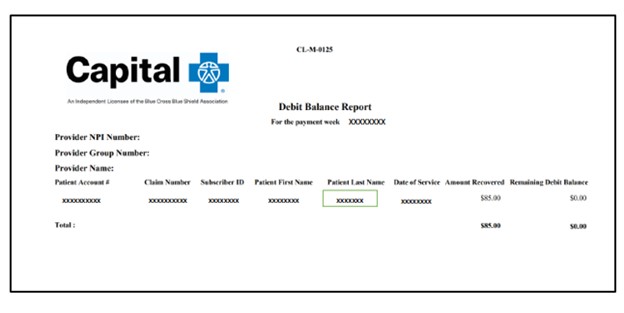
  • Download reports (Statement of Remittance [SOR], Debit Balance Reports [DBR],Gaps in Care Reports, and QualityFirst Primary Care Recognition Program scorecards, Preferred Language Letter).
  • Access valuable information via the Capital Blue Cross Provider Library.
  • View important news and announcements.

Applications and information specific to Capital Blue Cross is located on the Provider Portal Home Page under PAYER SPACES. Users receive access to these options from their Provider Portal Security Administrator.

The Applications Tab includes:

  • Accept/Reject reports
  • Claims Coding and Lookup
  • eClaims view and resubmission
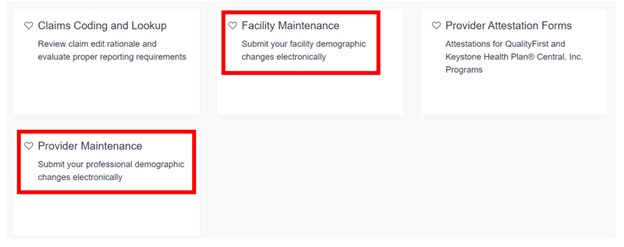
  • Facility Maintenance
  • Provider Attestation Forms
  • Provider Maintenance (professional Providers)
  • Secure File Transfer

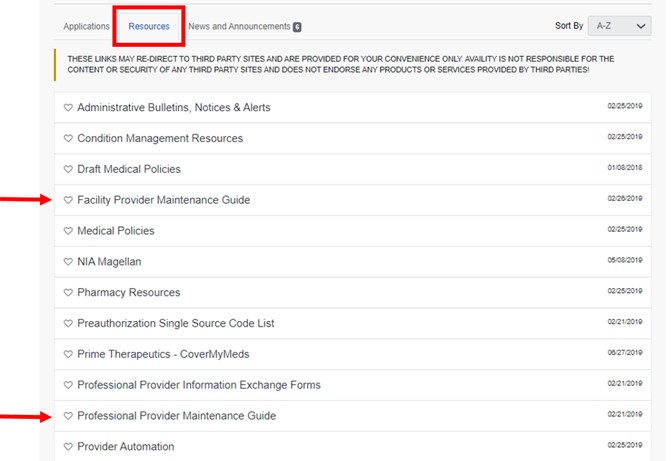
The Resources Tab includes Capital Blue Cross publications such as:

  • Medical Policies
  • Provider Library

The News and Announcement Tab is where special messages are posted. Highlights from these Tabs are listed, below:

Provider library
  • Preauthorization and Policies
    • The single source preauthorization code list
    • Medical Policies – Active, Retired, Out-of-area, Medical injectable, and Draft policies
    • Procedure Code Information
    • Reimbursement Policies
  • Education and materials
    • Provider Manual
    • BlueCard
    • Blue Distinction® Specialty Care Tip Sheet
    • FAQs
    • Medical Records Documentation
    • Prescription Drug Benefits
    • ProAuth Education Materials
    • Clinical Practice Guidelines
    • Comprehensive Performance Measure Guide
    • Administrative Bulletins
    • Preventive Services Health Coverage Guidelines
    • Quick Reference Guides – Quick tip sheets to help you navigate claims coding and lookup, CMS 1500 claims adjustments, Member cost share differentials, and more.
  • News and announcements
    • Administrative Bulletins: Issued to communicate such items as changes to Capital Blue Cross’ policies and procedures, new products, upcoming initiatives, updates to medical policies, formularies, and authorization requirements.
  • Provider training
  • Program information
  • Forms

Provider engagement lookup tool

If you have questions that cannot be answered via the Provider Portal, access the Provider Engagement Lookup Tool and enter your NPI or Tax ID number to identify your designated point of contact at Capital Blue Cross.

Provider/Facility maintenance

As a Participating Provider, you must review and update your practice or facility information using the Provider/Facility maintenance applications on Payer Spaces on Our Provider Portal. These applications allow users to update addresses, add or remove Practitioners, change bank account information, update Tax Identification Numbers, and more. This automated process offers expedited completion of directory updates. Capital Blue Cross does NOT receive updates from Availity’s Provider Data Management Tool. Note: No more than 5 locations will be printed in the directory.

Please note: Email requests are no longer accepted for any changes that can be made online and will be returned to the sender. All updates must be made through the Provider/Facility maintenance Tool on Payer Spaces. Whenever Providers experience a change, an online request should be submitted immediately.

If a confirmation email is not returned, do not resubmit the request. Please call Our Support Center at 717.541.7200 for issues with application functionality.

Training and customized automation support

Our Provider Automation staff is available by calling phone number 800.874.8433, option 4 to provide training and customized support. A listing of electronic services and resources are available in the Provider Toolkit section of Our website.

In support of the Health Information Technology for Economic and Clinical Health (HITECH) Act of 2009, Capital Blue Cross has taken steps to eliminate paper transactions. Electronic and online communications are integral to the successful relationship with Our Providers. Therefore, Capital Blue Cross requires all Participating Providers to enroll electronic programs sponsored and utilized by Capital Blue Cross now and in the future such as Our Provider Portal, Electronic Funds Transfer (EFT), and paperless Statement of Remittances (SORs).

Electronic Funds Transfer (EFT) and Electronic Statement of Remittances (SORs)

All Capital Blue Cross Participating Providers are required to set up EFT, and access SORs via the Provider Portal.

  • EFT – Providers must sign up and maintain any changes to their bank accounts, which provides a secure way to ensure your payments are directly deposited into appropriate accounts. Weekly deposits are typically completed on Wednesday of each week and eliminates the mail time and trips to the bank to deposit paper checks.
  • Online SORs – Paper SORs will not be mailed to Providers. By accessing your SOR via the Provider Portal, you have access as soon as they are available, eliminating delayed mail times.

How to set up Electronic Funds Transfer

After registering on Our Provider Portal, Providers should set up EFT. New requests, as well as changes to banking information, are to be submitted via the Facility/Provider Maintenance application on Capital Blue Cross’ Payer Spaces page on the Provider Portal.

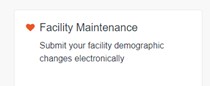
  • Choose Facility/Provider Maintenance from the Applications tab.
Provider maintenance, submit your professional demographic changes electronically
Faculty maintenance, submit your faculty demographic changes electronically
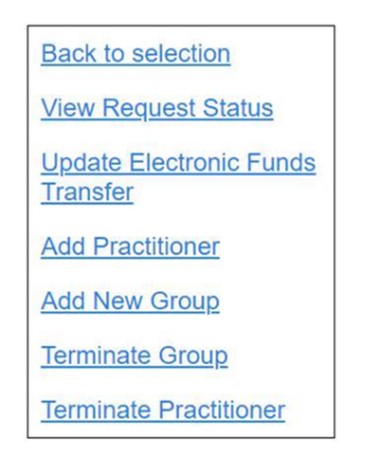
  • Select Update Electronic Funds Transfer from the menu on the left.

List of hyperlinks

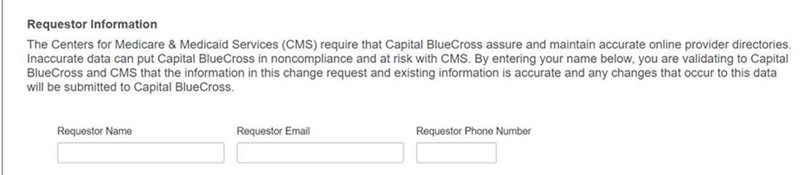
  • Enter the Requestor Information.

Form fields allowing to enter requester information

  • Update EFT information as necessary.
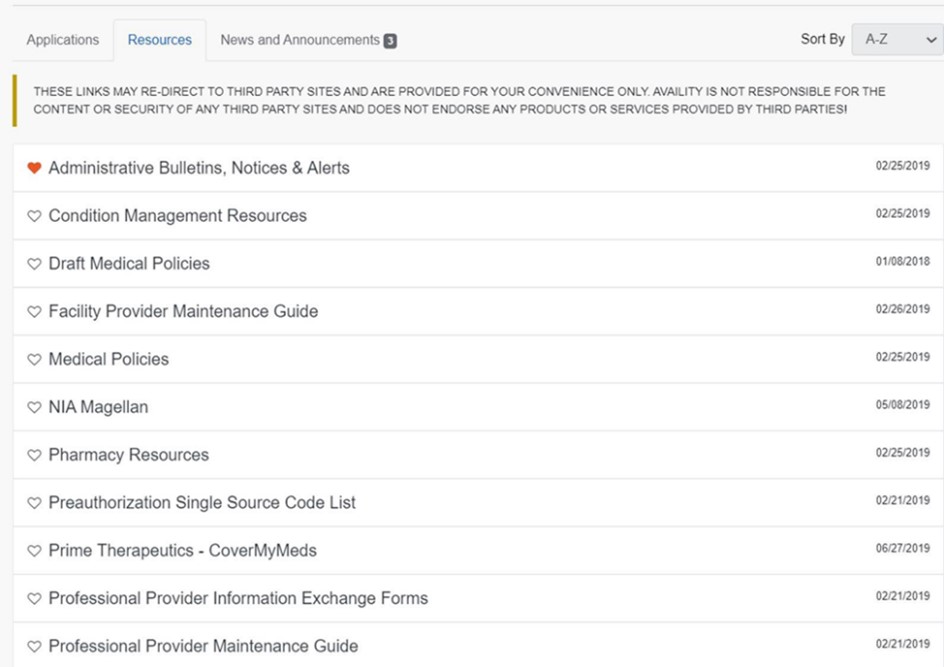
  • The Facility/Provider Maintenance User Guides are located under the Resources tab.

Tab showing resources, including the Faculty/Provider maintenance user guide

Please contact the Capital Blue Cross Support Center at 717.541.7200 if you need assistance.

Electronic Data Interchange (EDI) overview

Capital provides all Our Providers the opportunity to conduct business for Patient Account activities electronically. This process is more efficient, accurate, and cost-effective than paper submission, for not only Capital Blue Cross, but benefits health care facilities, professionals, and Members.

Capital has Trading Partner Agreements with more than four dozen clearinghouses and vendors. However, We are open to establishing new Trading Partner Agreements.

Providers may choose to submit Health Insurance Portability and Accountability Act (HIPAA) compliant files directly to Capital. Upon completing a Trading Partner Agreement, a testing process is conducted to assure files meet both HIPAA and Our requirements for successful transmission to Our adjudication system.

The following EDI transactions are available to Our Providers:

  • Claims (ANSI 837 Institutional and Professional)
  • Electronic Remittance Advice (ANSI 835)
  • Eligibility and Benefits (ANSI 270-271)
  • Claim Status (ANSI 276-277)
  • Referrals and Preauthorizations (ANSI 278)

Information regarding EDI transactions, enrollment, and electronic connections can be found on capitalbluecross.com, under Providers – Provider Toolkit – Provider automation.

Please use the following guidelines when you, as the Provider and/or your vendor or clearinghouse, are submitting Eligibility and Benefit or Claim Status Inquiry transactions directly to Capital Blue Cross.

Eligibility and Benefits Requests (ANSI 270/271)
  • Eligibility and benefit requests should only be submitted to Capital for Blue Plan members.
  • Eligibility and benefit requests should only contain Service Type Codes for the service being rendered.
  • Providers should wait a minimum of 20 seconds before resubmitting a request if a response has not been received.
  • If the response states “Member not found,” please follow up with the patient to verify their insurance.
  • When requesting eligibility and benefits for Capital members, please include the member’s ID number, prefix, and suffix to get the correct patient insurance information.
  • For members of other Blue Plans, include the member's first name, last name, date of birth, and ID number, including the prefix (and suffix if applicable).
Request for Claims Status (ANSI 276/277)
  • Providers should refer to their Acceptance/Rejection Report to confirm receipt and acceptance of the claim prior to submitting a claim status inquiry.
    • If the report shows a claim rejection, the claim should be corrected and resubmitted.
  • Providers should not submit a claim status inquiry for claims submitted fewer than 7 days ago.

Direct Data Entry (DDE)/(HCFA- 1500 and UB-04)

DDE enables users to submit claims directly via a secure internet connection. Please use Facility Claim or Professional Claim applications via Our Provider Portal.

Problem resolution contacts

The following table is designed to assist online users in resolving claims processing issues associated with electronic submission. Use this as a guide for determining the primary contact for each of the noted issues.

Problem resolution contacts

Claims processing technical, billing inquiry, and administrative issues

1 = Automation Consultant

2 = Provider Engagement Consultant

3 = Support Center (717.541.7200)

5 = Member Services (ID card)

6 = Provider Internal Support

7 = Provider Manual

8 = Provider/Facility Maintenance Application via Provider Web Portal

9 = Provider Telephone Line FEHB (1.800.344.5446)

10 = Provider Telephone Line PSHB (1.855.395.2583)

11 = Provider Telephone Line Professional/Facility (1.866.688.2242)

12 = Vendor/Clearinghouse

13 = Provider Web Portal Security Administrator

14 = Provider Web Portal Customer Service (Call 800.282.4548 for technical support or open a support ticket via your Provider Engagement Portal Account)

15 = Provider Web Portal – Claim Status Inquiry – Message the Payer (Investigation)

16 = Provider Web Portal = Pre-Authorization

17 = Provider Web Portal – Acceptance Rejection (A/R) Report application

Issue
Primary
Secondary
Tertiary
Communications Teleprocessing

Provider Web Portal is slow

6

14

3

Can’t connect to CapitalBlueCross.com?

6

3

Can’t connect to the Provider Web Portal?

6

14

3

Can’t find the Capital Blue Cross icon

14

3

Screen “froze up”

6

14

3

Administrative Issues

My Provider Portal user ID/password is not working

13

14

I don’t know who my Provider Web Portal Security Administrator is

14

I need Provider Portal security for a new employee

13

I have a question regarding Administrative Bulletin ____

9, 10,11

2

I need to have Provider demographic information changed

8

3

2

Questions During Billing

Online preauthorization system

16

3

3

Question regarding hard-copy claim

7

9, 10, 11

How do I obtain preauthorization?

16

9, 10, 11

3

What goes in Locator __?

6

7

9, 10, 11

I can’t get a valid HCPC code to accept

6

3

I need an explanation of a Capital Blue Cross Claim Adjudication code

15

9, 10, 11

I need an explanation of a vendor error code

12

6

I need an explanation of A/R rejection code ____

9, 10, 11

3

I didn’t receive my A/R report (direct transmittal to Capital Blue Cross)

17

3

I didn’t receive my A/R report (transmittal to Capital Blue Cross through vendor/clearinghouse)

17

12

3

Plan code or prefix not accepting after transmission

5

3

I can’t print

6

I need to know the status of a claim

15

9, 10, 11

Questions on Electronic Remittance Advice (ERA/eSOR) (direct transmittal from Capital Blue Cross)

3

1

Questions on ERA/eSOR (transmittal to Capital Blue Cross through vendor/clearinghouse)

15

12

3

The ERA is coming up in WordPad

6

12

3

I can’t find claims I sent (direct transmittal to Capital Blue Cross)

3

I can’t find claims I sent (transmittal to Capital Blue Cross through vendor/clearinghouse)

6

12

3

Questions about payment

15

9, 10, 11

I did not receive the Remittance in the mail

9, 10, 11

Software/Edit Changes

An issue regarding claims prior to being transmitted to Capital Blue Cross (direct transmittal to Capital Blue Cross)

6

An issue regarding claims prior to being transmitted to Capital Blue Cross (transmittal to Capital Blue Cross through vendor/clearinghouse)

6

12

An issue regarding claims after they are transmitted but rejected by Capital Blue Cross (direct transmittal to Capital Blue Cross)

17

3

An issue regarding claims after they are transmitted to Capital Blue Cross and accepted (transmittal to Capital Blue Cross through vendor/clearinghouse)

15

12

3, 9, 10, 11

Definitions

Member
  • An individual who meets the eligibility requirements and is then enrolled for coverage through a Group Contract.
Subscriber
  • A Member whose employment or other status, except for family dependency, is the basis for eligibility for enrollment through a Group Contract.
Dependent
  • A Member who, by being part of a Subscriber’s family, meets the applicable eligibility requirements and is enrolled through a Group Contract.
Group contract
  • As applicable, the group or individual policy, group or individual application, certificate of insurance, enrollment form, summary plan description, certificate of coverage or evidence of coverage or other agreement between Capital (or national or regional plan such as a Blue Cross or Blue Shield plan with whom Capital has a reciprocal arrangement) and a Contract Holder that expresses the agreed upon contractual rights and obligations of the Parties thereto, and that describes the costs, procedures, benefits, conditions, limitations, exclusions and other obligations to which Members are subject under each of the Programs, as applicable, which agreement is made before, on or after the Effective Date, as the same may be amended, modified or supplemented from time to time.
Contract holder
  • An individual, organization, firm or governmental entity, or Self-Funded Account that has executed a Group Contract with Capital for benefits or access to health care services for such person or its Members, employees, retirees, their spouses and Dependents, or others.

Identifying Capital Blue Cross members

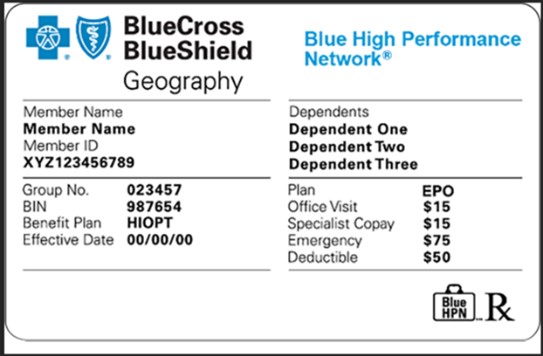
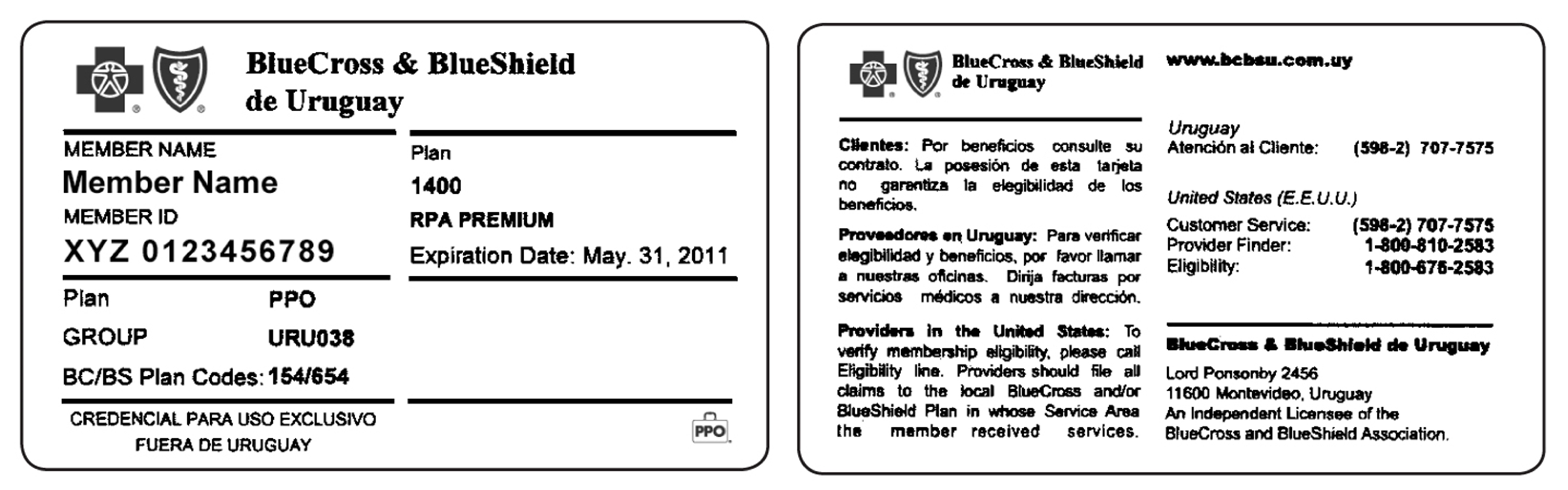
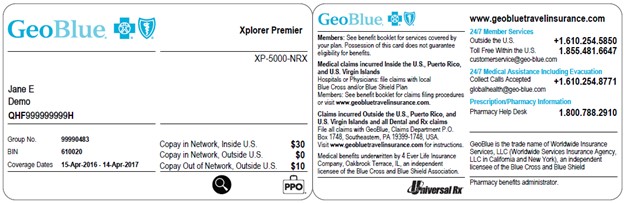
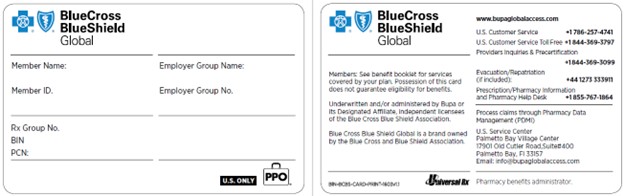
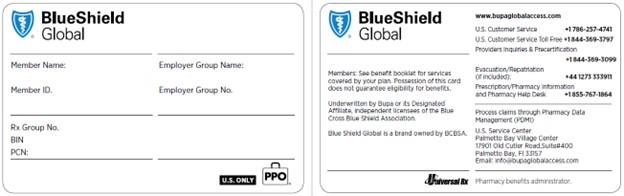
A Capital Blue Cross Member can be identified via their Capital Blue Cross ID card. For a patient’s first visit, ask to see a Member’s ID card before providing services. On subsequent visits, ask the patient if they have had a change in health insurance. A patient’s insurance information can change at any time and incorrect information can result in delayed claim payment.

Note: Beginning on January 1, 2026, as new Member ID cards are issued, Capital Blue Cross will remove the suitcase logo from the ID cards as per new BCBSA standards. This applies to all suitcase references and imagery in this Provider Mmanual. Please ignore all references in this Provider Manual to “suitcase logo”.

Although the ID card provides enrollment information for a Capital Blue Cross Member, you should always confirm eligibility for the date of service through Our Provider Portal or by performing an electronic HIPAA 270 Eligibility/Benefit Inquiry transaction.

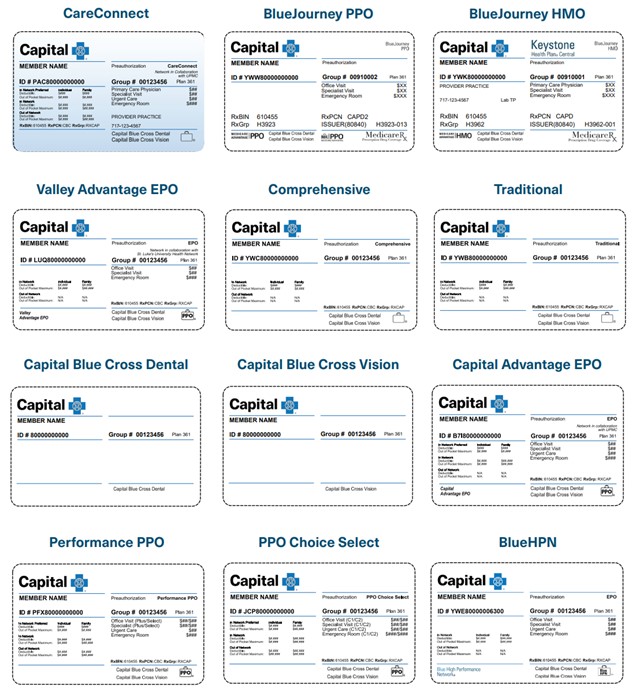
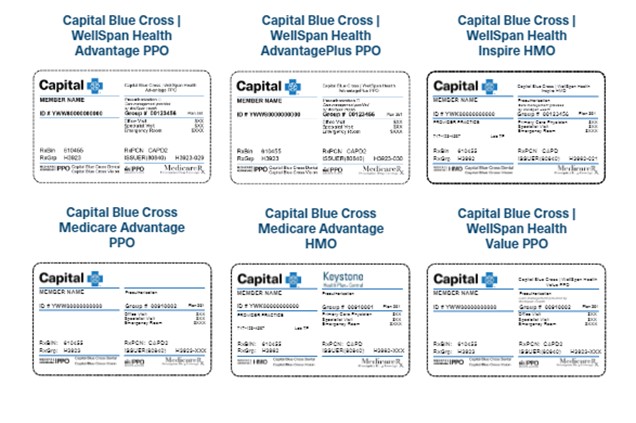
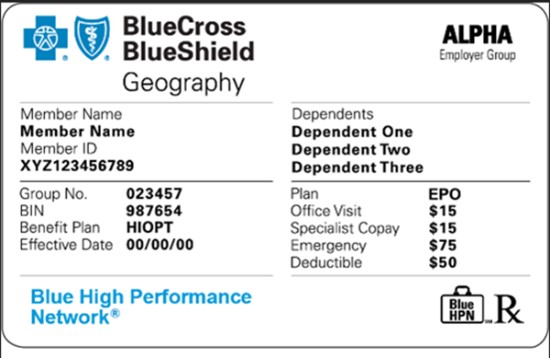
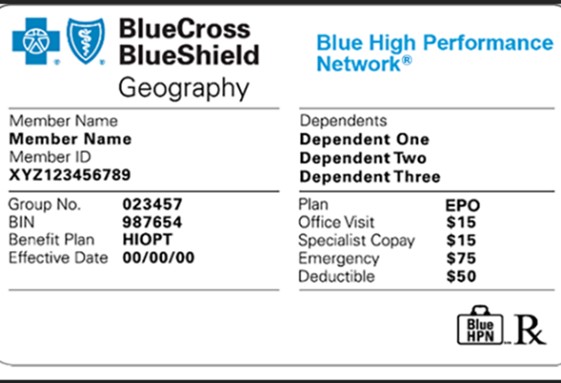
The ID cards may have slight variations depending upon the type of program and the location of the Blue Plan through which Members are enrolled. There may also be some small variances on cards of each employer group.

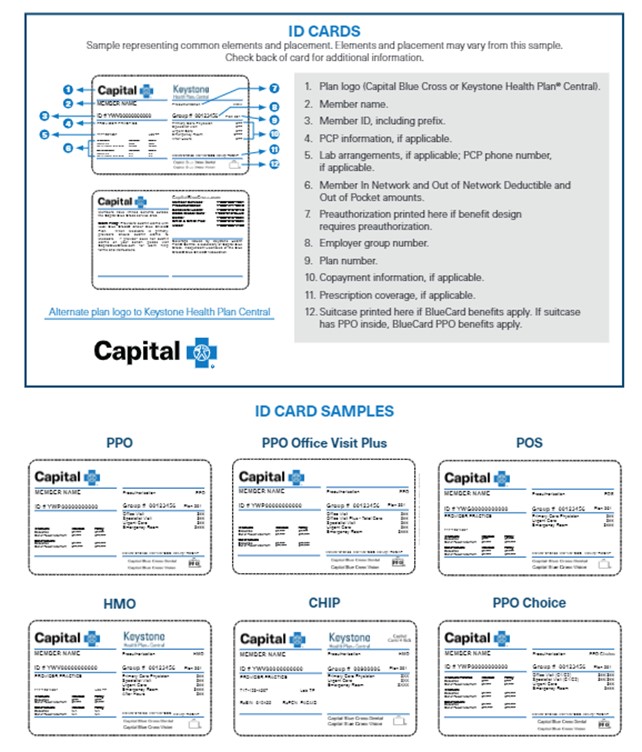
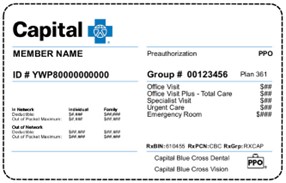
Generally, the identification card includes the following information:

  • Subscriber’s name.
  • Dependent’s name, if applicable.
  • Member’s Unique Member Identifier (UMI), or “Member ID,” which includes a 3 or 4-character prefix and an 11-digit identification number.
  • Group number – a series of alphabetical and numeric characters assigned to employment groups, professional associations, and direct payment programs.
  • Plan Code – three digits that identify the Blue Plan through which the Member is enrolled.
  • Type of agreement – a brief description of the type of agreements and coverage of the Member. Not all identification cards have this information.
  • BlueCard – all BlueCard Members can be identified by an alpha or alphanumeric -character prefix preceding the Member identification number on their identification card. Always report the prefix from any ID card.
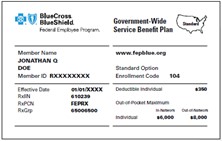
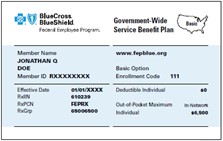
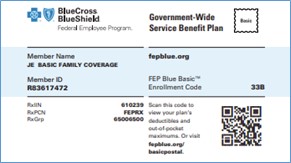
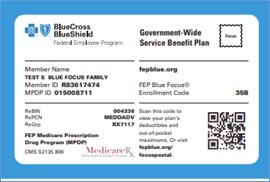
  • FEP ID cards include Member ID numbers that begin with the letter R followed by an eight-digit number.
  • Capital Blue Cross Dental and Capital Blue Cross Vision only ID cards will include a unique Member ID number with no alphanumeric prefix.
  • Additional information on the front of the Member’s ID card may include their PCP practice name, copayment amounts (including PCP, Specialist, and/or urgent care), the amount of in-network (INN) and out-of-network deductibles (OON), the INN and OON maximum out-of-pocket limits and pharmacy claims processing information.
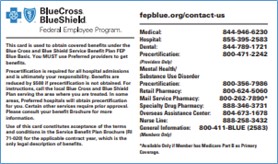
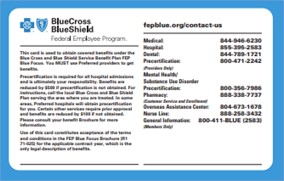
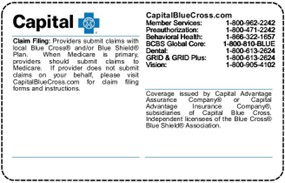
  • General information on the back of the Member’s ID card may include telephone numbers for preauthorization and Member services for medical, dental, and/or vision, as well as the website address for consumer assistance information.
Digital Identification (ID) Cards Student Health Plan

Effective June 2024, Capital Blue Cross issued digital identification cards (ID) for members enrolled in our student health plan coverage. These members will not have a physical ID card, and instead may present at the time of their visit the ID card image downloaded onto their smartphone or other mobile device.

How to access the digital ID card:

  • Member can display a digital copy.
  • Member can share the ID card as a PDF via email or text using secure messaging.*
  • Download an image of the ID card via Availity, using the Patient Registration tab on the home page and selecting the Eligibility and Benefits tile.*

*These options allow Providers to print and/or save a copy of the digital ID card image in the patient’s chart.

ID card sample representing common elements and placement

ID card sample array

ID card sample array

Capital Blue Cross App

This app is a way for Members to manage their health benefits on the go.

With the Capital Blue Cross app, Members can check their claims, benefits, and balances, view and share their ID cards with you, and much more.

The app is available to those with Capital Blue Cross medical, dental, and/or vision coverage. Members can download the app by searching for Capital Blue Cross in their app store. If they already have a secure account at CapitalBlueCross.com, they can log in to the app with the same username and password. If they do not have a secure account, they can register for one from the app or from CapitalBlueCross.com.

Verifying Eligibility and Benefits

It is important to confirm eligibility and benefits prior to rendering services to one of Our Members. You can do this online via Our Provider Portal via HIPAA 270/271 transaction, or by calling Provider Services*. Availability of benefits is always subject to other requirements of the Plan, such as limitations and exclusions, payment of premium, and eligibility at the time services are provided. The applicable terms of a Member’s plan control the benefits that are available. At the time the claims are submitted, they will be reviewed in accordance with the terms of the Group Contract.

For verifying eligibility and benefits for BlueCard Members, refer to Chapter 2, Unit 6 “The BlueCard Program”.

Please Note: Determination of a Member’s eligibility on the date of service is established using the date the claim is processed. If We determine a Member was not eligible for a service and the service has been provided, the Provider may bill the Member directly for the services provided.

Tips: The Eligibility and Benefits function available via Our Provider Portal is a great resource. Providers access Member eligibility utilizing their Member identification number, including prefix OR by using the Member’s name and date of birth. As a reminder, the Availity Essentials Learning Center (ALC) offers on demand training and education opportunities on all aspects of portal functionality. Please access the ALC for more in-depth education.

To verify Eligibility and Benefits via the portal, use the Patient Registration tab on the home page to toggle down to the Eligibility and Benefits option. Complete the Eligibility and Benefits prompts by choosing the appropriate selections for:

  • The Organization and Payer selections.
  • Provider Information (to ensure accurate results, use the Group NPI number, Practitioner level NPI information will not return results).
  • Patient Information
  • Service Information (to narrow the benefits, use the Benefit/Service Type field, this field allows you to view all Health Benefit Plan Coverage or a specific benefit).

Please note: If the Member has recently changed their PCP assignment, use of Our Provider Portal will be the most reliable method for verifying PCP assignment. Although the Member will have been issued a new ID card, the Member may bring the old ID card with them when they visit your office.

Confidentiality of Member Information

Providers must maintain the confidentiality of information contained in the medical records of Members, as well as other Member information, per standards set forth by state or federal law, accreditation entities, Our policies, and other pertinent requirements standard in the industry. Providers must also maintain the confidentiality of all information related to Members’ fees, charges, expenses, and utilization, except as specifically allowed by federal or state law.

Member Access to Physicians and Facilities

Accessibility expectations for providers

Participating Providers are required to arrange for appropriate coverage (24 hours a day, seven days a week) to provide for Member access to health care services during periods when the Participating Provider is unavailable. Routine referral to the emergency department is not an acceptable coverage arrangement.

  • Offer after-hours messaging information, including providing the covering Provider’s telephone number and instructing Our Member to call 911 or go to the emergency department, if a true emergency.
  • Coverage arrangements should be with another Participating Provider or a Provider who has otherwise been approved during Our credentialing process and is a Participating Provider of the same or similar specialty unless prior approval for other coverage arrangements has been secured.
  • Assure the covering Provider will not, under any circumstances, bill a Member for Covered Services, except for applicable copayments or other applicable cost-sharing provisions.
  • Inform covering Providers of the procedures to follow, including special arrangements regarding behavioral health vendor, durable medical equipment (DME), laboratory, etc.
  • Make suitable arrangements with the covering Provider regarding the manner in which they will be paid or otherwise compensated. Members cannot be charged for Covered Services, except for applicable copayments or other applicable cost-sharing provisions.

A covering Provider’s responsibilities are the same as those of a Participating Provider, including without limitation:

  • Provide access and availability, as appropriate, for the covering Provider’s specialty.
  • Verify Member eligibility at the time service is rendered.
  • Refer Members to Participating Providers and to participating facilities.
  • Secure preauthorization prior to delivering services in accordance with the Member’s preauthorization program requirements.
  • Provide notification of emergency services that require authorization within two business days.
  • Collect copayments or bill Members for Coinsurance and/or Deductibles only for Covered Services.
  • Comply with all administrative and clinical management programs, policies, and procedures.
  • Assure that services are available 24 hours a day, seven days a week during the periods of coverage.
Appointment availability

Appointments must be available to Members from the Provider or the covering practice within the recommended guidelines listed below.

Primary care services

Level of care

Access guidelines

Emergency

Immediate

Non-life threatening emergency

Within 6 hours
Immediate (Medicare Only)

Urgent

Within 24 hours
Immediate (Medicare Only)

Acute

Within 72 hours

Initial visit for routine care

Within 30 business days
Within 15 business days (CHIP Only)

Routine/follow-up

Within 30 business days
Within 10 business days (CHIP Only)

Preventive

Within 30 business days
Within 15 business days (CHIP Only)

After hours

When a patient calls after hours, a live person directs them to the practitioner or the on‑call practitioner, or a recording or live person directs the patient to an appropriate level of care

Specialty care services

Level of care

Access guidelines

Emergency

Immediate

Non-life threatening emergency

Within 6 hours
Immediate (Medicare Only)

Acute

Within 72 hours

Regular and routine care

Within 30 business days
Within 15 business days (CHIP Only for listed specialties*)
Within 10 business days (CHIP only all other specialties)

After hours

When a patient calls after hours, a live person directs them to the practitioner or the on‑call practitioner, or a recording or live person directs the patient to an appropriate level of care

Behavioral health care services

Level of care

Access guidelines

Emergency

Immediate

Non-life threatening emergency

Within 6 hours
Immediate (Medicare Only)

Urgent

Within 48 hours
Within 24 hours (CHIP Only)
Immediate (Medicare Only)

Initial visit for routine care

Within 10 business days
Within 7 business days (Medicare Only)

Routine/follow-up

Within 30 business days
Within 10 business days (CHIP Only)
Within 7 business days (Medicare Only)

After hours

When a patient calls after hours, a live person directs them to the practitioner or the on‑call practitioner, or a recording or live person directs the patient to an appropriate level of care

*Specialists List for CHIP:

  • Otolaryngology
  • Orthopedic surgery
  • Dermatology
  • Pediatric dentist
  • Allergy and immunology
  • Pediatric endocrinology
  • Pediatric gastroenterology
  • Pediatric general Surgery
  • Pediatric hematology
  • Pediatric infectious Disease
  • Pediatric nephrology
  • Pediatric neurology
  • Pediatric oncology
  • Pediatric pulmonology
  • Pediatric rehab Medicine
  • Pediatric rheumatology
  • Pediatric rrology

Waiting time

Participating Providers and/or covering Providers agree to follow recommended waiting room guidelines for scheduled appointments. The maximum waiting room time should not exceed 30 minutes. If the Participating Provider is detained with an emergency and is delayed or unable to keep the Member’s scheduled appointment, office staff should promptly inform the Member of the delay or cancellation and offer to reschedule the appointment within a reasonable period of time, if the Member so chooses.

Please note: The following is written for our Members, and is provided for your information.

CHIP members rights and responsibilities

Nondiscrimination policy

Keystone Health Plan® Central, and its network of doctors and other Providers of services, do not discriminate against Members based on race, sex, religion, national origin, disability, age, sexual orientation including LGBTQIA+, gender identity, or any other basis prohibited by law. As a Member, you have the following rights and responsibilities.

Member rights

As the parent or guardian of a CHIP Member, or as a CHIP Member, you have the right:

  • To receive information about your rights and responsibilities.
  • To be treated with respect, and recognition of your dignity and need for privacy.
  • To be provided with information about Keystone Health Plan Central, its services, the practitioners providing care, and Members’ rights and responsibilities.
  • To know about policies that can affect your child’s enrollment.
  • To be able to choose Providers, within the limits of the Keystone Health Plan Central network, including the right to refuse treatment from specific practitioners.
  • To request a specialist to serve as your child’s primary care physician if your child has certain special medical needs or diagnoses.
  • To participate in decision making regarding your child’s health care, including the right to refuse treatment, and to express preferences about future treatment decisions.
  • To have a health care Provider, acting within the lawful scope of practice, discuss medically necessary care and advise or advocate appropriate care with you or on your behalf, including information regarding the nature of treatment options; risks of treatment; alternative therapies; and consultation or tests that may be self-administered; without any restriction or prohibition from Keystone Health Plan Central.
  • To be informed by a physician about what may happen if drugs, treatments, of procedures are refused.
  • To give informed consent before the start of any procedure or treatment.
  • To ensure your child receives timely care in the case of an emergency.
  • To refuse to participate in medical research projects.
  • To question decisions made by Keystone Health Plan Central or its network Providers, and to file a complaint or grievance regarding any medical or administrative decisions you disagree with.
  • To file a grievance about Keystone Health Plan Central or care provided and to file a CHIP review appeal with the Department.
  • To have access to your medical records in accordance with applicable federal and state laws and the right to request that they be amended or corrected.
  • To expect information that you provide to Keystone Health Plan Central and anything you or your child discuss with the health care Provider will be treated confidentially and will not be released to others without your permission.
  • To make recommendations regarding Keystone Health Plan Central’s Members’ “rights and responsibilities” policy.
  • To exercise your rights without adversely affecting the way Keystone Health Plan Central, its Providers, and state agencies may treat you.
  • To be free from any form of restraint or seclusion used as a means of coercion, discipline, convenience, or retaliation.
Member responsibilities

As the parent or guardian of a CHIP Member or as a CHIP Member, you have a duty to:

  • To understand how CHIP, brought to you by Keystone Health Plan Central, works by reading this handbook and other information made available to you.
  • To follow the guidelines set forth in this handbook and in other information made available to you and ask questions about how to access health care services appropriately.
  • To inform Keystone Health Plan Central and your child’s Providers about any information that may affect your child’s Membership or right to program benefits, including other health insurance policies your child/you becomes covered under.
  • To supply up-to-date medical information to Keystone Health Plan Central and its Providers so they can provide your child/you with appropriate care.
  • To be sure that your primary care Provider has all your child’s medical records, including those from other Providers.
  • To contact your child’s primary care Provider first for all medical care except in the case of a true emergency.
  • To consent to the proper use of your child’s health information.
  • To treat your child’s Providers with dignity and respect, which includes being on time for appointments and calling ahead if you need to cancel an appointment.
  • To provide a safe environment for services administered in your home.
  • To learn about your child’s health problems and work with Providers to develop a plan for your child’s care.
  • To follow the instructions or guidelines you receive from the Provider, such as taking prescriptions as directed and attending follow up appointments.
  • To take full responsibility for any consequences of your decision to refuse treatment on your child’s behalf.
  • To contact Keystone Health Plan Central if your child is admitted to the hospital or in an emergency room within 24 hours or as soon as possible.
  • To use your child’s ID card to access care.
  • To pay any applicable fees.

Commercial members rights and responsibilities

As a Member of the Capital Blue Cross family of companies, you have certain rights and responsibilities. The success of your treatment and your satisfaction depends, in part, on you taking responsibility as a patient. Acquainting yourself with your rights and responsibilities will help you take a more active role in your health care.

You have a right:
  • To be treated with respect and recognition of your dignity and right to privacy at all times, to receive considerate and respectful care regardless of religion, race, national origin, age, gender, or financial status.
  • To receive information about us, Our services, Our contracted Providers, and facilities (including information regarding a Provider’s qualifications, such as medical school attended, residency completed, or board certification status), and Member rights and responsibilities. Members can call Member Services to obtain this information.
  • To make recommendations to the list of Member rights and responsibilities.
  • To have Our Member literature and material for the Member’s use, written in a manner which truthfully and accurately provides relevant information that is easily understood.
  • To know the name, professional status, and function of those involved in your care.
  • To obtain from your Provider complete current information concerning your diagnosis, treatment, and prognosis in terms you can reasonably understand, unless it is not medically advisable to provide such information.
  • To candid discussion of appropriate or medically necessary treatment options for your condition, regardless of cost or benefit coverage.
  • To participate with Providers in decision making regarding your health care.
  • To know what procedure and treatment will be used so that when you give consent to treatment, it is truly informed consent. Members should be informed of any side effects or complications that may arise from proposed procedures and treatment in addition to possible alternative procedures. Your physician is responsible for providing you with information you can understand.
  • To be advised if any experimentation or research program is proposed in your case and of your right to refuse participation.
  • To refuse any drugs, treatment, or other procedure offered to you to the extent permitted by law and to be informed by your Provider of the medical consequences of such refusal.
  • To all information contained in your medical record unless access is specifically restricted by the attending Provider for medical reasons.
  • To expect that all records pertaining to your medical care are treated as confidential unless disclosure is necessary for treatment, payment, and operations.
  • To be afforded the opportunity to approve or refuse release of identifiable personal information except when such release is allowed or required by law.
  • To file complaints or grievances about us, services requested, or the care rendered by your Provider and to file an appeal from an adverse benefit determination or final internal adverse benefit determination.
You have a responsibility:
  • To follow the rules of Membership and to read all materials carefully.
  • To carry your Capital Blue Cross ID card with you and present it when seeking health care services.
  • To provide Us with relevant information concerning any additional health insurance coverage which you or any of your Dependents may have.
  • To timely notify Us and your employer of any changes in your Membership, such as change of address, marital status, etc.
  • To seek and obtain services from the Primary Care Physician (PCP) you have chosen, as well as direct access to obstetrical/ gynecological care and in emergencies or when your chosen physician has referred them to other Participating Providers and/or We have preauthorized you to do so.
  • To communicate openly with the Provider, you choose by developing a Provider-patient relationship based on trust and cooperation.
  • To follow the plans and instructions for care that you have agreed upon with your Provider.
  • To ask questions to make certain you understand the explanations and instructions you are given.
  • To understand your health problems and participate, to the degree possible, in developing mutually agreed upon treatment goals.
  • To understand the potential consequences if you refuse to comply with treatment plans or recommendations.
  • To keep scheduled appointments or give adequate notice of delay or cancellation.
  • To pay appropriate copayments and Coinsurance to Providers when services are received.
  • To keep Us informed of any concerns regarding the medical care you receive.
  • To provide, to the extent possible, information that We and Our Providers and facilities need in order to facilitate and provide care and administer your coverage.
  • To treat others with respect and recognition of dignity, and to provide considerate and respectful interaction with others regardless of their religion, race, national origin, age, or gender.

Capital Blue Cross Medicare Advantage mmbers rights and responsibilities

Blue Cross and Blue Shield Federal Employee Program® members rights and responsibilities

Blue Cross and Blue Shield Federal Employee Program® members rights and responsibilities are located here:

Member eligibility determination

Capital Blue Cross must provide access to Member information through Our Provider Portal to confirm Member Eligibility.

To verify Eligibility and Benefits via the portal, use the Patient Registration tab on the home page to toggle down to the Eligibility and Benefits option. Complete the Eligibility and Benefits prompts by choosing the appropriate selections for:

  • The Organization and Payer selections.
  • Provider Information (to ensure accurate results, use the Group NPI number, Practitioner level NPI information will not return results).
  • Patient Information.
  • Service Information (to narrow the benefits, use the Benefit/Service Type field, this field allows you to view all Health Benefit Plan Coverage or a specific benefit).

Capital programs

Provider agrees to participate in Capital Blue Cross programs as described in the Provider Agreement. If Capital adds a program, and Provider is eligible to participate in the new program, Capital will notify the Provider of the new program by providing at least sixty (60) days prior written notice to the effective date of the new program.

Provider list

Capital must provide a current listing of Practitioners and/or Associated Providers, available to Members both electronically and in paper.

Group contracts

Capital has the discretion to (i) enter into any Group Contract upon such terms, including but not limited to those terms relating to scope of Covered Services, Members, the amount and application of any Cost Sharing Provisions, or clinical management requirements, (ii) amend such Group Contract, all without prior consultation with or approval of Provider, and (iii) participate in national or regional networks such as Blue Cross or Blue Shield plans with which Capital have a reciprocal arrangement.

Coverage determinations

Capital and its designated representatives must have sole authority to determine: (i) what is a Covered Service; (ii) eligibility requirements; (iii) who is a Member; and (iv) the amount and application of Cost Sharing Provisions.

Clinical management programs

The obligation to pay Provider for the provision of Covered Services to a Member must be conditioned upon a good faith determination by Capital that Provider is in compliance with the clinical management programs.

Medical necessity

The obligation to pay Provider for the provision of Covered Services to a Member must be conditioned upon a determination by Capital that the provision of Covered Services was Medically Necessary and Appropriate. Provider must have the right to appeal determinations that health care services were or were not Medically Necessary and Appropriate.

Payment for covered services

Capital must pay Provider for Covered Services provided to Members, according to the terms and conditions of the Provider Agreement. The obligation to pay Provider is conditioned upon the determination that the person receiving services, supplies, products, or accommodations from Provider is a Member and that such services, supplies, products, or accommodations are Covered Services.

Anti gag clause

In accordance with the federal law under the Consolidated Appropriations Act of 2021 (“CAA”), all payers (including Capital Blue Cross) are prohibited from entering into contracts with Providers that would "directly or indirectly restrict" the payer from:

  1. Sharing Provider specific cost or quality of care information or data to referring Providers, the plan sponsor, participants, beneficiaries, or enrollees, or individuals eligible to become participants, beneficiaries, or enrollees of the plan or coverage.
  2. Electronically accessing certain de-identified claims and encounter information or data on a per claim basis, for each participant, beneficiary, or enrollee in the plan or coverage upon request and consistent with applicable privacy regulations, or.
  3. Sharing information or data described in (1) and (2), or directing such information be shared, with a business associate.

Additionally, Pennsylvania Act 146 of 2022 expanded applicability of the Medical Gag Clause prohibition, which prevents payers from penalizing health care Providers for discussing certain information with their patients. This provision is applicable to insurers, Medical Assistance program (MA), and Children’s Health Insurance Program (CHIP).

Capital Blue Cross has removed any prohibited language from our participating Provider Agreements in accordance with federal law and added language in accordance with Pennsylvania law.

Chapter 2: Product information

Introduction

We offer a family of products to groups and individuals. Each product has a specific set of requirements. These requirements include, but are not limited to, scope of services covered, payment, member cost-sharing, network restrictions, referral, or preauthorization requirements.

Product information is available at CapitalBlueCross.com.

As outlined in the Provider Agreement, the Provider agrees to provide Covered Services in the same manner, and with the same availability, as stated here in the Provider Manual.

Provider must be paid for providing Covered Services as detailed in the Schedules attached to the Provider Agreement, and in accordance with this Provider Manual.

Please verify eligibility and benefits prior to providing services to Our members as the scope of Covered Services can vary. Verification can be performed by checking Our Provider Portal or by contacting Provider Services at 1.866.688.2242.

**Please see Chapter 2, Unit.2: Capital Blue Cross Medicare Advantage Products and Programs for more information on Capital Blue Cross Medicare Advantage.

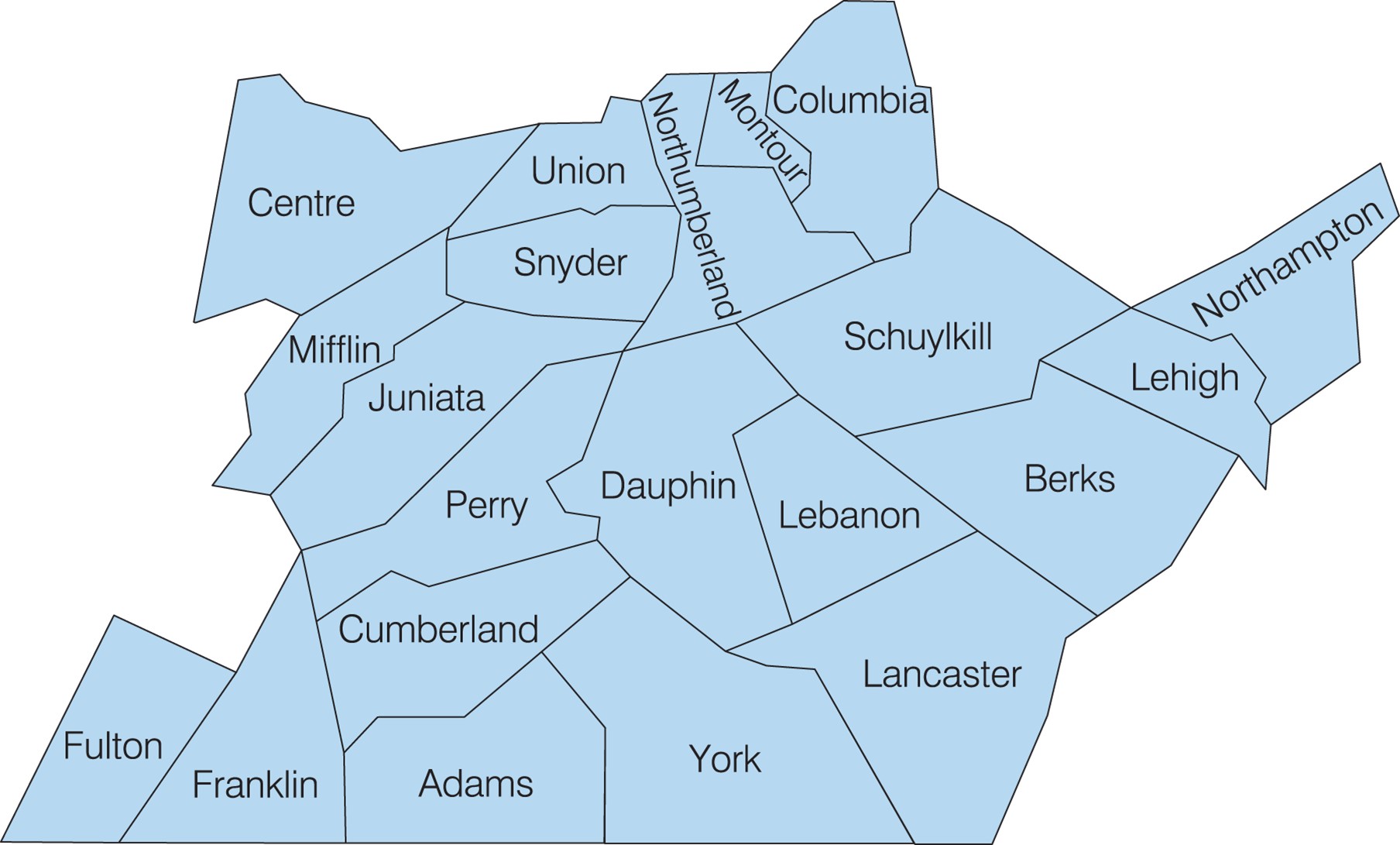
Capital Blue Cross Services Twenty-One Counties in Pennsylvania - Service Area Map

Capital Blue Cross service map

Essential Health Benefits

The Patient Protection and Affordable Care Act (PPACA) requires health insurers (such as Capital Blue Cross) to provide a core set of health care services to small group market and individuals on and off the Pennsylvania health insurance marketplace. Essential Health Benefits must include items and services within the following ten (10) benefit categories:

  1. Ambulatory patient services.
  2. Emergency services.
  3. Hospitalization.
  4. Maternity and newborn care.
  5. Mental health and substance use disorder services.
  6. Prescription drugs.
  7. Rehabilitative and Habilitative services and devices.
  8. Laboratory services.
  9. Preventive and wellness services and Chronic disease management.
  10. Pediatric services, including oral and vision care.

**Please see Chapter 1, Unit.4: Capital Blue Cross member Information; Identifying Capital Blue Cross members for examples of Capital Blue Cross ID cards.

Managed Care Overview

Managed care programs integrate the delivery and financing of medical care. The programs offer health care coverage through a network of contracted physicians who provide care to people who subscribe to the plan called members.

Managed care programs provide preventive coverage to members and use its network of physicians to assist in determining the appropriateness and the efficiency of the members’ care in order to promote and maintain good health while conserving resources.

All of Capital Blue Cross’s plans have some type of managed care programs. Most are managed by way of Our preauthorization processes, but some also require referrals from a Primary Care Provider.

Definitions

The following terms are commonly used in reference to managed care programs:

  • Covered Services: Those Medically Necessary and Appropriate services and supplies that are provided as part of a benefit plan.
  • Exclusions: Items or services that are not covered as part of a benefit plan.
  • Preauthorization: The process for evaluating requests or services prior to the delivery of care to ensure members’ care is Medically Necessary and Appropriate. All Capital Blue Cross medical plans have a preauthorization program whereby some services require preauthorization. Participating Providers can view Our preauthorization single source code list located in the Resources section via Our Provider Portal, Participating Providers are responsible for obtaining required preauthorizations.
  • Primary Care Physician (PCP): A Practitioner selected by a member in accordance with the member’s managed care program requirements. The Practitioner provides, coordinates, or authorizes the health care services covered by the managed care program. The PCP may be a general practitioner, family practitioner, internist, pediatrician, or certified registered nurse Practitioner (CRNP).

Traditional

  • Scope of services covered: Our Traditional products scope of services includes hospitalization, medical, surgical, preventive, and major medical benefits. The scope of Covered Services varies by employer group.
  • Payment Including Deductible, Coinsurance, and Copayment: After meeting an individual or family Deductible, Traditional benefits cover a percentage of the plan allowance based on health plan provisions. The remaining percentage, the Coinsurance, is determined according to the member’s plan. For some services, Participating Providers can collect a per-visit copayment from the member.
  • Network Restrictions: This product offers coverage without network restrictions. Members may choose any health care Provider. However, choosing a Participating Provider keeps member out-of-pocket costs lower. Benefits for services from non-Participating Providers are paid to the member.
  • Referral Requirements: None.
  • Preauthorization Requirements: Some services may require preauthorization in advance of treatment to determine whether certain proposed services are a Medical Necessity and Covered Service under a Group Contract. This may sometimes be referred to as “prior authorization.” Participating Providers can view Our preauthorization single source code list located in the Resources section via Our Provider Portal.

Comprehensive

  • Comprehensive Scope of services covered: Our Comprehensive products scope of services includes hospitalization, medical, surgical, preventive, and major medical benefits. The scope of Covered Services varies by employer group.
  • Payment Including Deductible, Coinsurance, and Copayment: After meeting an individual or family Deductible, Comprehensive benefits cover a percentage of the plan allowance based on health plan provisions. The remaining percentage, the Coinsurance, is determined according to the member’s plan. For some services, Participating Providers can collect a per-visit copayment from the member.
  • Network Restrictions: This product offers coverage without network restrictions. Members may select any health care Provider. However, selecting a Participating Provider keeps member out-of-pocket costs lower. Benefits for services from non-Participating Providers are paid to the member.
  • Referral Requirements: None.
  • Preauthorization Requirements: Some services may require preauthorization in advance of treatment to determine whether certain proposed services are a Medical Necessity and Covered Service under a Group Contract. This may sometimes be referred to as “prior authorization.” Participating Providers can view Our preauthorization single source code list located in the Resources section via Our Provider Portal.

Preferred Provider Organization (PPO)

  • Scope of Services Covered: Our PPO products scope of services includes hospitalization, medical, surgical, preventive, and major medical benefits. The scope of Covered Services varies by employer group.
  • Payment Including Deductible, Coinsurance, and Copayment: PPO benefits may include a Deductible and cover a percentage of the plan allowance based on health plan provisions. The remaining percentage, the Coinsurance, is determined according to the member’s plan. For some services, Participating Providers can collect a per-visit copayment from the member.
  • Network Restrictions: PPO products offer coverage without network restrictions; however, choosing a Participating Provider keeps member out-of-pocket costs lower. Benefits for services from non-Participating Providers are paid to the member.
  • Referral Requirements: None.
  • Preauthorization Requirements: Some services may require preauthorization in advance of treatment to determine whether certain proposed services are a Medical Necessity and Covered Service under a Group Contract. This may sometimes be referred to as “prior authorization.” Participating Providers can view Our preauthorization single source code list located in the Resources section via Our Provider Portal.

Health Maintenance Organization (HMO)

  • Scope of Services Covered: Our HMO products scope of services includes hospitalization, medical, surgical, preventive, and major medical benefits. The scope of Covered Services varies by employer group. Most services are provided by, or under the direction of, a participating PCP.
  • Payment Including Deductible, Coinsurance, and Copayment: The HMO benefits may include a Deductible and service, cover a percentage of the plan allowance based on health plan provisions. The remaining percentage, the Coinsurance, is determined according to the member’s plan. For some services, a per-visit copayment amount must be paid to the Provider.
  • Network Restrictions: Each HMO member must select his or her own PCP from Our network. The selection of a PCP is required when the member enrolls. The name of the PCP practice selected is displayed on the member’s identification card. PCPs provide general medical care and preventive services and, when necessary, refer members to other Participating Providers such as specialist physicians, other professional Providers, hospitals, and ancillary facilities. Members may seek emergency and urgent care regardless of the Provider’s network participation.
  • Referral Requirements: Some services require a referral. The PCP is responsible for providing the member with the referrals needed to obtain care from other Participating Providers and for notifying Us when issuing a referral. Women may self-refer to any Participating Provider for maternity, gynecological services, and mammograms and still receive benefits as if coordinated by their PCP. Behavioral health and substance use services are excluded from this referral requirement.
  • Preauthorization Requirements: Some services may require preauthorization in advance of treatment to determine whether certain proposed services are a Medical Necessity and Covered Service under a Group Contract. This may sometimes be referred to as “prior authorization.” Participating Providers can view Our preauthorization single source code list located in the Resources section via Our Provider Portal.

Qualified High Deductible Health Plan (QHDHP)

  • QHDHPs are PPO plans that meet criteria defined by the IRS, making them suitable for pairing with a Health Savings Account (HSA).
  • The scope of Covered Services and network restrictions are the same as any other PPO product.
  • Payment Including Deductible, Coinsurance, and Copayment: The IRS requires that a Deductible be met before any payment for non-preventive medical services or prescription drugs can be made. While many QHDHPs have copays noted on the member’s identification card, these copays will not be applied until after the Deductible has been met. After the Deductible, QHDHPs cover a percentage of the plan allowance based on health plan provisions. The remaining percentage, the Coinsurance, is determined according to the member’s plan. members who have opened HSAs may present debit cards to pay for any out-of-pocket costs, including amounts applied to Deductible, copayments, or Coinsurance.
  • Network Restrictions: PPO products offer coverage without network restrictions; however, choosing a Participating Provider keeps member out-of-pocket costs lower. Benefits for services from non-Participating Providers are paid to the member.
  • Referral Requirements: None.
  • Preauthorization Requirements: Some services may require preauthorization in advance of treatment to determine whether certain proposed services are a Medical Necessity and Covered Service under a Group Contract. This may sometimes be referred to as “prior authorization.” Participating Providers can view Our preauthorization single source code list located in the Resources section via Our Provider Portal.

Exclusive Provider Organization (EPO), Valley Advantage EPO, and Capital Advantage EPO

  • Scope of services covered: Our EPO products’ scope of services includes hospitalization, medical, surgical, preventive, and major medical benefits. The scope of Covered Services varies by employer group.
    • Valley Advantage EPO is offered in Lehigh and Northampton counties.
    • Capital Advantage EPO is offered in Cumberland, Dauphin and Perry counties.
  • Payment Including Deductible, Coinsurance, and Copayment: After meeting an individual or family Deductible, if applicable, EPO benefits cover a percentage of the plan allowance based on health plan provisions. The remaining percentage, the Coinsurance, is determined according to the member’s plan. For some services, Participating Providers can collect a per-visit copayment from the member.
  • Network restrictions: Each type of EPO utilizes a different clinically-integrated network tailored to a specific geographic area. With the exception of urgent care, emergent care, and wigs, there is no coverage outside of the designated EPO network. For emergent care and post stabilization services, members have in-network coverage with any PPO participating hospital and professional Provider. All other out-of-network services are excluded from EPO benefits. However, BlueCard Providers outside of Our 21-county service area are participating in each of Our EPO networks.
    • Valley Advantage EPO utilizes a network that includes St. Luke’s University Health System and select independent Providers.
    • Capital Advantage EPO utilizes a network that includes UMPC facilities and professional Participating Providers and select independent Providers.
  • Referral Requirements: None.
  • Preauthorization Requirements: Some services may require preauthorization in advance of treatment to determine whether certain proposed services are a Medical Necessity and Covered Service under a Group Contract. This may sometimes be referred to as “prior authorization.” Participating Providers can view Our preauthorization single source code list located in the Resources section via Our Provider Portal.

Blue High Performance Network (HPN)

  • Scope of Services Covered: Beginning January 1, 2022, Our Blue High Performance Network product’s scope of services includes hospitalization, medical, surgical, preventive, and major medical benefits. The scope of Covered Services varies by employer group.
  • Payment Including Deductible, Coinsurance, and Copayment: After meeting an individual or family Deductible, if applicable, HPN benefits cover a percentage of the plan allowance based on health plan provisions. The remaining percentage, the Coinsurance, is determined according to the member’s plan. For some services, Participating Providers can collect a per-visit copayment from the member.
  • Network Restrictions: This national network consists of carefully selected Providers who are committed to and accountable for enhancing care quality. It exists in more than 65 major U.S. markets. Capital Blue Cross offers BlueHPN in the following markets:
    • Lehigh Valley, including Lehigh and Northampton Counties, using a subset of the Valley Advantage EPO Network.
    • Capital area, including Cumberland, Dauphin and Perry Counties, using a subset of the Capital Advantage EPO Network.
  • members are not required to select a primary care physician and can self-refer to network specialists as needed.
  • There are no out-of-network benefits except for emergent care.
    • For emergent care, members will have in network coverage at any participating BlueCard Provider, ensuring they have in-network coverage when they need it most, regardless of their location.
    • For urgent services, members that need care while they are traveling in a non-BlueHPN market will have in-network coverage for urgent care at any participating BlueCard Provider.
  • Referral Requirements: None.
  • Preauthorization Requirements: Some services may require preauthorization in advance of treatment to determine whether certain proposed services are a Medical Necessity and Covered Service under a Group Contract. This may sometimes be referred to as “prior authorization.” Participating Providers can view Our preauthorization single source code list located in the Resources section via Our Provider Portal.
  • Recommending Other BlueHPN Providers: BlueHPN is a national high-performance network, offering a full-range of health care Providers, including acute care facilities, primary care Providers, and all relevant specialty types, including ancillary services. However, not all health care Providers are included in BlueHPN. Therefore, it is important when your BlueHPN patients need to see a specialist or another health care Provider that you only recommend other BlueHPN health care Providers to ensure the patient will have full benefits, and you can also feel confident they will receive the same exceptional care you provide to your patients today. You can use the Capital Blue Cross Provider finder, MyCare Finder, on CapitalBlueCross.com to identify BlueHPN health care Providers are also committed to delivering high quality care and cost-efficiency. If a BlueHPN patient needs, for a specific medical reason, to receive care from a non-BlueHPN specialist or hospital, please contact 800.471.2242, option 2 before referring the patient to the non-BlueHPN health care Provider.
  • Claim Filing: In overlapping service areas, providers will be required to file Host BlueHPN claims to the Blue Plan in which the provider is BlueHPN contracted. For Out of Area BlueHPN members receiving services in the 21 counties of Central PA and the Lehigh Valley, claims must be submitted to Capital Blue Cross when the provider is contracted with Capital’s BlueHPN. However, when the provider is contracted with Highmark BlueHPN, the claim should be filed with Highmark. When a provider submits a Host claim and is not contracted with Capital BlueHPN, but is contracted with Highmark, the claim will be rejected with the following front-end error code and description: P1010F - Our records indicate you are contracted in a High-Performance Network with an alternate local plan. Please resubmit your claim to the appropriate local plan.

CareConnect

  • Scope of Services Covered: Our CareConnect products scope of services includes hospitalization, medical, surgical, preventive, and major medical benefits. The scope of Covered Services varies by employer group.
  • Payment Including Deductible, Coinsurance, and Copayment: After meeting an individual or family Deductible, if applicable, CareConnect benefits cover a percentage of the plan allowance based on health plan provisions. The remaining percentage, the Coinsurance, is determined according to the member’s plan. For some services, Participating Providers can collect a per-visit copayment from the member.
  • Network Restrictions: members covered by Our CareConnect product select a UPMC PCP to serve as their key care coordinator in the following counties: Cumberland, Dauphin, and Perry.
  • Referral Requirements: Referrals are required to obtain care at the highest level of payment. members may self-refer to a non-UPMC facility or professional Participating Provider; however, the member’s out-of-pocket costs will be greater than if they see a UPMC Participating Provider.
  • Preauthorization Requirements: Some services may require preauthorization in advance of treatment to determine whether certain proposed services are a Medical Necessity and Covered Service under a Group Contract. This may sometimes be referred to as “prior authorization.” Participating Providers can view Our preauthorization single source code list located in the Resources section via Our Provider Portal.

PPO Choice

  • Scope of Services Covered: Our PPO Choice products scope of services includes hospitalization, medical, surgical, preventive, and major medical benefits. The scope of Covered Services varies by employer group.
  • Network Restrictions: PPO Choice has a unique network design that offers Our members lower out-of-pocket costs if they use selected facilities and professional Participating Providers in the following counties: Berks, Lancaster, and Adams.
  • Payment Including Deductible, Coinsurance, and Copayment: Facilities and professional Participating Providers in Our 21-county service area are divided into three groups, Choice 1, Choice 2, and non Participating Providers.
    • The Choice 1 group includes selected participating professional and facility Providers as well as out of area BlueCard Providers. Cost sharing is at its lowest level for members choosing these Providers.
    • Note: Emergency and Urgent Care process under Choice 1 Provider group.
    • The Choice 2 group includes the remaining participating professional and facility Providers. Cost sharing is at a higher level for members choosing these Providers.
    • Note: Choice 1 and Choice 2 have separate deductibles. For example, if a member meets their Choice 1 deductible, they will still have a deductible to satisfy if they visit a Choice 2 Provider.
    • The third group is non-Participating Providers. Members choosing these Providers will have the highest out-of-pocket costs.
  • Providers can identify their tier via the Provider Maintenance Tool (PMT).
  • Referral Requirements: None.
  • Preauthorization Requirements: Some services may require preauthorization in advance of treatment to determine whether certain proposed services are a Medical Necessity and Covered Service under a Group Contract. This may sometimes be referred to as “prior authorization.” Participating Providers can view Our preauthorization single source code list located in the Resources section via Our Provider Portal.

PPO Choice Select

  • Scope of Services Covered: Our PPO Choice Select products includes hospitalization, medical, surgical, preventive, and major medical benefits. by employer group.
  • Network Restrictions: PPO Choice has a unique network design that offers Our members lower out-of-pocket costs if they use selected facilities and professional Participating Providers in the following counties: Cumberland, Dauphin, Perry, and York.
  • Payment Including Deductible, Coinsurance, and Copayment: Facilities and professional Participating Providers in Our 21-county service area are divided into three groups, Choice 1, Choice 2, and non Participating Providers.
    • The Choice 1 group includes selected participating professional and facility Providers as well as out of area BlueCard Providers. Cost sharing is at its lowest level for members choosing these Providers.
    • Note: Emergency and Urgent Care process under Choice 1 Provider group.
    • The Choice 2 group includes the remaining participating professional and facility Providers. Cost sharing is at a higher level for members choosing these Providers.
    • Note: Choice 1 and Choice 2 have separate deductibles. For example, if a member meets their Choice 1 deductible, they will still have a deductible to satisfy if they visit a Choice 2 Provider.
    • The third group is non-Participating Providers. Members choosing these Providers will have the highest out-of-pocket costs.
    • Providers can identify their tier via the Provider Maintenance Tool (PMT).
  • Referral Requirements: None.
  • Preauthorization Requirements: Some services may require preauthorization in advance of treatment to determine whether certain proposed services are a Medical Necessity and Covered Service under a Group Contract. This may sometimes be referred to as “prior authorization.” Participating Providers can view Our preauthorization single source code list located in the Resources section via Our Provider Portal.

Performance PPO

  • Scope of Services Covered: Our Performance PPO products scope of services includes hospitalization, medical, surgical, preventive, and major medical benefits. The scope of Covered Services varies by employer group.
  • Network Restrictions: Performance PPO has a unique network design that offers Our members lower out-of-pocket costs if they use selected facilities and professional Participating Providers in the following counties: Adams, Franklin, Lancaster, Lebanon, Lehigh, Northampton, and York.
  • Payment Including Deductible, Coinsurance, and Copayment: Facilities and professional Participating Providers in Our 21-county service area are divided into three groups, Performance Plus, Performance Select, and non Participating Providers.
    • Performance Plus Tier – Includes selected participating professional and facility Providers as well as out-of-area BlueCard Providers. Cost sharing is at its lowest level for members choosing these Providers.
    • Note: Emergency and Urgent Care process under Performance Plus Tier.
    • Performance Select Tier – Consists of the remaining participating professional and facility Providers. Cost sharing is at a higher level for members choosing these Providers.
    • Note: Performance Plus and Performance Select tiers have separate deductibles. For example, if a member meets their Performance Plus deductible, they will still have a deductible to satisfy if they visit a Provider in the Performance Select Tier.
    • Non-Participating Tier – The third group is non-Participating Providers. Members choosing these Providers will have the highest out of pocket costs.
  • Providers can identify their tier via the Provider Maintenance Tool (PMT).
  • Referral Requirements: None.
  • Preauthorization Requirements: Some services may require preauthorization in advance of treatment to determine whether certain proposed services are a Medical Necessity and Covered Service under a member’s Group Contract. This may sometimes be referred to as “prior authorization.” Participating Providers can view Our preauthorization single source code list located in the Resources section via Our Provider Portal.

Advance PPO

  • Scope of Services Covered: Our Advance PPO products scope of services includes hospitalization, medical, surgical, preventive, and major medical benefits. The scope of Covered Services varies by employer group.
  • Network Restrictions: Advance PPO has a unique network design that offers Our Members lower out-of-pocket costs if they use selected facilities and professional Participating Providers in the following counties: Adams, Berks and Lancaster.
  • Payment Including Deductible, Coinsurance, and Copayment: Facilities and professional Participating Providers in Our 21-county service area are divided into three groups, Choice 1, Choice 2, and non-Participating Providers.
    • The Choice 1 group includes selected participating professional and facility Providers. Cost sharing is at its lowest level for Members choosing these Providers.
    • Note: Emergency and Urgent Care process under Choice 1 Provider group.
    • The Choice 2 group includes the remaining participating professional and facility Providers, as well as out of area BlueCard Providers. Cost sharing is at a higher level for Members choosing these Providers.
    • Note: Choice 1 and Choice 2 have separate deductibles. For example, if a Member meets their Choice 1 deductible, they will still have a deductible to satisfy if they visit a Choice 2 Provider.
    • The third group is non-Participating Providers. Members choosing these Providers will have the highest out-of-pocket costs.
  • Providers can identify their tier via the Provider Maintenance Tool (PMT).
  • Referral Requirements: None.
  • Preauthorization Requirements: Some services may require preauthorization in advance of treatment to determine whether certain proposed services are a Medical Necessity and Covered Service under a Group Contract. This may sometimes be referred to as “prior authorization.” Participating Providers can view Our preauthorization single source code list located in the Resources section via Our Provider Portal.

Capital Advantage PPO

  • Scope of Services Covered: Our Capital Advantage PPO products include hospitalization, medical, surgical, preventive, and major medical benefits. by employer group.
  • Network Restrictions: Capital Advantage PPO has a unique network design that offers Our Members lower out-of-pocket costs if they use selected facilities and professional Participating Providers in the following counties: Cumberland, Dauphin, Perry, and York.
  • Payment Including Deductible, Coinsurance, and Copayment: Facilities and professional Participating Providers in Our 21-county service area are divided into three groups, Choice 1, Choice 2, and non-Participating Providers.
    • The Choice 1 group includes selected participating professional and facility Providers. Cost sharing is at its lowest level for Members choosing these Providers.
    • Note: Emergency and Urgent Care process under Choice 1 Provider group.
    • The Choice 2 group includes the remaining participating professional and facility Providers, as well as out of area BlueCard Providers. Cost sharing is at a higher level for Members choosing these Providers.
    • Note: Choice 1 and Choice 2 have separate deductibles. For example, if a Member meets their Choice 1 deductible, they will still have a deductible to satisfy if they visit a Choice 2 Provider.
    • The third group is non-Participating Providers. Members choosing these Providers will have the highest out-of-pocket costs.
  • Providers can identify their tier via the Provider Maintenance Tool (PMT).
  • Referral Requirements: None.
  • Preauthorization Requirements: Some services may require preauthorization in advance of treatment to determine whether certain proposed services are a Medical Necessity and Covered Service under a Group Contract. This may sometimes be referred to as “prior authorization.” Participating Providers can view Our preauthorization single source code list located in the Resources section via Our Provider Portal.

Convenience PPO

  • Scope of Services Covered: Our Convenience PPO product scope of services includes hospitalization, medical, surgical, preventive, and major medical benefits. The scope of Covered Services varies by employer group.
  • Network Restrictions: Convenience PPO has a unique network design that offers Our Members lower out-of-pocket costs if they use selected facilities and professional Participating Providers in the following counties: Adams, Franklin, Lancaster, Lebanon, Lehigh, Northampton, and York.
  • Payment Including Deductible, Coinsurance, and Copayment: Facilities and professional Participating Providers in Our 21-county service area are divided into three groups, Choice 1, Choice 2, and non Participating Providers.
    • The Choice 1 group includes selected participating professional and facility Providers. Cost sharing is at its lowest level for Members choosing these Providers.
    • Note: Emergency and Urgent Care process under Choice 1 Provider group.
    • The Choice 2 group includes the remaining participating professional and facility Providers, as well as out of area BlueCard Providers. Cost sharing is at a higher level for Members choosing these Providers.
    • Note: Choice 1 and Choice 2 have separate deductibles. For example, if a Member meets their Choice 1 deductible, they will still have a deductible to satisfy if they visit a Choice 2 Provider.
    • The third group is non-Participating Providers. Members choosing these Providers will have the highest out-of-pocket costs.
  • Providers can identify their tier via the Provider Maintenance Tool (PMT).
  • Referral Requirements: None.
  • Preauthorization Requirements: Some services may require preauthorization in advance of treatment to determine whether certain proposed services are a Medical Necessity and Covered Service under a Group Contract. This may sometimes be referred to as “prior authorization.” Participating Providers can view Our preauthorization single source code list located in the Resources section via Our Provider Portal. Our Advance PPO products scope of services includes hospitalization, medical, surgical, preventive, and major medical benefits. The scope of Covered Services varies by employer group.

Health Reimbursement Arrangement (HRA)

  • An HRA is a way for a member’s employer to help pay for a member’s out-of-pocket costs. Employers decide how much they will pay and what portion of the Deductible will be the member’s responsibility.
  • Capital Blue Cross offers HRAs in conjunction with another type of health plan. Most often, an HRA is paired with a PPO, but it can also be paired with an HMO, EPO or QHDHP.
  • While HRAs help to pay a member’s Deductible, there is often a portion of the Deductible that the member must pay before the HRA funds are made available.
  • Payments made from an HRA to a Participating Provider for medical services are included in the same reimbursement check as the medical claim.

Third Party Administrator (TPA)

  • An arrangement with National Alliance, a division of BlueCross BlueShield of South Carolina to provide benefit and claim administrative services to a unique population of Capital Blue Cross group employer members.
  • The TPA will handle administrative services, including benefit configuration and administration, preauthorization, care/case management and applies National Alliance medical policies for the members in this population.
  • member eligibility and benefits can be verified via the Capital Blue Cross Provider portal, by contacting National Alliance 800.868.2510, or by calling BlueCard Eligibility at 800.676.2583.
  • Claims should be submitted to Capital following your normal claims submission process. Payment will continue to be made through Capital for these members. Contact Capital Blue Cross for inquiries on claims submitted to Capital using the existing Provider tools and resources.
  • Contact Capital Blue Cross for inquiries on claims submitted to Capital using the existing Provider tools and resources.
  • Provider appeal rights remain unchanged and should continue to be submitted to Capital Blue Cross.
  • Information on each employer group transitioning to the TPA will be provided via Administration Bulletin.

Shared Administrative Services (SAS)

  • An arrangement with self-funded ASO commercial groups who have a third-party administrator (TPA) or their own labor force to support administrative services.
  • The TPA will handle administrative services, including benefit configuration and administration, utilization management, Medical Necessity, and care/case management.
  • Claims should be submitted to Capital following your normal claims submission process. Payment will continue to be made through Capital for these members.
  • Contact Capital Blue Cross for inquiries on claims submitted to Capital using the existing Provider tools and resources.
  • Members in these groups will not be included in Capital Blue Cross’ value-based quality programs.
  • Information on each arrangement will be provided via Administrative Bulletin.

Excluded groups (Behavioral Health Services)

Some employer groups have made alternative arrangements for behavioral health services for their employees. In those instances, the member’s ID card contains information about behavioral health benefits. In the event alternative arrangements for behavioral health services need to be made, the member is responsible for obtaining such services in accordance with the benefits provided by their employer.

Capital Blue Cross Medicare Advantage nondiscrimination in health care delivery

Participating Providers agree to comply with Federal and state laws that prohibit the unlawful discrimination in the treatment of or in the quality of services delivered to members based on race, sex, sexual orientation including LGBTQIA+, age, religion, place of residence, health status, membership in a program, national origin, physical or mental disability, medical condition, ethnicity, claims experience, medical history, evidence of insurability (including conditions arising out of acts of domestic violence), genetic information, or source of payment.

The Centers for Medicare and Medicaid (CMS) notes in their antidiscrimination provisions that Capital Blue Cross Medicare Advantage Providers have procedures in place for each of its MA plans to ensure that enrollees are not discriminated against in the delivery of health care services, consistent with the benefits covered in their policy, based on race, ethnicity, national origin, religion, gender, age, mental or physical disability, sexual orientation including LGBTQIA+, genetic information, or source of payment. Discrimination based on “source of payment” means, for example, that MA Providers cannot refuse to serve enrollees because they receive assistance with Medicare cost-sharing from a State Medicaid program.

Capital Blue Cross currently offers the following Medicare Advantage products:
  • Capital Blue Cross Medicare Advantage HMO*.
  • Capital Blue Cross Medicare Advantage PPO.
  • Medicare Supplement and Medicare Complementary Insurance.

*Capital Blue Cross PPO is offered by Capital Advantage Insurance Company®. Capital Blue Cross HMO is offered by Keystone Health Plan® Central. All are independent licensees of the Blue Cross Blue Shield Association. Communications issued by Capital Blue Cross in its capacity as administrator of programs and Provider relations for all companies.

Capital Blue Cross Medicare Advantage HMO

A Capital Blue Cross Medicare Advantage HMO is a Medicare managed care option in which members typically receive services provided by a network of physicians and hospitals. Generally (except in urgent or emergency care situations), medical services are only covered when provided by Participating Providers. Members are limited to Capital Blue Cross network Providers. The level of benefits, and the coverage rules, may vary by Capital Blue Cross Medicare Advantage plans. Members cannot utilize the BlueCard program to obtain services outside of the Capital Blue Cross Medicare HMO network unless preauthorization is obtained and approved.

  • Scope of Services Covered: This product qualifies as a Capital Blue Cross Medicare Advantage Prescription Drug plan (MAPD) and has a prescription drug coverage component. Most services are provided by or under the direction of a network participating PCP.
  • Payment Including Coinsurance and Copayments: Capital Blue Cross Medicare Advantage HMO benefits may include a Deductible and cover a percentage of the plan allowance based on health plan provisions. The remaining percentage, the Coinsurance, is determined according to the member’s plan. For some services a per-visit copayment amount must be paid to the Provider.
  • Network Restrictions: Our Capital Blue Cross Medicare Advantage HMO has network restrictions. members must use Participating Providers to obtain Covered Services with the following exceptions:
    • Emergency ambulance services.
    • Emergency care.
    • Urgently needed care when a Participating Provider is not available.
    • Out-of-area dialysis.
    • members must select his or her PCP from Our Medicare Advantage HMO participating network of PCPs. The selection of a PCP is made when the member enrolls. The name of the PCP practice selected is noted on the member’s ID card. PCPs provide general medical care and preventive services and, when necessary, refer members to other Participating Providers such as specialist physicians, other professional Providers, hospitals, and ancillary facilities.
  • Referral Requirements: None.
  • Plan Segmentation: One Capital Blue Cross Medicare Advantage HMO plan has been segmented for 2026.
    • Capital Blue Cross Essential HMO (segments 001 – 005)
  • The counties in each segment are as follows:
    • Segment 001 – Centre, Dauphin, Juniata, Mifflin, Perry
    • Segment 002 – Columbia, Montour, Northumberland, Snyder, Union
    • Segment 003 – Berks, Lehigh, Northampton, Schuylkill
    • Segment 004 – Cumberland, Fulton, Lancaster, Lebanon
    • Segment 005 – Adams, Franklin, York
  • Preauthorization Requirements: Some services may require preauthorization. Participating Providers can view Our preauthorization single source code list located in the Resources section via Our Provider Portal. Please note that there is a list of procedures that require preauthorization specifically for Capital Blue Cross Medicare Advantage members that may differ from the list for commercial members.
  • There are three (3) Capital Blue Cross Medicare Advantage HMO plan options one of which also has a Part B premium reduction.

Capital Blue Cross Medicare Advantage PPO

A Capital Blue Cross Medicare Advantage PPO is a plan that has a network of Providers, but unlike traditional HMO products, it allows members who enroll access to services provided outside the contracted network of Providers. Required member cost sharing may be greater when Covered Services are obtained out-of-network. Capital Blue Cross Medicare Advantage PPO plans may be offered on a local or regional (frequently multi-state) basis. Special payment and other rules apply to regional PPOs.

  • Scope of Services Covered: This product qualifies as a Capital Blue Cross Medicare Advantage Prescription Drug plan (MAPD) and has a prescription drug coverage component.
  • Payment Including Coinsurance and Copayments: After meeting a combined in/out-of-network Deductible, benefits cover a percentage of the plan allowance based on health plan provisions. The remaining percentage, the Coinsurance, is determined according to the member’s plan. For some services, a per-visit copayment amount must be paid.
  • Network Restrictions: Our Capital Blue Cross Medicare Advantage PPO product offers coverage without participating network restrictions. However, Members may experience less out of pocket costs when staying in network.
  • Referral Requirements: None.
  • Plan Segmentation: Five (5) Capital Blue Cross Medicare Advantage PPOs have been segmented for 2026.
    • Capital Blue Cross Value PPO (segments 001 – 005)
    • Capital Blue Cross Select PPO (segments 001 – 004)
    • Capital Blue Cross Enhanced PPO (segments 001 – 004)
    • Capital Blue Cross Complete PPO (segments 001-005)
    • Capital Blue Cross Basic PPO (New plan with segments 002,003, and 005)
  • The counties in each segment are as follows:
    • Segment 001 – Centre, Dauphin, Juniata, Mifflin, Perry
    • Segment 002 – Columbia, Montour, Northumberland, Snyder, Union
    • Segment 003 – Berks, Lehigh, Northampton, Schuylkill
    • Segment 004 – Cumberland, Fulton, Lancaster, Lebanon
    • Segment 005 – Adams, Franklin, York
  • Preauthorization Requirements: Some services may require preauthorization in advance of treatment to determine whether certain proposed services are a Medical Necessity and Covered Service under a member’s Medicare Advantage plan. This may sometimes be referred to as “prior authorization.” Participating Providers can view Our preauthorization single source code list located in the Resources section via Our Provider Portal. Please note that there is a list of procedures that require preauthorization specifically for Capital Blue Cross Medicare Advantage members that may differ from the list for commercial members.
  • There are seven (7) Capital Blue Cross Medicare Advantage PPO plan options, including two (2) with a zero monthly premium, one of which also have a Part B premium reduction.

Medicare Supplement and Medicare complementary insurance

We offer seven Medicare Supplement options on BlueReliance (Plan A, B, C, D, F, G, and N). Each of these options help pay for health care services beyond the benefits provided through Medicare Part A (for hospital services) and Part B (for medical services), such as copayments, coinsurance, and deductibles.

We offer a supplemental bundle, Reliance Plus, that includes dental, hearing, and vision benefits for a $35 monthly premium. This includes a $500 dental allowance, $125 eyeglass or contact lens allowance, and a $500 hearing aid allowance, plus low exam copays for dental, vision, and hearing. You must have one of our Medicare Supplemental plans (BlueReliance or Security) to be eligible for the supplemental bundle package.

Medicare Supplement member Services is available Monday through Friday from 8:00 a.m. to 6:00 p.m. at 1.800.562.6298 (TTY: 711).

Complementary products are similar to a Medicare Supplement product but, like a commercial product that pays secondary to Medicare, these are often referred to as SeniorSM product.

Medicare Advantage PPO network sharing

  • This pertains to out-of-area Medicare Advantage members.
    • See Chapter 2 Unit 6: The BlueCard program.

Children’s Health Insurance Program (CHIP)

We contract with the Commonwealth of Pennsylvania’s Department of Human Services to provide free, low-cost, and full-cost health insurance to uninsured children and adolescents in Central Pennsylvania and the Lehigh Valley. CHIP benefits are provided under the Commercial HMO product for all counties in Our service area.

All Providers who order, refer, or prescribe items or services to CHIP enrollees must be enrolled with the Department of Human Services’ (DHS) Provider Reimbursement and Operations Management Information System (PROMISe) as a Provider. Both individual Providers and groups must enroll separately.

  • Providers must complete an enrollment application for their Provider type for each service location and submit all required documents to DHS. Providers who practice at multiple locations must enroll each location.
  • Providers who are already enrolled in the Pennsylvania Medical Assistance (MA) Program do not need to enroll again.
  • Providers may choose to only enroll for CHIP, they do not have to enroll in MA and will not be required to see MA patients if they enroll for CHIP only.
  • Providers who are part of another state’s Medicaid or CHIP program, or who are enrolled in Medicare, must still enroll.
  • Providers who receive this information from multiple CHIP managed care organizations are only required to enroll once.

For additional information, please visit the Department of Human Services.

Any Provider who has not obtained the required PROMISe ID may be removed from Our CHIP network and, therefore, unable to provide services to CHIP beneficiaries.

PROMISE IDs are required in order to receive payment for services rendered to CHIP members. Claims submitted to Capital Blue Cross for services rendered to CHIP members by an in-network Provider without a PROMISe ID corresponding to the location where the services were rendered will be denied in accordance with the DHS requirements. This location-based requirement may result in the denial of CHIP claims that were previously approved and paid. Additionally, please be advised that in accordance with Capital Blue Cross’ contracts, claims denied for the reason code L99 (CHIP Provider ineligible at time of service) will be considered Provider liability and will not be eligible for balance billing of the Member.

Nondiscrimination/sexual harassment provisions applicable to CHIP
  1. Provider, and any person acting on behalf of Provider, shall furnish all necessary employment documents and records to and permit access to its books, records, and accounts to the PID and the Pennsylvania Department of General Services, Bureau of Contract Administration and Business Development, for purposes of investigation to ascertain compliance. If Provider does not possess documents or records reflecting the necessary information requested, it shall furnish such information on reporting forms supplied by the PID or the Bureau of Contract Administration and Business Development.
  2. In the hiring of any employees for the manufacture of supplies, performance of work, or any other activity required, Provider, and any person acting on behalf of Provider, shall not discriminate based on gender, race, creed, or color against any citizen of the Commonwealth of Pennsylvania who is qualified and available to perform the work to which the employment relates.
  3. Provider, and any person acting on behalf of Provider, shall not in any manner discriminate against or intimidate any employee involved in the manufacture of supplies, the performance of work or any other activity on account of gender, race, creed, or color.
  4. Provider, and any person acting on behalf of Provider, agrees to establish and maintain a written sexual harassment policy and shall inform its employees of the policy. The policy must contain a notice that sexual harassment shall not be tolerated and employees who practice it shall be disciplined.
  5. Provider, and any person acting on behalf of Provider, shall not discriminate by reason of gender, race, creed, or color against any subcontractor or supplier who is qualified to perform work.
  6. Provider, and any person acting on behalf of Provider, shall include these provisions in every subcontract so that such provisions shall be binding on each subcontractor.
  7. Provider acknowledges that the Commonwealth of Pennsylvania may cancel or terminate the contract and all money due or to become due under the contract may be forfeited for a violation of these Nondiscrimination/Sexual Harassment Provisions. In addition, Provider acknowledges that the agency may proceed with debarment or suspension or may place Provider in the Contractor Responsibility file.
Enroll in Pennsylvania’s Telephonic Psychiatric Consultation Service Program (TiPS)

A Pennsylvania HealthChoices program, TiPS is designed to increase the availability of child psychiatry consultation teams regionally and telephonically to PCPs and prescribers of psychotropic medications. This free program is available for CHIP members (up to age 19). The program provides real-time peer-to-peer resources to PCPs needing immediate consultative advice for CHIP children with behavioral health concerns.

By enrolling in the program, your team will have access to the TiPS team of clinicians and support personnel who offer same-day service and can answer questions about medications, diagnoses, screening tools, resources, and other topics, and can refer patients to care coordinators or licensed therapists. They assist pediatricians and family physicians effectively meet the needs of youth with common behavioral health conditions such as ADHD and mild depression. TiPS teams can also connect to appropriate care when specialty psychiatric care and medication needs require additional assistance outside the PCP setting.

Who is the TiPS team?

TiPS provides one team per each HealthChoices’ zone across the state to ensure access to quality services in the appropriate setting and mitigate the lack of child psychiatry resources.

In Capital Blue Cross’ 21-county service area, Penn State Health’s division of child psychiatry is the designated TiPS team, consisting of seven child psychiatrists, two clinical coordinators, and two therapists.

What services will TiPS provide?
  • Telephone and face-to-face psychiatric consultations.
  • Care coordination.
  • Training and education.
Enroll in TiPS

Contact the TiPS team at 800.233.4082, option 3. The TiPS line is open Monday through Friday, 9 a.m. to 5 p.m.

Once your practice enrolls in TiPS, your regional team will come to your office or provide education over the phone for you and your staff. They will explain the program, how to access services, answer questions, and discuss expectations.

Providers already enrolled in TiPS for Medicaid members do not need to do a separate enrollment for CHIP members.

How much does it cost to enroll with TiPS?

TiPS is a free service to all Pennsylvania PCPs who treat CHIP-members.

To contact the TiPS line:

Call 800.233.4082, option 3.

You may call any time during business hours to receive a live answer or leave a message any time outside business hours and your call will be returned the next business day. TiPS is not available on holidays.

What information will I need when I call?
  • Physician name and return phone number.
  • Specific time requested for a call back.
  • Patient information:
    • Full name.
    • Date of birth.
    • Name of insurance.
    • Foster care status (yes, no, former).
  • The reason for the call/question for the psychiatrist.
  • Practice Information (if not enrolled).
Do I need to get my patient’s consent before calling TiPS?

No. “Curbside consultation” is a well-established medical practice that does not require written, verbal, or financial consent. Provider-to-Provider consultation is addressed within the boundaries of the Health Insurance Portability and Accountability Act (HIPAA).

However, in order for your patient to receive additional services from TiPS, such as care coordination or a face to face evaluation, verbal consent is required. We recommend obtaining verbal consent prior to calling TiPS when possible, to avoid a delay in services.

Can families call the TiPS hotline?

No. The TiPS line is designated to be a consult service for PCPs – PAs, MDs, CRNPs – only.

What are the possible outcomes of a TiPS telephone consultation?

The TiPS child psychiatrist may:

  • Answer the PCP’s question over the telephone.
  • Request to see the patient for a face-to-face one time evaluation.
  • Refer the child and family to a TiPS care coordinator for linkage to community services; or
  • Recommend the patient see a TiPs therapist for an evaluation and short-term transitional care.
How does TiPS care coordination begin?

During the initial TiPS consultation, you will be asked to provide a patient phone number and parent/guardian name, which will be used if care coordination is recommended. TiPS Care Coordinators cannot contact patients and/or families until you have obtained verbal consent from the family.

TiPS Care Coordination begins when the primary care clinician consults with a TiPS Child Psychiatrist, and the psychiatrist recommends care coordination.

What do TiPS care coordinators do?
  • Research resources to find options close to the family that are accepting new patients and accepting the child’s insurance.
  • Provide resource options to families and discuss the process for scheduling an appointment.
  • Answer questions about levels of care, obtaining services, and additional resources available.
  • Follow up with the family to ensure appointments are made and kept, and problem solve barriers to receiving services.
  • Work with existing service coordinators to assist in locating resources and supporting the family.
  • Provide additional support and resources if current options are not working.
  • Provide general resources back to PCP without a TiPS consultation.
  • Schedule appointments for patients/families with community Providers.
  • Act as long term service coordinators.
  • Provide shortcuts to outpatient psychiatry, circumvent agency waiting lists, or otherwise get patients/families into agencies faster.
  • Act as a referral source for parents to contact independently.
TiPS Consult Process
  1. PCP has a question about psychotropic medication or a behavioral health concern.
    • PCP obtains verbal consent and has patient information available.
  2. Call 800.233.4082, option 3.
    • Talk to TiPS team member, who will gather basic information and initiate a return call from a TiPS Child Psychiatrist (within 30 minutes or at a time specified by PCP).
  3. PCP and TiPS Child Psychiatrist consult via phone.
    • Medication recommendations/Level of Care recommendations made.
    • TiPS Care Coordinator provides resources to PCC or family, if needed.
    • TiPS Licensed Therapist or Child Psychiatrist evaluation, if needed.
Special category of Medical Assistance (MA) for children with special health care needs

Many CHIP children with physical or mental health disabilities qualify for MA coverage regardless of their parents’ household income. The MA program has the broadest coverage of medical and mental health services for persons up to age 21 of any insurance plan.

There is a special category of MA for children with special health care needs. Capital will review CHIP member submitted claims data to make a determination if a CHIP member may be eligible for this special category of MA. Dependent on the use of health care services for a child’s health condition, Capital will determine the need for expanded health care services beyond what CHIP covers, and whether or not they will be eligible for this special category of MA.

The rules for CHIP and MA are clear. If a child is eligible for the MA special health care needs program, he or she is not eligible for CHIP. To that end, We ask that Providers help Us to ensure that children receive the health insurance coverage he or she requires without interruption.

After discussing the child’s health condition with the head of household and the diagnosing physicians office, Capital will send a Physician Certification Form for Child with Special Needs to be completed. This form is used by the Commonwealth of Pennsylvania to refer CHIP members with disabilities to MA. Disability status in a child under 18 is: a medically determinable physical or mental impairment, which results in marked and severe functional limitations, and which can be expected to result in death or which has lasted or can be expected to last for a continuous period of no less than 12 months. If the returned form indicates either “Temporarily Disabled – 12 Months or more” or “Permanently Disabled” your patient will be referred to MA.

If or when a Provider receives this form to be completed, please complete the form and return it to Capital as directed. If the form is not returned it is possible that a child could lose their CHIP coverage due to failure to cooperate with the referral process.

Blue Cross and Blue Shield Federal Employee Program®

Capital Blue Cross jointly administers the Federal Employee Program® (FEP) with Highmark. Capital processes the facility Provider claims, submitted on a UB-04 and Highmark processes the professional Provider claims, submitted on a 1500.

Please Note: Capital Blue Cross does not produce ID cards for FEP. However, here is an example of the ID cards that are produced for FEP products.

Federal Employee Health Benefits Program members:

FEP Blue Standard®
FEP Blue Standard front ID Card
FEP Blue Standard back ID Card
FEP Blue Basic®
FEP Blue Basic front ID Card
FEP Blue Basic back ID Card
FEP Blue Focus®
FEP Blue Focus front ID Card
FEP Blue Focus back ID Card


Postal Service Health Benefits Program members:

  • This is not an all-inclusive list of ID card examples.
FEP Blue Standard®
FEP Blue Standard front ID Card
FEP Blue Standard back ID Card
FEP Blue Basic®
FEP Blue Basic front ID Card
FEP Blue Basic back ID Card
FEP Blue Focus®
FEP Blue Focus front ID Card
FEP Blue Focus back ID Card


FEP members have three product options:

  • FEP Blue Standard® – Provides coverage with the flexibility to receive care in and out-of-network.
  • FEP Basic Blue® – Provides coverage with no Deductible for services provided by Participating Providers. There are no out-of-network benefits.
  • FEP Blue Focus® – Provides budget-friendly benefits for Participating Providers. There are no out of network benefits.

CVS caremark™ is the Pharmacy Benefit Manager for FEP members.

Provider inquiries can be completed telephonically or through Our Provider Portal.

FEP has several Incentive Programs to reward eligible members for taking an active role in their health in addition to programs that offer free items to help support their health:

  • Hypertension Management Program – Eligible members receive a free blood pressure monitor to make healthier choices to reduce the potential for complications from cardiac disease. As part of this program, the member is eligible to receive a new blood pressure monitor every two years.
    • This program is available to FEP Blue Focus®, FEP Blue Standard® and FEP Blue Basic® members.
  • Pregnancy Care Incentive Program – FEP Blue Standard® and FEP Blue Basic® members are eligible to participate in the Pregnancy Care Incentive Program which is designed to encourage early and ongoing prenatal care that improves the baby’s weight and decreased risk of preterm labor.
  • Diabetes Management Program by Livongo can help FEP Blue Standard® and FEP Blue Basic® Option members with diabetes manage their condition. Livongo is a comprehensive, no-cost diabetes program that provides:
    • An advanced blood glucose meter.
    • Unlimited test strips and lancets.
    • One-on-one coaching and support from a diabetes coach.
  • Tobacco Cessation Incentive Program – The Tobacco Cessation Incentive Program offers FEP Blue Standard® and FEP Basic Blue® members an opportunity to obtain specific generic and brand-name smoking and tobacco cessation medications at no charge. Members are also eligible to obtain over the counter (OTC) smoking and tobacco cessation medications at no charge, when prescribed by a physician. Members must qualify for the incentive under this program each calendar year.
  • Routine Annual Physical Incentive Program – FEP Blue Focus® members can get rewarded for having their routine annual physical.
  • Discount Drug Program – The Discount Drug Program is a way for FEP BlueFocus®, FEP Blue Standard® and FEP Blue Basic® members to get lower prices on prescription drugs not covered by their pharmacy benefits through preferred retail pharmacies.

Health education and wellness

Our health education and wellness programs are provided through various areas/services. We believe that motivating individuals to adopt healthier lifestyles results in better outcomes when individuals have access to comprehensive and accurate health and wellness information.

Adult health initiatives

We have numerous adult preventive health initiatives to promote health awareness and prevention of disease. These outreach interventions, which are in conjunction with care and advice from a physician, promote a healthy lifestyle and compliance with preventive health services (see the member’s current Schedule of Preventive Care Services). They are often targeted messages, based on current data, and are shared via digital platforms. General education can also be presented in a social media format. Focused initiatives include preventive cancer screenings in breast, cervical, and colorectal cancer for women and prostate and colorectal cancer for men, diabetes prevention and management and education around the prevention and treatment of low back pain. We also work directly with employer groups to facilitate cancer screening services such as colorectal cancer at-home screening or mobile mammography opportunities.

Child and adolescent health initiatives

These initiatives aim to educate parents/guardians about the importance of timely immunizations and wellness visits to maintain the health of their children. They can be sent as targeted immunization reminders encouraging parents to check with their child’s physician to make sure their child receives all recommended immunizations or as general education on recommended vaccines according to the Advisory Committee on Immunization Practices (ACIP) and published by the Centers for Disease Control and Prevention (CDC). Education also focuses on the prevention of diseases. Initiatives can be shared via digital platforms. Other focused initiatives include: focusing on the importance of healthy nutrition, obesity and weight loss interventions, physical activity, the importance of wellness visits, or the prevention of alcohol, tobacco, and drug use. Including, anxiety, depression, sexually transmitted diseases, such as HPV and chlamydia, when indicated for older children (see the member’s current Schedule of Preventive Care Services).

Capital Blue Cross has developed a new reference document that includes health coverage guidelines regarding adult and children preventive services. The Capital Blue Cross Preventive Services Health Coverage Guidelines is available in the Provider Library accessed via Our Provider Portal in the Education and Manuals section under Guidelines.

Bright Futures

Bright Futures is a national health promotion and prevention initiative, led by the American Academy of Pediatrics and supported, in part, by the US Department of Health and Human Services, Health Resources and Services Administration (HRSA), Maternal and Child Health Bureau (MCHB).

The Bright Futures Guidelines are recommendations for preventive care screenings and well-child visits. Provider practices may already be using many of the Bright Futures principles and recommendations. We ask that Providers review and consider these recommendations when developing a wellness plan for children, adolescents, and CHIP patients.

Additionally, Capital Blue Cross has developed a reference document that includes health coverage guidelines regarding preventive services. The Capital Blue Cross Preventive Services Health Coverage Guidelines is available in the Provider Library accessed via Our Provider Portal in the Education and Manuals section under Guidelines.

Pennsylvania Immunization Electronic Registry System (PIERS)

Managed by the DOH, the PIERS is a statewide immunization registry that collects vaccination history information. It was developed to achieve complete and timely immunization for all people, particularly in the age group most at risk, birth through two years of age. Immunization information is entered into the system by health care Providers who agree to participate for the benefit of their patients. The PIERS is a web-based registry that is currently available at no cost to health care Providers and their staff for both data entry and inquiry.

The PIERS helps to serve the public health goal of preventing the spread of vaccine preventable diseases. A major barrier to reaching this goal is the continuing difficulty of keeping immunization records accurate and up to date. The PIERS addresses this problem by capturing immunization information from health care Providers and storing this information in one central location.

For more information visit the PIERS website.

Telehealth

Overview

The term “telehealth” is often used in conjunction with telemedicine and these terms are often interchangeable. Capital Blue Cross pays for eligible Telehealth services where a licensed qualified health care professional is furnishing the remote service to a member via an interactive audio and or video telecommunication system.

Capital Blue Cross’ Provider network should reference Network Reimbursement Policy NR-30.026 Telehealth Services for a full description of Capital Blue Cross’ methodology applied to payment of telehealth services.

What are telehealth services?

As defined by the American Telemedicine Association (ATA) “telemedicine is the use of medical information exchanged from one site to another via electronic communications to improve a patient’s clinical health status.” The Agency for Health care Research and Quality (AHRQ) states, “telehealth is the use of telecommunications technologies to deliver health-related services and information that support patient care, administrative activities, and health education.” The Centers for Medicare and Medicaid Services (CMS) define it as “a two-way, real- time interactive communication between a patient and a physician or Practitioner at a distant site through telecommunications equipment that includes, at a minimum, audio and visual equipment.”* The terms telemedicine and telehealth are considered synonymous and are used interchangeably to describe use of electronic information and telecommunications technologies to support clinical health care, patient and professional health-related education, public health and health administration**.

The Health Resources and Services Administration (HRSA) of the U.S. Department of Health and Human Services (HHS) defines telehealth as the use of electronic information and telecommunications technologies to support and promote long-distance clinical health care, patient and professional health-related education, public health, and health administration. Technologies include videoconferencing, the internet, store-and-forward imaging, streaming media, and terrestrial and wireless communications.

Telehealth legislation/references

*https://www.aap.org/en-us/professional-resources/practice-transformation/telehealth/Pages/What-is-Telehealth.aspx

**Telemedicine Defined. American Telemedicine Association. http://www.americantelemed.org/about-telemedicine/what-is-telemedicine#.VquyglLMbbo

Proposed legislation for telehealth practice standards and coverage by commercial insurance plans is under consideration at state and government levels.

Standards and requirements

Physicians and Allied Health Professionals are required to: (i) provide all Telehealth Services in a manner consistent with all accepted standards of professional practice, the Health Insurance Portability and Accountability Act (HIPAA) of 1996 and the Health Information and Technology for Economic and Clinical Health (HITECH) Act and any regulations promulgated thereunder; (ii) adhere to all ethical standards and requirements, state and federal laws and regulations; (iii) dress professionally and be located in a physical environment conducive to an effective, private conversation when providing Telehealth Services; (iv) maintain access to a supported computer and web browser, a high-speed Internet connection (DSL, Cable modem, T1) and web camera all in accordance with Physician’s telehealth system requirements and any Company policies, procedures and/or attestation requirements; and (v) permit Company, or Company’s designees, to assess and audit Physician’s telehealth system and Physician’s adherence to any Company policies, procedures, and/or attestation requirements.

Telehealth requirements
  • Obtain member written consent specific to the receipt of telehealth services which must be kept on file.
  • Have written protocols to ensure telehealth services meet the requirements of state and federal laws and established patient care standards.
  • Have written protocols for management of urgent/emergent situations.
  • Maintain a complete medical record of all telehealth services provided to members and provide the medical record on request to members and consulting physicians.
  • Provide all telehealth sessions through secure and HIPAA compliant technology.
  • Obtain professional liability insurance for required limits per occurrence and aggregate through self, group or employer and such insurance shall include services performed via telehealth in the coverage territory where the provision of services occurs.
  • Employ prevailing encryption methods, including FIPS 140-2, or successor method, known as the Federal Information Processing Standard, to guarantee data security.
  • Utilize videoconference software that does not allow multiple concurrent sessions to be opened by a single user.
  • Secure all session logs not stored on Providers’ device and access to these logs shall only be granted to authorized individuals.
  • Employ professional grade or high-quality cameras and audio equipment when using a personal computer, laptop, iPad, or other mobile device.
  • Install up-to-date antivirus software and a personal firewall on all devices.
  • Ensure all personal computers or mobile devices have the latest security patches and updates applied to the operating system and any third-party applications.
  • Ensure connectivity has adequate bandwidth, resolution, and speed for clinical consultations, which is a minimum bandwidth of 384 Kbps in both downlink and uplink directions and a minimum resolution of 640X360 and speed at 30 frames per second.
Covered services

Capital Blue Cross will consider eligible Telehealth services when performed where a licensed qualified health care professional is furnishing the remote service to a member via an interactive audio and video telecommunication system. The Plan will recognize the most current published Centers for Medicare and Medicaid Services (CMS) list of Covered Services, excluding Provider consultation services. From time-to-time CMS may update the published list of covered Telehealth services.

Coverage will be provided for patient to physician visits (Primary Care, Behavioral Health, and Specialists).

Eligible providers

Capital Blue Cross recognizes the list of CMS Practitioners eligible to be paid for Telehealth Services.

For a list of the most up-to-date eligible Providers, please see Capital Blue Cross’ Provider Network Reimbursement Policy NR-30.026 Telehealth Services.

Billing and reimbursement

The Plan will recognize the most current published Centers for Medicare and Medicaid Services (CMS) list of Covered Services, excluding Provider consultation services. From time-to-time CMS may update the published list of covered Telehealth services and Capital Blue Cross will evaluate those additional codes for inclusion once published.

*For a list of the most up-to-date covered Telehealth codes, please see Capital Blue Cross’ Provider Network Reimbursement Policy NR-30.026 Telehealth Services.

Allied Health Professional (AHP) listed in this policy will be considered for payment when the service is performed in accordance with applicable requirements under State Law. Once the AHP meets those requirements, services should be reported identifying the AHP as the performing Provider of record.

Exclusions and ineligible payment
  • The Telehealth Services Reimbursement Policy NR-30.026 is not applicable to Federal Qualified Health Clinics (FQHC) rendering care to a Children Health Insurance Program (CHIP) member.
  • Billing with the “GT” modifier.
  • Provider to Provider consults.
  • Payment for services rendered by a nurse or via Capital Blue Cross’ Virtual Care platform hosted by Our contracted vendor.
  • Originating site billing and reimbursement.
  • Distant site billing and reimbursement.
Reimbursement policy bulletin

Capital Blue Cross’ Telehealth Services Reimbursement Policy NR-30.026 Telehealth Services allows any state licensed Provider, who has telehealth capability, to provide Covered Services, and Capital Blue Cross will pay for services billed under the codes outlined in Capital Blue Cross’ Telehealth Services CY2020 code set. All telehealth services are subject to criteria set forth as stated in the most current NR-30.026 Telehealth Services policy and other Capital Blue Cross applicable policies.

This policy is intended to serve as a guide and is not a guarantee of payment; other factors may influence payment and, in some cases, may supersede this policy such as member eligibility, a covered benefit under the Group Contract, and Medical Necessity. The Provider should consult their Provider Agreement for further details of their contractual obligations. This policy excludes geographic limitations for Metropolitan Statistical Area (MSA) and Health Professional Shortage Area (HPSA).

Definitions

For a list of the most up-to-date definitions, please see Capital Blue Cross’ Provider Network Reimbursement Policy NR-30.026 Telehealth Services.

VirtualCare

VirtualCare is the name of the Capital Blue Cross platform used by members to access telehealth visits at any time, via their smart phone, computer, or tablet.

Members can access VirtualCare app through the Capital Blue Cross App, members can download the App from the Apple app store, or Google Play. The service is provided through Our contracted vendor. These VirtualCare Providers are considered in-network for Capital Blue Cross as long as the services rendered are covered under a member’s benefit.

Acupuncture

Capital Blue Cross will consider acupuncture services covered when medically necessary for the treatment of migraines, tension headaches, chronic back and neck pain (longer than three months), and/or when the condition has failed to respond to conservative treatment such as physical therapy or pharmacotherapies like non-steroidal anti-inflammatory drugs (NSAIDs), muscle relaxants, and analgesics.

Acupuncture services must be provided by a licensed acupuncturist, and will not require preauthorization. In addition, at least one acupuncture procedure code must be billed with the appropriate diagnosis code for chronic pain. This diagnosis code must be included on the 1st diagnosis position of the claim.

Acupuncture – Capital Blue Cross Medicare Advantage

Acupuncture services will be covered for Capital Blue Cross Medicare Advantage members for the treatment of chronic low back pain.

Acupuncture specifically targeted for chronic low back pain will be limited to 12 visits under the following circumstances:

  • Chronic low back pain (cLBP) lasting 12 weeks or longer;
  • cLBP nonspecific, in that it has no identifiable systemic cause (i.e., not associated with metastatic, inflammatory, infectious, etc. disease);
  • cLBP not associated with surgery; and
  • cLBP not associated with pregnancy.

An additional eight (8) sessions will be covered for those patients demonstrating an improvement. No more than twenty (20) acupuncture treatments may be administered annually. Example: If the first service is performed on March 21, 2023, the remaining 11 (or 19 if qualified for additional visits) visits must take place by or before December 31, 2023. On January 1, 2024, the member would begin the 12 visit benefit again, if needed.

Physicians may furnish acupuncture in accordance with applicable state requirements. Primary Care Physicians cannot perform acupuncture. Physician assistants (Pas), nurse practitioners (NPs)/clinical nurse specialists (CNSs), and auxiliary personnel may furnish acupuncture if they meet all applicable state requirements and have:

  • A masters or doctoral level degree in acupuncture or Oriental Medicine from a school accredited by the Accreditation Commission on Acupuncture and Oriental Medicine (ACAOM); and,
  • A current, full, active, and unrestricted license to practice acupuncture in a State, Territory, or Commonwealth (i.e., Puerto Rico) of the United States or District of Columbia.

Auxiliary personnel furnishing acupuncture must also be under the appropriate level of supervision of a physician, PA, or NP/CNS. Treatment must be discontinued if the patient is not improving or is regressing.

Diabetes prevention program

Capital Blue Cross strategically adopts innovative technologies that can meet Our members’ changing needs. As part of that adoption, We are working with (Omada and Virta) to offer three Digital Diabetes Programs:

  1. Digital Diabetes Prevention – For members with prediabetes.
    • The diabetes prevention program powered by Omada is a personalized program that helps members reach their health goals, whether that’s losing weight, reducing cholesterol and blood pressure, reducing risk of getting diabetes, or improving overall health at no cost to the member. Available to members for ages 18+ with a BMI ≥ 27 or a BMI ≥ 25 and at least one qualifying factor: dyslipidemia, hypertension, prediabetes, or tobacco use.
    • The program includes an integrated mobile app used to monitor progress, the ability to track meals, steps, and activity, support through one-on-one health coaching and a virtual community, and weekly lessons on the app. Each member also receives a free wireless smart scale that connects to the app.
  2. Digital Diabetes Management – For members diagnosed with type 1 and type 2 diabetes.
    • The diabetes management program powered by Omada is a personalized program that helps members with type 1 or type 2 diabetes manage their diabetes at no cost to the member. Members can monitor progress using an integrated mobile app with the ability to track meals and blood sugar levels. Members who enroll will receive at no member cost: A wireless smart scale (that connects to the app), diabetes supplies (meters, test strips, etc.), one-on-one health coaching and diabetes support, weekly lessons on the app, and support from a virtual community.
  3. Diabetes Reversal – For members who are committed to reversing (rather than managing) their type 2 diabetes; requiring members to follow a personalized nutrition plan.
    • The diabetes reversal program powered by Virta gives members with type 2 diabetes an opportunity to lower their dependence on prescription drugs and decrease their HbA1c all at no cost to the member. Virta uses a well-formulated ketogenic diet, which is nutritionally complete and can be followed for years. It sets up a state of nutritional ketosis in the body whereby fat becomes the primary fuel instead of carbohydrates. members who enroll will receive a body weight scale and a blood glucose and ketone testing meter that automatically transmits readings to the Virta app. Additional supplies such as test strips and lancets are also available at no cost to the member. As members progress through the program, the Virta medical team will deprescribe medications. Providers will receive monthly faxes with lab values and medication lists. Virta physicians are available for peer-to-peer patient reviews if you need to understand how Virta is supporting the goals you have for your patients.

These programs, offered in two different apps, and are part of Our growing library of digital health tools that help Our members manage chronic conditions from the comfort of home. Eligible members who participate in a program will not be charged an additional fee; the cost is included with medical benefits.

The Digital Diabetes Programs are available to Our Commercial group and individual members (including those enrolled via Pennie), 18 and older, with Capital Blue Cross medical coverage, and Our Capital Blue Cross Medicare Advantage members. The programs are not available to Members covered under CHIP or FEP.

While each program has unique offerings, they all provide a personalized experience based on a participant’s needs and health goals. Members already diagnosed with type 2 diabetes can choose between the Management or Reversal program. Members who enroll in any of the Digital Diabetes Programs will have access to:

  • A professional health coach.
  • Connected devices members can automatically link to their account.
  • A curriculum and resources on topics like healthy eating, managing stress, and improving sleep habits.
  • Their own community of participants who can offer group support and encouragement.

As a Provider, you play a key role in helping your patients reduce their risk of diabetes by spreading the word about this new benefit and encouraging your eligible Capital patients to go to www.capbluecross.com/diabetes for more information.

Case management will continue to be available: members with diabetes who require additional clinical support will continue to have access to Capital Blue Cross’ telephonic case management program at 888.545.4512 (TTY: 711). Our case management program offers members one-on-one contact with a nurse. Case managers will also be able to refer members to either Diabetes Management or Reversal depending on each member’s needs and preferences.

Nutritional therapy (counseling and education)

Benefits for nutritional therapy include counseling and education for the treatment of diagnoses in which dietary modification is medically necessary, including, but not limited to, the treatment of heart disease, diabetes, obesity, morbid obesity, and other chronic conditions (e.g., cancer, and eating disorders, etc.).

For Nutritional Therapy, Capital Blue Cross applies a 20-visit limit per benefit period for Our chronic conditions benefit and a 20-visit limit per benefit period for nonpreventive obesity counseling only. The benefit is currently available when billed with eligible chronic condition, obesity, or diabetes coding, when prescribed by a physician as medically necessary.

Visit limits do not apply to Our other Nutritional Therapy benefits (diabetes). It also does not impact nutritional guidance offered at Our Capital Blue Cross Connect health and wellness centers. Pediatric nutritional feeding benefit is also not part of the change, and that benefit will remain as it is today.

This benefit impacts Commercial lines of business only and does not apply to Members covered under Medicare or FEP. Nutritional therapy does not require preauthorization. Visit limits per benefit period for Nutritional Therapy also applies to telehealth/virtual care visits.

Please remember to always verify all member benefits at the time of service and check the ID card for applicable copays and deductibles.

Health equity

Health equity is the attainment of the highest level of health for all people. Health disparities are differences in health outcomes and their causes among groups of people. The underlying causes of health disparities are complex and involve social determinates of health (SDoH). Today, communities including racial and ethnic minorities, sexual and gender minorities, individuals with disabilities and those living in rural areas experience a disproportionate share of acute and chronic diseases and adverse health outcomes compared to their non-minority counterparts. Capital Blue Cross is focused on these disparities and addressing health disparities is not only necessary to address health inequities but to improve overall quality of care, population health, and reduce costs. In addition to population health and community initiatives, Capital Blue Cross promotes training to Our network Providers to increase cultural awareness through self-learning course(s) offered by the Department of Health and Human Services.

Opioid Treatment Program (OTP)

Benefits are available for opioid treatment programs (OTPs) for the treatment of substance use conditions performed and billed by a licensed and accredited SAMHSA OTP Provider.

OTP SAMHSA Providers must follow the billing requirements below: (see Chapter 6: Billing and Payment for details)

  • Institutional providers must bill on Form CMS – 1450 (UB-04) claim form.
  • Type of Bill (TOB): 087X (freestanding non-residential OTP).
  • Revenue Codes: 090x-091x, and 0949.
  • Only HCPCS Codes G-codes (G2067 through G2080, G2215, G2216 and G2086 through G2088).

We encourage Providers to access the MLN Fact Sheet titled, Opioid Treatment Programs (OTPs) Medicare Billing and Payment Fact Sheet, for additional details related to billing requirements. Please review your Provider Agreement regarding payment.

Annual physical exam

Capital covers one Annual Physical Exams for Our Medicare Advantage members.

An Annual Physical Exam does not necessarily need to be tied to a treatment or diagnosis for a specific illness, symptom, complaint, or injury. Instead, We anticipate Providers will work with members to address all health conditions. The Annual Physical Exam puts health promotion, disease prevention, and early detections at the forefront of care.

Certain components make up the Annual Physical Exam. For this service, Providers should complete the following:

  1. Review the member’s medical and social history.
  2. Review the member’s potential depression risk factors, including current or past experiences with depression or other mood disorders.
  3. Review the member’s functional ability and safety level.
  4. Provide thorough examination that includes the measuring of height, weight, and other similar screens.
  5. Optional screening electrocardiogram (EKG).
  6. Conduct end-of-life planning, so long as the member consents to this discussion.
  7. Review of current opioid prescriptions, if applicable.
  8. Screen for potential substance use disorders.
  9. Educate, counsel, and refer other services, as appropriate.

Submitted claims should include all diagnosis codes documented in the medical record and as a result of a face to face visit. This means that diagnoses cannot be wholly determined from test results and the patient’s medical history. For new patients, please use Procedure Codes 99381–99387. For established patients, please use Procedure Codes 99391–99397. NOTE: The diagnosis must be coded according to the International Classification of Diseases (ICD) Clinical Modification Guidelines for Coding and Reporting.

Additionally, the patient’s medical record should include any present illness, review of symptoms, a physical exam, and show the medical decision-making process. It is acceptable to include “history of” conditions if it affects the current treatment plan. Each diagnosis must be documented in an assessment and care plan and demonstrate that the Provider is monitoring, evaluating, assessing/addressing, or treating the condition (MEAT). These four factors help Providers establish the presence of a diagnosis during an encounter and ensure proper documentation. For additional information about MEAT please refer to: https://insideangle.3m.com/his/blog-post/m-e-t-even-better-well-done/

In addition to coverage for an Annual Physical Exam, coverage will continue to be afforded for Annual Wellness Visits. Moreover, the Annual Physical Exam may be provided at the same time as the Annual Wellness Visit. The Annual Wellness Visit allows for the performance of a health risk assessment. Combining the Annual Physical Exam into this visit ensures complete care for Our members.

Kidney care solutions

As a health care Provider, you are instrumental in transforming kidney care for your patients. That is why Capital Blue Cross is continuing with strategic investments and has partnered on advanced kidney care solutions with Strive Health. Strive Health is a value-based kidney care organization at the forefront of kidney care innovation. Their clinical program features data-driven care solutions that cater to every kidney patient's stage of their journey.

Strive Health provides its Kidney Care Programs to our health care Provider network and their patients across the US. These programs are accessible to Capital Blue Cross members aged 18 and older who have been diagnosed with chronic kidney disease stages 3, 4, 5, or end-stage renal disease. There are no additional charges for eligible patients; the cost is integrated with their existing medical benefits. Our collaboration extends to:

  • Integrated health delivery systems.
  • Insurance payors.
  • Medical groups.
  • And independent nephrology practices.

As a valued Provider, Strive Health gives you access to:

  • Kidney Heroes™ Extended Care Team – For patients under the care of nephrologists and primary care Providers, our program offers a comprehensive team of health care professionals. This team includes nurse practitioners, social workers, dietitians, and care coordinators, all working together to provide holistic patient support.
  • Data-Driven Care – No matter the stage of chronic kidney disease, Strive harnesses the power of purpose-built, machine learning to coordinate and deliver seamless, individualized care, ensuring each patient receives tailored support that aligns with their care goals and health care journey.
  • Quality-Assured Care Management – Strive’s program is accredited by the National Committee for Quality Assurance (NCQA) with technology certified by HITRUST, delivered through the CareMultiplier™ platform. You can trust that Strive Health’s care management meets the highest standards.

Additionally, Strive’s accredited case management program remains available for those patients requiring more intensive clinical support. Your patients will benefit from one-on-one guidance from a dedicated nurse case manager who acts as an extension of your care plan, can guide them through their kidney care journey and make appropriate referrals based on their individual requirements. To learn more, we invite you to visit StriveHealth.com. Strive Health is committed to providing your patients with the best possible care, ensuring that they get the right intervention at the right time and improve their overall quality of life.

Social Determinants of Health (SDoH)

Social Determinants of Health (SDoH) are the social and economic elements that influence an individual's health and well-being. Some examples include access to food, housing, transportation, education, and public safety as well as culture and potential language barriers. Capital Blue Cross understands that individuals facing SDoH obstacles often experience poor health. Therefore, it is Our goal to help remove potential barriers and ensure the health of all Our members.

Capital Blue Cross is urging Our Providers to help Us in these efforts. The ICD-10 medical billing codes contains a set of Z Codes related to social circumstances. Examples of these medical billing codes include:

  • Z55.0: Illiteracy and low-level literacy.
  • Z59.0: Homelessness.
  • Z59.6: Low income.
  • Z63.72: Alcoholism and drug addiction in family.

We ask Our Providers to submit Factors influencing Health Status and Contact with Health Services codes on claims. Through these submissions, Capital Blue Cross will identify population health trends, create, and model community partnerships, and develop a social determinants strategy that helps improve Our members' quality of life.

Women’s health digital tools program

Capital Blue Cross is continuing Our strategic adoption in innovative technologies that can meet Our members’ changing needs. As part of that adoption, we have collaborated with Ovia Health™ to offer interactive women’s health digital tools:

  • Ovia – Monitors reproductive health and fertility. This app also includes additional health content, including perimenopause and menopause, endometriosis education, polycystic ovary syndrome (PCOS) management, male fertility, and more. Included in this app is also the pregnancy track that monitors the baby’s growth and track pregnancy milestones. This track also provides physician-developed clinical programs such as breastfeeding preparation, gestational diabetes prevention, mental health education, and more. Ovia helps you and your patients identify concerns before issues emerge.
  • Ovia Parenting – Provides support postpartum health and the return-to-work process and allows members to connect with a community for every stage of the parenting journey. This app includes parenting resources for children up to age 17 and includes topics such as infant sleep and parent fatigue, sleep training, and more.

These programs are part of Our growing library of digital health tools that provide our members with personalized guidance and coaching to support their health and family building goals in between Provider visits. Eligible members who participate in a program will not be charged an additional fee; the cost is included with medical benefits.

The Women’s Health Digital Programs are available to Our Commercial group and individual members, 18 to 65 years of age, with Capital Blue Cross as their primary medical coverage. FEP is also included in a pilot program. The programs are not available to Members covered under CHIP, or Medicare. Eligibility is determined during the member’s registration process.

While each program has unique offerings, they all provide a personalized experience based on a participant’s needs and health goals. Members who enroll in any of the Women’s Health Digital Programs will have access to:

  • A professional health coach.
  • A consistent source of support on topics like fertility, reproductive health, pregnancy, and postpartum health, as well as parenting and child health.

As a Provider, you play a key role in helping your patients by spreading the word about this benefit and encouraging your eligible Capital patients to download the Ovia app that is right for their current stage of women’s health and/or family building journey.

Locating our formularies

Our Commercial formularies are located in the “Your Care”, “Prescription Drugs” section on Our website at CapitalBlueCross.com. Our Capital Blue Cross Medicare Advantage formularies are located on Our website at CapitalBlueMedicare.com.

Pharmacy and therapeutics (PandT) committee

Our P and T committee regularly reviews new and existing medications to ensure that the formularies We use remain clinically sound and responsive to the needs of Our members and to you. The P and T committee is a multidisciplinary peer committee made up of physicians from diverse specialties and participating pharmacists. We encourage you to become familiar with Our formularies.

Home delivery pharmacy

members can receive maintenance prescription medications (excluding specialty medications) through the home delivery pharmacy. Most prescription drug plans allow for up to a 90-day supply dispensed through Express Scripts Pharmacy. Medicare prescription plans allow for a 100-day supply through Express Scripts Pharmacy.

Our pharmacy benefits manager (PBM)

Our PBM is Prime Therapeutics. On behalf of Capital Blue Cross, Prime Therapeutics assists in the administration of Our prescription drug program for Our Commercial, CHIP, and Medicare Part D program members. They are responsible for Our pharmacy network, pharmaceutical preauthorization, and, where applicable, drug utilization review (DUR) program.

Please Note: Some self-funded employer groups elect to contract with a PBM vendor other than through us. In those instances, you will be required to contact the specified member’s prescription drug administrator regarding questions concerning the member’s prescription drug benefit.

Preauthorization

Prime performs preauthorization for medications under a member’s pharmacy benefit for Commercial and Capital Blue Cross Medicare Advantage products. These medications are designated in Our formularies with clearly defined symbols.

Some medical injectables are covered under a member’s medical benefit. For those medications, Prime performs preauthorization for Capital Blue Cross Medicare Advantage products and preauthorization for Commercial products. We created the below grid to help you determine where to enter preauthorizations and to provide you with appeals information.

Business unit
Pharmacy preauthorization
Medical injectable preauthorization
Rx and medical appeals
Medical policy

Commercial

Online:

www.covermymeds.com

Fax: 1.855.212.8110

Mail: Prime Therapeutics, LLC Attn: Clinical Review Dept. 2900 Ames Crossing Rd Eagan, MN 55121

Formulary questions: 1.866.688.2242

Online:

www.Availity.com/Essentials

*Using the ProAuth Preauthorization application under the Authorization and Referrals tab within the Patient Registration dropdown

Telephone: 1.800.471.2242

Mail: member Appeals Dept. Capital Blue Cross PO Box 779518 Harrisburg, PA 17177

Fax: 717.541.6915

*For Provider appeals, include the Provider Dispute Form or the Provider BlueCard Claim Appeal Form. The forms are available on the Capbluecross.com provider page.

*For appeals made on a member’s behalf, include member Appeal Form and Authorization of Designated Appeal Representative Form.

Multiple Capital medical policies adopted/adapted from Magellan Rx Management

Capital Medical Policy (MP-3.016) Drug Infusion Site of Service

Capital Blue Cross Medicare Advantage

Online:

www.covermymeds.com

Fax: 1.800.693.6703

Mail: Prime Therapeutics, LLC Attn: Medicare D Clinical Review 2900 Ames Crossing Rd Eagan, MN 55121

Formulary questions: 1.866.688.2242

Online:

www.covermymeds.com

Fax: 1.855.212.8110

Mail: Prime Therapeutics, LLC Attn: Medicare D Clinical Review 2900 Ames Crossing Rd Eagan, MN 55121

Pharmacy Appeals for Capital Blue Cross Medicare Advantage HMO and Capital Blue Cross Medicare Advantage PPO

Mail: Prime Therapeutics, LLC Attn: Medicare Appeals Dept. 2900 Ames Crossing Rd Eagan, MN 55121

Fax: 1.800.693.6703

Medical Injectables: Capital Blue Cross

Fax: 1.888.456.2449

Mail: Capital Blue Cross Capital Blue Cross Medicare Advantage HMO Appeals (OR) Capital Blue Cross Medicare Advantage PPO Appeals PO Box 779970 Harrisburg, PA 17177-9518

Prime Medical Policy for Medical Necessity

Preauthorization requests for commercial pharmacy, Capital Blue Cross Medicare Advantage pharmacy, and Capital Blue Cross Medicare Advantage medical injectable medications will be handled through Prime Therapeutics and should be requested online via the CoverMyMeds Portal.

How do I create an account?

Simply click here to register covermymeds.com. Account set-up is quick and completely free. Once you’ve registered, you can begin submitting PA requests immediately. Also, once registered, you will be asked to verify your prescribers. CoverMyMeds recommends verifying all prescribers in your office to ensure all preauthorization requests are received electronically.

What training is available?

CoverMyMeds offers 15-minute educational webinars on Tuesday, Wednesday, and Thursday of each week. Register here: covermymeds.com for your complimentary demo. If these times are not suitable for your office, please reach out to 866.452.5017 to schedule a personalized session time.

Live support

CoverMyMeds offers live support Monday-Friday, 8 a.m. – 11 p.m. ET and Saturday 8 a.m. – 6 p.m. via their online ‘Chat’ feature. You can also call 866.452.5017 for assistance.

Please Note: Some self-funded employer groups elect to contract with a PBM vendor other than through us. In those instances, you will be required to contact the specified member’s prescription drug administrator regarding questions concerning the member’s prescription drug benefit.

Specialty medical injectables – prior authorization and dosage calculations

Prime Medical Pharmacy Solutions (MPS) is now responsible for prior authorization of Specialty Medical Injectables for Our commercial and Medicare populations. As a result of this change, prior authorization requests will no longer be submitted using the ProAuth tool, but will instead be submitted directly through the Prime MPS GatewayPA Portal.

If preauthorization cannot be performed online, Prime MPS will be accepting requests via phone or fax: Telephone: (800) 424.1710 Fax: (888) 656.6671

As a reminder, when requesting prior authorization of medical injectables, it is imperative that the correct number of units be requested. For drugs with specific J-codes, the number of units requested should be consistent with the measurement reflected in the descriptor of the code being reported. This information will be reported in the notes section of the authorization request.

  • When medications are packaged in multi-dose vials, Providers must request the exact number of units that represent the dose to be administered to the patient.
  • When the medication to be administered is available only in a single dose vial, Providers must request the number of units representative of the smallest dose packaging available to meet the dosage requirements of the patient.

Additional tips for correct unit/dosage calculation:

  • Pound to kilogram conversion: Kilograms multiplied by 2.2 = pounds.
  • Kilogram to pound conversion: Pounds divided by 2.2 = kilograms.
  • Weight based drugs: In the case of a significant weight change during the course of therapy, certain drugs may require a dose adjustment. To request a more appropriate dose, a Provider will need to call Prime MPS to have the current authorization updated. A change in dose and/or frequency may be requested via phone at (800) 424.1710.
  • Drug waste is NOT included in approved units.

Below are several examples of unit calculation for authorization requests. The approved authorization notice will include the total number of approved units for the authorization timeframe. During the actual treatment, if the dosing requirement (units used per service) changes, or the authorization date needs to be extended, you will need to contact Prime MPS to revise the authorization.

Request – Omalizumab 150mg, 1 injection monthly x 6 months.

  • Code J2357 description is Omalizumab, 5 mg.
  • Therefore, one unit equals 5 mg.
  • Requested total dosage is 150 mg. Divide that by unit description: 150 divided by 5 = 30 single dose units. Therefore, each service date would be 30 units.
  • 30 single dose units x frequency of 6 months = 180 units.
  • The total of 180 units would be entered in the approved authorization to ensure adequate units for claims processing for the authorization timeframe.

Request – Botox 90mg, one injection monthly x 6 months.

  • Code J0585 description is Onabotulintoxina 1 unit (mg); 1 unit = 1mg.
  • Requested dosage is 90 mg per visit. Divide that by unit description: 90 divided by 1 = 90 single dose units. Therefore, each service date would require 90 single dose units.
  • 90 single dose units x frequency of 6 months = 540 units.
  • The total of 540 units would be entered in the approved authorization to ensure adequate units for claims processing for the authorization timeframe.

Additional training documentation on entering authorization requests via the Prime MPS GatewayPA Portal can be accessed in the accessed on the GatewayPA Portal.

Mark Cuban Cost Plus Drugs

Capital Blue Cross collaborated with Marke Cuban Cost Plus Drugs (Cost Plus Drugs) to offer our Members and communities greater access to low-cost prescription drugs.

Effective January 1, 2023, Cost Plus Drugs became an in-network mail delivery pharmacy for most Members with pharmacy coverage, including Medicare and Commercial members*. These Members can use their ID card number on Cost Plus Drugs’ website to apply their prescription drug benefits to their purchase.

For more information about Cost Plus Drugs, please visit the website at Information for Providers | Mark Cuban Cost Plus Drugs Company.

*Because Cost Plus Drugs does not have a PROMISe ID, Children’s Health Insurance Program (CHIP) members will not have coverage at Cost Plus Drugs. Likewise, because of its unique pharmacy network, Weis members also will not have coverage at the pharmacy. Nevertheless, these members can pay out of pocket and may still experience a savings.

Medication synchronization (Med Sync) benefit program

In accordance with a Pennsylvania state mandate, Capital Blue Cross implemented a pharmacy program to coordinate prescription drug fills for members with two or more maintenance prescriptions in order to improve medication adherence.

Optional for Our members, this program applies partial prescription fills, at a prorated cost share, to allow synchronization of a member’s medications with other maintenance medications. Once all maintenance medications are synchronized, the member will make fewer trips to the pharmacy.

Additional program notes:

  • Pharmacists may offer this option to the member at the time of their maintenance refill or members may request synchronization by their pharmacy.
  • Some controlled substances are excluded from the program.
  • There is a maximum of three synchronizations a year.

Step therapy (ST) – commercial and Capital Blue Cross Medicare Advantage

Step therapy is a program whereby a second-line medication is only authorized if Our member does not respond satisfactorily to a first-line or preferred medication.

Please note: A second-line medication will not be covered if Our member did not try the prerequisite first-line medication.

Medications covered under the step therapy program are designated with the “ST” symbol next to the product name on Our formulary.

If you believe it is medically necessary for Our member to use a second-line drug without the first-line drug trial, a coverage determination form is required. The coverage determination form is located in the forms section of the Resource Center on Our Provider Portal. It is also located on Our Capital Blue Cross Medicare Advantage website at CapitalBlueMedicare.com.

For questions, please call:

You may fax the form:

Transition policy – Capital Blue Cross Medicare Advantage

Our Capital Blue Cross Medicare Advantage members may be able to receive a temporary supply for up to a 30-day supply of medications to facilitate continuation of a medication therapy that is limited due to utilization management programs, e.g., Prior Authorization, step therapy, or quantity level limits. This limited prescription fill is only available to newly enrolled members or renewing members who are negatively impacted by formulary changes during their initial 90 days of enrollment in Capital Blue Cross Medicare Advantage.

  • This one-time retail prescription fill is meant to give the prescriber an opportunity to change the prescription to a formulary medication, initiate the nonformulary process, or request a prior authorization.
  • Our members identified as being in a long-term care facility are eligible for cumulative fills up to a 31-day supply of the medication at the applicable copayment/Coinsurance within the first 90 days of enrollment.

Please Note: A Capital Blue Cross Medicare Advantage member who has received this temporary supply fill will not have coverage for additional fills unless any one of the below items has been completed:

  • Medication has been approved through Our nonformulary consideration process.
  • The member has completed step therapy.
  • Prior authorization has been obtained.

Real-time benefit check

Real-Time Benefit Check (RTBC) is a drug cost transparency tool that can help lower out of pocket costs for prescription drugs and reduce the need for prior authorization (PA) requests and pharmacy callbacks.

RTBC allows a Provider to quickly view patient-specific, lower-cost alternative medicines and compare prices for patients in the e-prescribing workflow before a prescription is sent to the pharmacy. RTBC gives a Provider the following information in real time:

  • Out-of-pocket cost information for the chosen medication based on the patient’s health plan benefits and formulary.
  • Up to three lower-cost, clinically equivalent alternative medications, along with the patient out of pocket cost for the medications and total drug cost savings (based on actual payer costs and rebates).
  • PA requirements along with alternative medication(s) that do not require PA (if available).
  • Other coverage notices or denials that could generate patient or pharmacy calls.

Capital Blue Cross member data is included in your Surescripts Real-Time Prescription Benefit solution to enable you with the ability to provide patients with greater transparency into prior authorization requirements and prescription prices at the point of prescribing.

RTBC is integrated with multiple electronic health record (EHR) platforms, including Epic®, Cerner®, Practice Fusion®, Aprima®, NextGen®, Modernizing Medicine®, and several others. If a Provider’s office has the most up-to-date version of an EHR listed above, a Provider may be able to see cost data at the time of prescribing for Capital Blue Cross members beginning January 1, 2021.

Aprima® is a registered trademark of Aprima Medical Software, Inc.

Cerner® is a registered trademark of Cerner Corporation.

Epic® is a registered trademark of Epic Systems Corporation.

Modernizing Medicine® is a registered trademark of Modernizing Medicine, Inc.

NextGen® is a registered trademark of QSI Management, LLC.

Practice Fusion® is a registered trademark of Practice Fusion, Inc.

Tier exception requests – Capital Blue Cross Medicare Advantage

A prescriber, on behalf of a Capital Blue Cross Medicare Advantage member, may request a higher level of medication coverage under any of Our formularies. For example, a prescriber may request a fourth-tier nonpreferred medication be covered at the third-tier preferred level or a second-tier generic medication be covered at a first-tier preferred generic level. Prescribers must submit a request to Prime Therapeutics and include the reason for the exception.

Medications under the specialty tiers, along with Medicare Part D excluded medications, and nonformulary medications are not subject to tier exception requests.

For questions, please call:

  • 1.800.779.6962 for Capital Blue Cross Medicare Advantage HMO members.
  • 1.800.987.4213 for Capital Blue Cross Medicare Advantage PPO members.

Drug utilization review (DUR), concurrent – commercial and Capital Blue Cross Medicare Advantage

Concurrent DUR uses a single set of integrated clinical guidelines in mail-service and retail pharmacies at the point of dispensing. The DUR guidelines are based on industry standards by offering special alert programs and protocols to serve at-risk populations such as the elderly, women, and children. Examples of common concurrent DUR edits that are issued to dispensing pharmacists include:

  • Drug allergy (if previously reported by the patient).
  • Drug-age precaution.
  • Drug-gender precaution.
  • Drug-drug interaction.
  • Drug-pregnancy precaution.
  • High/low dose.
  • Therapy duplication.
  • Drug quantity limitations.
  • Prior authorization/enhanced prior authorization.

Drug utilization review (DUR), retrospective – commercial and Capital Blue Cross Medicare Advantage

Retrospective DUR focuses on drug therapy that has already been dispensed and is reviewed to determine if there may be concerns related to the therapy. When a potential problem requiring intervention is identified, a written communication identifying the concern is generated to the prescriber. Examples include:

  • Drug interaction.
  • Duration of therapy.
  • Addictive substances.
  • Drug-pregnancy interaction.
  • Duplicate therapy.

Nonprescription medication policy – commercial and Capital Blue Cross Medicare Advantage

If a prescription medication has an available over-the-counter (OTC) equivalent, the prescription-only product will not be covered for Commercial members. Select OTC products may be covered as determined by the member’s pharmacy benefit plan. When available, nonprescription products may have equivalent efficacy and be less costly to the member than a prescription-only product.

OTC products are not covered for Capital Blue Cross Medicare Advantage members. If a prescription medication has an available OTC equivalent, the prescription product may be covered with a valid script.

Generic drug substitution – commercial only

Under most prescription drug benefit plans, Our members pay the lowest cost share for generic drugs on the formulary. In addition, some plans include generic substitution programs which require Our member to pay the applicable brand cost share plus the difference in cost between the brand and generic drug (referred to as the ancillary fee) if you or Our member requests a brand-name drug be dispensed when a generic equivalent is available.

Maximum day supply – commercial and Capital Blue Cross Medicare Advantage

Each prescription or refill is subject to a maximum day supply. Day supply parameters may vary based on the member’s Certificate of Coverage (COC). Depending on the member’s COC, certain medications may have additional quantity or therapy limitations based on clinical guidelines.

  • For Our Commercial members, each prescription or refill may be dispensed in quantities up to a maximum 30-day supply from participating retail pharmacies and up to a maximum 90-day supply from the mail service pharmacy.
  • Specialty medications, available through Accredo, will be dispensed in quantities up to a maximum 30-day supply.
  • For Capital Blue Cross Medicare Advantage members, each prescription or refill (excluding specialty or high cost medications) may be dispensed in quantities up to a maximum 100-day supply from a participating pharmacy that has contracted to dispense up to a 100-day supply. Specialty or high cost medications will be dispensed in quantities up to a maximum 30-day supply.

Quantity limitations – commercial and Capital Blue Cross Medicare Advantage

To facilitate proper utilization, some prescription medications are limited to specific quantities per prescription or per day supply. These medications are designated in Our formulary with symbols next to the product name. Participating prescribers and pharmacists on the P and T Committee recommend the quantity coverage criteria based on product and medical literature information. To request a quantity limitation override to enable coverage to be extended beyond established coverage criteria, please call 1.866.688.2242. This is a Provider services number and Providers will be pointed to CoverMyMeds.

Opioids

For the convenience of Providers in responding to the opioid overdose epidemic—described as the worst public health crisis in the Commonwealth of Pennsylvania—We made Provider education resources available in the Provider section of CapitalBlueCross.com. Select “Providers” in the top right corner. From there, select the “Provider toolkit” link and click the “Opioid epidemic” link. No logins are required to access this information.

Resources will include the following, and more:

  • Online education from the Pennsylvania Department of Health, such as Continuing Medical Education (CME) requirements related to patient safety and risk management.
  • Evidence-based prescribing tools for opioids.
  • Opioid limits.
  • Links to resources for safe drug disposal.
  • Recommended treatments for common chronic pain conditions.
  • Dental prescribers.

Please be sure to check the Provider Toolkit section of CapitalBlueCross.com often for new information and resources to help educate and address this crisis.

Capital Blue Cross RxAid

Capital Blue Cross launched, effective January 1, 2023, a Prescription Assistance program called Capital Blue Cross RxAid to assist our members in applying for the drug manufacturer programs that pertain to them. We will assist eligible members who choose to participate through the application process and work with the health care provider to obtain any prescription information required by the drug manufacturer.

Unit 6: The BlueCard program

Introduction

What is the BlueCard program?

Products included in the BlueCard program

Accounts exempt from the BlueCard program

How the BlueCard program works

BlueCard Traditional

BlueCard PPO

BlueCard POS members

BlueCard HMO members

Capturing ID card data at time of service

Verifying eligibility and benefits

Obtaining precertification/preauthorization

Preauthorization and Medical Policy Electronic Provider Access (EPA)

Medical records

Submitting BlueCard program claims

BlueCard Coordination of Benefits (COB) claims

Payment for BlueCard claims

BlueCard—Institutional inpatient prepayment review

Contact for BlueCard claims questions

Calls from members and Local Blue plans other than Capital Blue Cross

Submitting Capital Blue Cross Medicare Advantage claims

BlueCard Capital Blue Cross Medicare Advantage provider billing

Types of Capital Blue Cross Medicare Advantage plans

Medicare Advantage PPO network sharing

Submitting claims

Payment for providing services to out-of-area Blue Medicare Advantage PPO network-sharing members

Payment for providing services to out-of-area Blue Medicare Advantage HMO members

Member cost-sharing level and copayments

Determining where to file BlueCard and Medicare Advantage claims

Blue Cross Blue Shield National Coordination of Care™ overview

Inter-plan claim submission summary

Managed Care Organization (MCO) providers

Referring patients to in-network lab providers

BlueCard program claims quick tips

Glossary of BlueCard program

Introduction

Participating Capital Blue Cross Providers and facilities may render services to patients who are members of other Blue Plans and who travel or live in Our 21-county service area in Central Pennsylvania and the Lehigh Valley. This chapter describes the advantages of the BlueCard program and provides information to make filing claims easy.

A dedicated BlueCard Provider Service Unit to answer questions concerning BlueCard program claims is available at 1.877.892.6298. All Providers and facilities are encouraged to send BlueCard claims to Capital Blue Cross for processing.

Please Note: References to Traditional, PPO, POS, and HMO products in this section are associated with products from other Blue Plans. When used in this section, these names are not referring to Capital Blue Cross products with the same names.

What is the BlueCard program?

BlueCard is a national program that enables members of one Blue Plan to obtain health care service benefits while traveling or living in another Blue Plan’s service area. The BlueCard program links participating health care Providers with independent Blue Plans across the country and in more than 200 countries and territories worldwide through a single electronic network for claims processing and payment.

Products included in the BlueCard program

A variety of products and claim types are eligible to be delivered via BlueCard; however, not all Blue Plans offer all products to their members. Currently, Capital Blue Cross offers products indicated by the asterisks noted below. Providers and facilities may see members from other Blue Plans enrolled in the other products.

  • Traditional (indemnity insurance)*.
  • PPO (Preferred Provider Organization)*.
  • EPO (Exclusive Provider Organization), including Blue High Performance Network® (BlueHPN)*
  • POS (Point of Service)*.
  • HMO (Health Maintenance Organization)*.
  • Medigap*.
  • Medicaid: Payment is limited to the member’s plan’s state Medicaid payment rates. These cards will not have a suitcase logo.
  • SCHIP (State Children’s Health Insurance Plan) if administered as part of Medicaid. Payment is limited to the member’s plan’s state Medicaid payment rates. These ID cards also do not have a suitcase logo. Stand-alone SCHIP programs will have a suitcase logo.
  • Stand-alone vision.
  • Stand-alone prescription drugs.

Please Note: Stand-alone vision and stand-alone self-administered prescription drugs programs are eligible to be processed through BlueCard when such products are not delivered using a vendor. Consult claim filing instructions on the reverse side of the ID cards.

Accounts exempt from the BlueCard program

The BlueCard program applies to all inpatient, outpatient, and professional claims. Traditional, PPO, POS, and HMO products are included in the BlueCard program. The following claims are excluded from the BlueCard program:

  • Capital Blue Cross Dental.
  • Blue Cross and Blue Shield Federal Employee Program®.
  • Medicare Advantage*.

*Medicare Advantage is a separate program from BlueCard and delivered through its own centrally administered platform. However, since you might see members of other BCBS Plans who have Medicare Advantage coverage, there is a section on Medicare Advantage claims processing in this Provider Manual.

How the BlueCard program works

BlueCard program workflow chart

In the example above, suppose member has PPO coverage through Blue Cross Blue Shield of Tennessee. There are two scenarios where that member might need to see a Provider in another Plan’s service area, in this example, Illinois:

  1. If the member was traveling in Illinois; or
  2. If the member resided in Illinois and had employer-provided coverage through Blue Cross Blue Shield of Tennessee.

In either scenario, the member can obtain the names and contact information for BlueCard PPO Providers in Illinois by calling the BlueCard Access Line at 1.800.810.BLUE (2583). The member also can obtain information online, using the BlueCard National Doctor and Hospital Finder available at www.bcbs.com.

Please Note: members are not obligated to identify Participating Providers through either of these methods, but it is their responsibility to go to a PPO Provider if they want to access PPO in-network benefits.

When the member makes an appointment and/or sees an Illinois BlueCard PPO Provider, the Provider may verify the member’s eligibility and coverage information via the BlueCard Eligibility Line at 1.800.676.BLUE (2583). The Provider also may obtain this information via a HIPAA electronic eligibility transaction if the Provider has established electronic connections for such transactions with the local Plan, Blue Cross and Blue Shield of Illinois.

After rendering services, the Provider in Illinois files a claim locally with Blue Cross and Blue Shield of Illinois. Blue Cross and Blue Shield of Illinois forwards the claim to Blue Cross Blue Shield of Tennessee that adjudicates the claim according to the member’s benefits and the Provider’s arrangement with the Illinois Plan. When the claim is finalized, the Tennessee Plan issues an explanation of benefit or EOB to the member, and the Illinois Plan issues the explanation of payment or remittance advice to its Provider and pays the Provider.

BlueCard Traditional

BlueCard Traditional is a national program that offers members traveling or living outside of their Blue Plan’s area the traditional or indemnity level of benefits when they obtain services from a physician or facility outside of their Blue Plan’s service area.

BlueCard PPO

BlueCard PPO is a national program that offers members traveling or living outside of their Blue Plan’s area the PPO level of benefits when they obtain services from a physician or facility designated as a BlueCard PPO Provider.

BlueCard POS members

POS members affiliated with other Blue Plans may seek services from Capital Blue Cross Participating Providers and facilities. Claims are handled the same way as Traditional members from other Blue Plansby submitting them through the BlueCard program. BlueCard POS members receive the indemnity level of benefits offered through BlueCard Traditional when they obtain services outside their Blue Plan’s service area.

BlueCard HMO members

HMO members affiliated with other Blue Plans may seek services from Capital Blue Cross Participating Providers and facilities. Claims are handled the same way as Traditional members from other Blue Plans-by submitting them through the BlueCard program. BlueCard HMO members receive the indemnity level of benefits offered through BlueCard Traditional when they obtain services outside their Blue Plan’s service area. Please note that HMO products may have limited benefits out-of-area. The potential for such benefit limitations is indicated on the reverse side of an HMO ID card. Providers and facilities will be paid for Covered Services in accordance with their Capital Advantage Insurance Company / Capital Advantage Assurance Company (CAIC/CAAC) Provider Agreement, which is in alignment with their PPO fees.

Capturing ID card data at time of service

It is very important to capture all ID card data at the time of service. It is critical for verifying membership and coverage. The alpha or alpha numeric prefix is critical for verifying benefits/eligibility and submitting claims.

Please remember that the member’s Blue Plan ID number is NOT his/her social security number. All Blue Plans have replaced social security numbers on ID cards with an alternate, unique identifier.

Verifying eligibility and benefits

Providers can access Our Provider Portal or call BlueCard Eligibility at 1.800.676.BLUE (2583).

English- and Spanish-speaking operators are available weekdays between 7 a.m. and 10 p.m. ET. They will ask for the prefix shown on the member’s ID card. After providing the prefix, Providers will be asked to confirm the prefix provided. Confirmation is an important step that will ensure calls are routed correctly. When the prefix is confirmed, Providers will be connected directly to the appropriate staff at the out of area member’s Blue Plan. After hour callers will receive a recorded message stating business hours. Keep in mind Blue Plans are located throughout the country and may operate on a different time schedule than does Capital Blue Cross. It is possible Providers will be transferred to a voice response system linked to customer enrollment and benefits or they may need to call back at a later time.

After receiving confirmation of the member’s BlueCard eligibility, Providers can submit claims to Capital Blue Cross for processing and payment. They may also want to inquire about the timely filing rule for the member when requesting eligibility information and file the claim accordingly.

The BlueCard eligibility line is for eligibility, benefit, and precertification/referral authorizations only. It should not be used for claim status questions. Payments to Providers are based on Capital Blue Cross’ fee schedule under the terms of the Provider’s Agreement with Capital Blue Cross.

Providers and/or facilities can verify member eligibility and coverage by:

  • Accessing Our Provider Portal. Providers with electronic access may verify eligibility information electronically.
  • Submitting a HIPAA Eligibility and Benefits 270 transaction.
  • Using electronic health ID cards.
    • Some local BCBS plans have implemented electronic health ID cards to facilitate a seamless coverage and eligibility verification process.
    • Electronic health ID cards enable electronic transfer of core Subscriber/member data from the ID card to the Provider's system.

A Blue electronic health ID card has a magnetic stripe on the reverse side of the card, similar to what can be found on the back of a credit or debit card. The Subscriber/member electronic data is embedded on the third track of the three track magnetic stripe and can include core Subscriber/member name, ID, date of birth, and plan ID information.

The Plan ID data element identifies the health plan that issued the card. Providers will need a track 3 card reader in order for the data on track 3 of the magnetic stripe to be read (the majority of card readers in Provider offices only read tracks 1 and 2 of the magnetic stripe; tracks 1 and 2 are proprietary to the financial industry).

See below for sample ID card:

Eligibility annd benefits ID card sample #1
Eligibility annd benefits ID card sample #2
Prefixes—BlueCard identification numbers

Alpha or alphanumeric prefixes at the beginning of the member’s identification number is the key element used to identify and correctly route Blue Plan claims and HIPAA transactions. The prefix identifies the Blue Plan or national account to which the member belongs. It is also used to verify membership and coverage. The following list contains important information concerning Blue Plan member IDs.

  • A correct member ID number includes the alpha or alphanumeric prefix and all subsequent characters, up to 17 positions total. This means that you may see cards with ID numbers between 6 and 14 numbers/letters following the prefix.
  • Do not add/delete characters or numbers within the member ID.
  • Do not change the sequence of the characters following the prefix.
  • The prefix is critical for the electronic routing of specific HIPAA transactions to the appropriate Blue Plan.
  • members who are part of the FEP will have the letter "R" in front of their member ID number.
Examples of ID numbers
ID prefix example #1
ID prefix example #2
ID prefix example #3

As a Provider servicing out-of-area members, you may find the following tips helpful:

  • Ask the member for the most current ID card at every visit. Since new ID cards may be issued to members throughout the year, this will ensure you have the most up-to-date information in the member’s file.
  • Verify with the member that the ID number on the card is not his/her social security number. If it is, call the BlueCard Eligibility line 1.800.676.BLUE (2583) to verify the ID number.
  • Make copies of the front and back of the member’s ID card and pass this key information on to your billing staff.
  • Remember: member ID numbers must be reported exactly as shown on the ID card and must not be changed or altered. Do not add or omit any characters from the member ID numbers.

To ensure accurate claim processing, it is critical to capture all ID card data. If the information is not captured correctly, you may experience a delay with claim processing. Please make copies of the front and back of the ID card and pass this key information to your billing staff.

  • Do not make up prefixes.
  • Do not assume that the member’s ID number is the social security number. All Blue Plans replaced Social Security numbers on ID cards with an alternate, unique identifier.
Sample ID card
Eligibility annd benefits ID card sample #3
Eligibility annd benefits ID card sample #4
ID cards with no alpha or alphanumeric prefix

Some ID cards may not show an alpha or alphanumeric prefix. This may indicate the claims are handled outside of the BlueCard program. Do not attempt to develop prefixes. Providers and facilities should look for instructions or a telephone number on the reverse side of the member’s ID card for claim filing instructions. Providers and facilities must submit paper claims to the Blue Plan at the address noted on the reverse side of the member’s ID card. If the information is not available, please call Capital Blue Cross’ dedicated BlueCard Provider Service Representatives at 1.877.892.6298.

Identifying BlueCard members

Please remember to ask members for their Blue Plan ID card. The main identifiers for BlueCard members are the alpha or alphanumeric prefix, a blank suitcase logo, and, for eligible PPO members, the “PPO in a suitcase” logo.

Blank suitcase logo

Note: Beginning on January 1, 2026, as new Member ID cards are issued, Capital Blue Cross will remove the suitcase logo from the ID cards as per new BCBSA standards. This applies to all suitcase references and imagery in this Provider Manual.

PPO in a suitcase logo

Note: Beginning on January 1, 2026, as new Member ID cards are issued, Capital Blue Cross will remove the suitcase logo from the ID cards as per new BCBSA standards. This applies to all suitcase references and imagery in this Provider Manual.

Identifying BlueCard managed Care/POS members

The BlueCard Managed Care/POS program is for members who reside outside of their Blue Plan’s service area. Unlike the BlueCard PPO program, in the BlueCard Managed Care/POS program, members are enrolled in Capital Blue Cross’ network and have a primary care physician (PCP). BlueCard Managed Care/POS members can be identified from the ID card. The ID cards will include a local network identifier and an alpha or alphanumeric three-character prefix preceding the member’s ID number. The POS ID card also includes the blank suitcase logo. Providers and facilities will be paid for Covered Services in accordance with their Provider Agreement.

Identifying international members

Providers and facilities may, occasionally, see ID cards from members of International Licensees. Currently, those Licensees include Blue Cross Blue Shield (BCBS) of U.S. Virgin Islands, Blue Cross and Blue Shield of Uruguay, and Blue Cross and Blue Shield of Panama and Blue Cross Blue Shield of Costa Rica, and those products include those provided through GeoBlue and the Blue Cross Blue Shield Global portfolio. If in doubt, always check with Capital Blue Cross as the list of International Licensees may change. ID cards from these Licensees will also contain three-character alpha or alphanumeric prefixes and may or may not have one of the benefit product logos referenced in the following sections. Please treat these members the same as domestic Blue Plan members (e.g., do not collect any payment from the member beyond cost-sharing amounts such as Deductible, Coinsurance, and copayment) and file the claims to Capital Blue Cross.

Sample international licensee ID card

Sample international licensee ID card

Sample international products ID card

Sample international products ID card

Sample global core ID card

Sample global core ID card

Sample shield only ID card

Note: in certain territories, including Hong Kong and the United Arab Emirates, Blue Cross branded products are not available. The ID cards of members in these territories will display the Blue Shield Global Core logo (see example below).

Sample shield only ID card

Please Note: The Canadian Association of Blue Cross Plans and its members are separate and distinct from the Blue Cross Blue Shield Association and its member plans in the U.S. Claims for members of the Canadian Blue Cross Plans are not processed through the BlueCard program. For these plans, please follow the instructions, if any, on the ID cards. The Blue Cross Plans in Canada are: Alberta Blue Cross®, Atlantic Blue Cross Care, Manitoba Blue Cross®, Pacific Blue Cross™, Quebec Blue Cross®, and Saskatchewan Blue Cross®.

Blue Plan member consumer-directed health care (CDHC) and health care debit cards

members who have CDHC plans often carry health care debit cards that allow them to pay for out-of-pocket costs using funds from their Health Reimbursement Arrangement (HRA), Health Savings Account (HSA), or Flexible Spending Account (FSA).

Some cards are debit cards to cover out-of-pocket costs, while others can also serve as an ID card. The debit cards can help simplify administration processes and can help reduce paperwork, minimize bookkeeping and patient account functions for handling cash and checks, and avoid unnecessary claim payment delays. The card will have the nationally recognized Blue logo, along with the logo from a major debit card company such as MasterCard® or Visa®. The cards include a magnetic strip so that Providers can swipe the card to collect the member cost sharing amount at the point of service.

With health debit cards, members can pay for cost sharing when Providers swipe the card through any debit card swipe terminal. The funds are deducted automatically from the member’s appropriate HRA, HSA, or FSA account. Members can also use their cards, via phone, to process payments.

When the member presents a debit card (stand-alone or combined), be sure to verify the out of pocket amounts. Providers can verify the member’s benefits or access their accumulated Deductible information by calling BlueCard Eligibility at 1.800.676.BLUE (2583). Benefits can also be verified online.

  • All services, regardless of whether or not Providers have collected the member cost sharing amount(s) at the time of service, must be billed to Capital Blue Cross for proper benefit determination and to update the member’s claim history.

Please do not use the debit card to process full payment upfront. Providers and/or facilities with questions about member benefits may call BlueCard Eligibility at 1.800.676.BLUE (2583) or access benefits online. For questions about the health care debit card, processing instructions, or payment issues, contact the toll-free debit card administrator’s number on the reverse side of the debit card.

Obtaining precertification/preauthorization

members from other Blue Plans are responsible for obtaining precertification/preauthorization for their services from their Blue Plan. Participating Providers are responsible for obtaining preservice review for inpatient facility services when the services are required by the account or member Certificate of Coverage (Provider Financial Responsibility). In addition, members are held harmless when preservice review is required and not received for inpatient facility services (unless an account receives an approved exception).

Providers must also follow specified timeframes for preservice review notifications:

  • 48 hours to notify the member’s plan of change in preservice review; and
  • 72 hours for emergency/urgent preservice review notification.

Failure to contact the member’s Blue Plan for preservice review or for a change or modification of the preservice review will result in claim denials for inpatient facility services. The BlueCard member must be held harmless and cannot be balance-billed if preservice review has not occurred*.

*Unless the member signed a written consent to be billed prior to rendering the inpatient facility service.

Preauthorization of outpatient services for BlueCard Medicare Advantage PPO Plans

Effective June 30, 2024, Capital Blue Cross’ participating Providers will be responsible for obtaining preauthorization of outpatient services for BlueCard Medicare Advantage PPO members and for holding those members harmless when the required preauthorization is not obtained*.

*Unless the member signed a written consent to be billed prior to rendering the outpatient service.

General information on precertification/preauthorization can be found on Capital Blue Cross’ Medical Policy and Precert/Preauth for Out-of-Area members webpage at CapitalBlueCross.com. Providers will be able to locate the policies using the Search function.

You may also contact the member’s Plan on the member’s behalf. You can do so by:

  • Calling 1.877.892.6298 for Capital Blue Cross members.
  • Call BlueCard Eligibility at 1.800.676.BLUE (2583) and ask to be transferred to the utilization review area for other BCBS Plans members.

When precertification/preauthorization for a specific member is handled separately from eligibility verifications at the member’s Blue Plan, Provider calls will be routed directly to the area handling precertification/preauthorization. Providers can choose from four options, depending on the type of service requested:

  • Medical/Surgical.
  • Behavioral Health.
  • Diagnostic Imaging/Radiology.
  • Durable/Home Medical Equipment (D/HME).

The member’s Blue Plan may contact Providers directly regarding clinical information and medical records prior to treatment or for concurrent review or condition management for a specific member.

Providers are encouraged to follow up immediately with a member’s Blue Plan to communicate any changes in treatment or setting to ensure existing authorization is modified or a new one is obtained, if needed. Failure to obtain approval for the additional days may result in claims processing delays and potential payment denials.

Preauthorization and Medical Policy Electronic Provider Access (EPA)

Providers have the ability to access an out-of-area member’s Blue Plan (Home Plan) Provider portal to conduct electronic preservice review. The term preservice review is used to refer to pre-notification, precertification, preauthorization, and prior approval, amongst other pre-claim processes. EPA enables Providers to use their local Blue Plan Provider portal to gain access to an out-of-area member’s Home Plan Provider Portal, through a secure routing mechanism.

Medical policy and preauthorization/precertification information for BlueCard members is available in the preauthorization and policies section in the Provider Library via Our Provider Portal. When on the medical policy and preauthorization/precertification for out-of-area member webpage, you will be prompted to enter the type of information requested along with the member’s prefix. This will take you to the member’s Home Plan landing page.

The Home Plan landing page allows Providers to connect to the available electronic preservice review processes. Because the screens and functionality of Home Plan preservice review processes vary widely, Home Plans may include instructional documents or e-learning tools on the Home Plan landing page to provide instruction on how to conduct an electronic preservice review. The page will also include instructions for conducting preservice review for services where the electronic function is not available.

Medical records

Blue Plans have made many improvements to the medical records process to make it more efficient and are able to send and receive medical records electronically with other Blue Plans. This new method significantly reduces the time it takes to transmit supporting documentation for out-of-area claims, reduces the need to request records multiple times, and eliminates lost or misrouted records.

Under what circumstances may the Provider get requests for medical records for out-of-area members?

  • As part of the preauthorization process.
    • If Providers receive requests for medical records from other Blue Plans prior to rendering services, as part of the preauthorization process, they will be instructed to submit the records directly to the member’s plan that requested them. This is the only circumstance where medical records would not be submitted to Capital Blue Cross.
  • As part of claim review and adjudication.
    • These requests will come from Capital Blue Cross in the form of a letter, fax, email, or electronic communication requesting specific medical records and including instructions for submission.
  • Requesting medical records to give plans a complete understanding of member health status.
    • Providers will receive medical record requests from Capital Blue Cross related to your patients that are Capital Blue Cross Medicare Advantage PPO members residing in Our 21-county service area and enrolled with a Blue Cross Blue Shield plan. Per the program structure, these member plans will be requesting medical records through Capital Blue Cross. You will not need to be in contact with any Blue Plan that you are not contracted with for the purposes of medical record retrieval.

To ensure timely processing, providers are encouraged to respond to the medical record request within 10 days of receipt.

Medical record retrieval

Virtix Health is authorized to retrieve medical records for out-of-area Blue members or from Providers in other Plans’ service areas to support Health care Effectiveness Data and Information (HEDIS®), Risk Adjustment, and government-required programs related to the Affordable Care Act on behalf of Capital Blue Cross.

Virtix Health is an experienced health care analytics company and best-in-class supplier. The vendor will provide an efficient centralized process to coordinate medical record requests from Blue Cross and Blue Shield companies across the country and help reduce multiple requests for patient data.

Effective medical record retrieval services play a fundamental role in driving optimal quality reporting outcomes and ensuring appropriate risk scores.

As outlined in your Provider Agreement, you are required to respond to requests in support of Risk Adjustment, HEDIS, and other government-required activities within the requested timeframe. This includes requests from Virtix Health on Our behalf.

HIPAA/Privacy

Virtix Health is contractually bound to preserve the confidentiality of Our members’ protected health information (PHI) obtained from medical records, in accordance with HIPAA regulations. Please note that patient authorized information releases are not required in order for you to comply with these requests for medical records.

Providers are permitted to disclose PHI to health plans without authorization from the patient when both the Provider and health plan had a relationship with the patient and the information relates to the relationship [45 CFR 164.506(c)(4)].

BlueCard medical record process for claim review
  • An initial communication, generally in the form of a letter, will be sent to Providers and facilities requesting the needed information.
  • A remittance may be sent indicating the claim is being denied pending receipt and review of records. Occasionally, the medical records submitted might cross in the mail with the remittance advice for the claim indicating a need for medical records. A remittance advice is not a duplicate request for medical records. If medical records have been previously submitted and a remittance advice indicating records were still needed, please contact Capital Blue Cross to ensure the original submission has been received and processed. This will prevent unnecessary duplicate record submissions.
  • If only a remittance advice indicating records are needed has been received and there is no medical records request letter, contact Capital Blue Cross to determine if records are needed.
  • Upon receipt of the information, the claim(s) will be reviewed to determine the benefits.
Helpful hints
  • If the records are requested following submission of the claim, forward all requested medical records to Capital Blue Cross.
  • Follow the submission instructions given on the request, using the specified address or fax number. The address or fax number for medical records may be different than the address used to submit claims.
  • Include the cover letter sent with the request when submitting the medical records. This is necessary to make sure the records are routed properly once received. A separate cover letter should be attached to separate members. Do not attach multiple member records to a single cover letter.
  • Please submit the information to Capital Blue Cross as soon as possible to avoid further delay.
  • Only send the information specifically requested. Frequently, complete medical records are not necessary.
  • Please do not proactively send medical records with the claim. Unsolicited claim attachments may cause claim payment delays.
  • For claim-related questions, visit our Provider Portal, or through an electronic HIPAA transaction or call Capital Blue Cross’ dedicated BlueCard Provider Service Representatives at 1.877.892.6298.

Submitting BlueCard program claims

BlueCard claims should be submitted electronically.

Be sure to include the member’s complete identification number. The complete identification number includes the alpha or alphanumeric prefix. Do not make up prefixes. Incorrect or missing prefixes and member identification numbers delay claims processing.

Capital Blue Cross will electronically route claims to the member’s Blue Plan. The member’s Blue Plan will then process the claim according to the member’s Certificate of Coverage. Payment, either in full or in part, will be made after the claim(s) process(es).

If a member’s ID card shows a “PPO in a suitcase” and seeks services from a non PPO Provider, the Provider should accept the card and send the claim(s) to Capital Blue Cross.

International claims

The claim submission process for international Blue Plan members is the same as for domestic Blue Plan members. Claims can be submitted directly to Capital Blue Cross.

BlueCard Coordination of Benefits (COB) claims

Coordination of Benefits (COB) refers to how Capital Blue Cross ensures members receive full benefits and prevent double payment for services when a member has coverage from two or more sources. The member’s Certificate of Coverage language explains the order for which entity has primary responsibility for payment and which entity has secondary responsibility for payment. If a member is covered by more than one health plan and:

  • Capital Blue Cross or any other Blue Plan is the primary payer, submit the other carrier’s name and address with the claim to Capital Blue Cross.
  • A non-Blue health plan is primary and Capital Blue Cross or any other Blue Plan is secondary, submit the claim to Capital Blue Cross only after receiving payment from the primary payer, including the explanation of payment from the primary carrier.

If COB information is not included with the claim, the member’s Blue Plan will have to investigate the claim. This investigation could cause a delay in payment or result in a post-payment adjustment.

Payment information from all payers involved on the remittance advice should be reviewed before balance billing the member for any potential liability. The information listed on the Capital Blue Cross remittance advice as “patient liability” might be different from the actual amount owed by the member, which is due to the combination of the primary insurer payment and the Provider Capital Blue Cross negotiated amount.

If the member does not have other insurance, it is imperative on the electronic HIPAA 837 2330A and 2330B loop claims submission transaction or CMS 1500 claim form, in box 11D, either “YES” or “NO” be checked. Leaving the box unmarked can cause the member’s plan to stop the claim to investigate for COB.

The complete Health Insurance Claim Number (HICN)/MBI should be included, along with the member’s complete Blue Plan identification number, including alpha or alphanumeric prefix, and the Blue Plan name as it appears on the member’s ID card for supplement insurance. This will help ensure crossover claims are forwarded appropriately.

Do not file with Capital Blue Cross and Medicare simultaneously. Wait thirty (30) days until the Explanation of Medicare Benefits form (EOMB) or payment advice from Medicare has been received.

When the remittance advice from the Medicare intermediary has been received, confirm whether the claim has been automatically forwarded (crossed over) to the Blue Plan:

  • If the remittance advice indicates that the claim was crossed over, Medicare has forwarded the claim to the appropriate Blue Plan and the claim is in process. DO NOT resubmit that claim to Capital Blue Cross.
  • If the remittance advice indicates that the claim was not crossed over, submit the claim to Capital Blue Cross with the Medicare remittance advice.
  • In some cases, the ID card may contain a COBRA ID number. If so, be certain to include that number on claims.
  • For claim status inquiries, access Our Provider Portal, or contact Capital Blue Cross.
  • When will payment be received?
    • Claims submitted to the Medicare intermediary will be crossed over to the Blue Plan only after they have been processed. This process may take up to 14 business days. This means that the Medicare intermediary will be releasing the claim to the Blue Plan for processing about the same time you receive the Medicare remittance advice. As a result, it may take an additional 14–30 business days for Providers and facilities to receive payment from the Blue Plan.
  • What, if anything, should Providers do in the meantime?
    • If a claim has been submitted to the Medicare intermediary/carrier, and a response has not been received, Providers are asked to not automatically submit another claim. Providers should:
      • Review the automated resubmission cycle on the Provider’s claim system.
      • Wait 30 days.
      • Check claims status before resubmitting by accessing Our Provider Portal, or through an electronic HIPAA 276 transaction, or by contacting Capital Blue Cross by phone.

Sending another claim, or having a billing agency resubmit claims automatically, slows down the claim payment process and creates confusion for the member.

  • Who should Providers contact for questions or to check claim status?

Payment for BlueCard claims

Participating Providers with Capital Blue Cross receive payment directly from Capital Blue Cross for BlueCard members. For questions regarding the status of a BlueCard claim, please do not resubmit the claim. Instead, Providers should access Our Provider Portal, or call Capital Blue Cross’ dedicated BlueCard Provider Service Representatives at 1.877.892.6298.

In some cases, a member’s Blue Plan may suspend a claim because medical review or additional information is necessary. When resolution of claim suspension requires additional information, Capital Blue Cross will contact the submitting Provider. The other Blue Plan should not contact Capital Blue Cross Participating Providers and facilities directly.

BlueCard—Institutional inpatient prepayment review

The following applies to acute care facilities only.

Capital Blue Cross and other Blue Cross Blue Shield Plans made updates to a claim payment accuracy program with acute care hospitals. Itemized bills are requested for institutional inpatient BlueCard claims.

Equian (an Optum company) facilitates this program for Capital Blue Cross. Equian will contact Providers directly to request the detailed bill before the claim's final adjudication process. The itemized bill detail should include the date and corresponding charges for each supply or service rendered to the member. The summation of the itemized bill must match the total charge amount billed on the requested member claim.

PLEASE NOTE: Itemized bills will not be requested from facilities for Covered Services paid on a per diem, flat fee case rate, or flat fee diagnosis-related group (DRG) methodology. Medicare Supplement/Medigap, traditional Medicaid, and Blue Distinction® Centers for Transplant claims are excluded.

The requested itemized bill should be submitted directly to Equian using one of the following methods:

For Standard/USPS mail: Optum - Itemized Bill Review PO Box 31309 Salt Lake City, UT 84131

For UPS/FedEx packages: Optum - Itemized Bill Review 1355 S. 4700 West Salt Lake City, UT 84104

Email: Send to MCA@equian.com or MCA@optum.com Fax: 1.800.435.2049 Provider Portal: https://providerportal.equian.com

For questions regarding this process, contact Capital Blue Cross' dedicated BlueCard Provider Service Representatives at 877.892.6298 or your assigned Provider Engagement Consultant.

Contact for BlueCard claims questions

We provide a staff of dedicated BlueCard Provider Service telephone representatives to handle all calls related to the status of previously submitted BlueCard claims. We have also established a special telephone number for Providers and facilities to reach BlueCard experts. For any questions concerning your BlueCard claims, please access Our Provider Portal or contact Capital Blue Cross’ dedicated BlueCard Provider Service Representatives at 1.877.892.6298.

Calls from members and Local Blue plans other than Capital Blue Cross

Please direct members to contact their Blue Plan. They should be referred to the front or reverse side of the ID card for a member Services telephone number. Blue Plans other than Capital Blue Cross should not contact Providers directly, unless a claim was filed directly with that plan.

Submitting Capital Blue Cross Medicare Advantage claims

Capital Blue Cross Medicare Advantage (MA) is the program alternative to standard Medicare Part A and Part B fee-for-service coverage (generally referred to as traditional Medicare). It offers Medicare beneficiaries several product options, similar to those available in the commercial market, including HMO, PPO, POS, private fee-for-service (PFFS), and Medical Savings Account (MSA) plans. All MA plans must offer beneficiaries at least the standard Medicare Part A and B benefits, but many offer additional Covered Services as well (e.g., enhanced vision and dental benefits).

MA plans may allow in-network and out-of-network benefits, depending on the type of product selected. Providers should confirm the level of coverage by submitting an electronic inquiry or calling 1.800.676.BLUE (2583) for all MA members prior to providing service since the level of benefits and coverage rules may vary depending on the MA plan.

BlueCard Capital Blue Cross Medicare Advantage provider billing

The following information applies only to Capital Blue Cross Medicare Advantage PPO, Capital Blue Cross Medicare Advantage HMO, and Out-of-Area Medicare Advantage members.

Capital Blue Cross needs to receive certain data elements in order to adjudicate Capital Blue Cross Medicare Advantage claims accurately and timely.

Capital Blue Cross Medicare Advantage members have distinctive product logos on their medical ID card (see examples below):

BlueCard provider billing logos

Most Providers supply all the information We require to adjudicate claims. However, some Providers miss certain critical data elements that Capital Blue Cross needs to process Medicare Advantage claims.

The data elements identified below need to be included on Medicare Advantage claims sent to Capital Blue Cross to ensure that claims will be paid accurately and timely. The Centers for Medicare and Medicaid Services (CMS) already requires Providers to bill with these elements for traditional Medicare.

Providers must include the following data elements on Medicare Advantage claims, when applicable. For Capital Blue Cross Medicare Advantage PPO in-network claims, please follow billing requirements according to the MA PPO contracts.

Data element
Facility claim form
Professional claim form

Taxonomy code (if you represent an institution with more than one subpart to bill)

X


National provider identifier

X

X

Service location ZIP code (if different than billing provider ZIP code)

X

X

Treatment code information (for home health claims)

X


Height and weight for ESRD patients

X


Core based statistical area (for home health claims)

X


Ambulance pick-up zip code

X

X

Source of referral for admission (for home health claims) (one alpha-numeric character indicating transfer or admission)

X


Admitting diagnosis code

X


Present On Admission (POA) indicator

X


HIPPS code for home health, skilled nursing, and inpatient rehabilitation

X


Failing to provide the necessary data elements on a claim, when applicable, may delay payment of the claim or may result in the claim being returned for correction.

Providers should submit the claim to Capital Blue Cross under their current billing practices. Do not bill Medicare directly for any services rendered to a Capital Blue Cross Medicare Advantage member.

Types of Capital Blue Cross Medicare Advantage plans

  • Capital Blue Cross Medicare Advantage HMO
    • A Capital Blue Cross Medicare Advantage HMO is a Medicare managed care option in which members typically receive services provided by a network of physicians and hospitals. Generally (except in urgent or emergency care situations), medical services are only covered when provided by Participating Providers. Members are limited to Capital Blue Cross network Providers. The level of benefits, and the coverage rules, may vary by Capital Blue Cross Medicare Advantage plan. Members cannot utilize the BlueCard program to obtain services outside of the Capital Blue Cross Medicare HMO network unless preauthorization is obtained and approved.
  • Capital Blue Cross Medicare Advantage PPO
    • A Capital Blue Cross Medicare Advantage PPO is a plan that has a network of Providers, but unlike HMO products, it allows members who enroll access to services provided outside the contracted network of Providers. Required member cost sharing may be greater when Covered Services are obtained out-of-network. Capital Blue Cross Medicare Advantage PPO plans may be offered on a local or regional (frequently multi-state) basis. Special payment and other rules apply to regional PPOs.

Capital Blue Cross Medicare Advantage PPO members have in-network access to Blue MA PPO Providers.

Medicare Advantage PPO network sharing

Capital Blue Cross and many other Blue Medicare Advantage (MA) PPO Plans participate in reciprocal network sharing. This network sharing allows Blue MA PPO members, such as Capital Blue Cross Medicare Advantage PPO members, to obtain in-network benefits when traveling or living in the service area of any other participating Blue MA PPO Plan as long as the member sees a contracted MA PPO Provider.

Providers who are contracted with Capital Blue Cross as an MA PPO Provider and who see MA PPO members from other participating Blue Plans will be paid in accordance with the rate under their Provider Agreement. These MA PPO members from other participating Blue Plans will receive in-network benefits in accordance with their member health plan.

Providers who are not contracted with Capital Blue Cross as an MA PPO Provider and who render services for any Blue MA PPO members will receive the Medicare allowed amount for Covered Services. For urgent or emergency care, Providers will be paid at the member’s in network benefit level. Other services will be paid at the out-of-network benefit level.

The “MA” in the suitcase indicates a member who is covered under the MA network-sharing program. Members have been asked not to show their Original Medicare ID card when receiving services. Instead, members should provide their Blue Cross and/or Blue Shield member MA PPO ID.

MA PPO Medicare Advantage logo

Providers who are contracted with Capital Blue Cross as an MA PPO Provider should provide the same access to care to members of participating Blue MA PPO plans as given to Capital Blue Cross Blue MA PPO members. Providers can expect to receive the same contracted rates for such Covered Services.

Providers who are not contracted as an MA PPO Provider may see Blue MA PPO members but are not required to do so. Should a Provider decide to render services to Blue MA PPO members, payment will be made for Covered Services at the Medicare-allowed amount based on where the services were rendered and under the member’s out-of-network benefits. For urgent or emergency care, Providers will be paid at the in-network benefit level.

Practices that are closed to new Medicare Advantage PPO members do not have to provide care for Blue MA PPO out-of-area members. The same contractual arrangements apply to these out-of-area network sharing members as your local Medicare Advantage PPO members.

Submitting claims

Providers should submit claims to Capital Blue Cross under the current billing practices. Do not bill Medicare directly for any services rendered to a Capital Blue Cross Medicare Advantage member.

Payment for providing services to out-of-area Blue Medicare Advantage PPO network-sharing members

MA PPO Providers contracted with Capital Blue Cross will have their payment based on the contracted MA PPO rate for providing Covered Services to MA PPO members from any Blue MA PPO Plan. Once the MA PPO claim is submitted, Capital Blue Cross will work with the other Blue Plan to determine benefits and send payment to the Provider.

Payment for providing services to out-of-area Blue Medicare Advantage HMO members

If you are a Medicare Advantage Provider contracted with Capital Blue Cross, We will pay you for Covered Services according to the Medicare Fee schedule when you render services to Medicare Advantage HMO members who are enrolled in an out of area Blue Plan, who are not Capital Blue Cross members.

Other than the applicable member cost sharing amounts, payment is made directly by Capital Blue Cross. In general, you may collect only the applicable cost sharing (e.g., co-payment) amounts from the member at time of service and may not otherwise charge or balance bill the member.

Member cost-sharing level and copayments

MA PPO members from participating Blue Plans who see MA PPO Providers (who participate with Medicare Advantage PPO) will pay the same cost-sharing level (in-network cost sharing) they would pay if they received covered benefits from any MA PPO Participating Providers. Providers may collect the copayment amounts from the member at the time of service.

Providers may not balance bill the member for this difference. Members may be balance billed for any Deductibles, Coinsurance, and/or copays.

If there is a question concerning the payment amount, acess Our Provider Portal or contact Capital Blue Cross’ dedicated BlueCard Provider Service Representatives at 1.877.892.6298.

Determining where to file BlueCard and Medicare Advantage claims

Occasionally, exceptions may arise in which Capital Blue Cross requires claims to be submitted directly with the member’s Blue Plan. Some of those exceptions are discussed below.

Providers may be required to file the claim with the member’s Blue Plan if Providers are contracted with the member’s Blue Plan (for example, in contiguous county or overlapping service area situations) or the ID card does not include an alpha or alphanumeric prefix. When the member’s Blue Plan is Highmark, Independence Blue Cross (IBC), Highmark Mountain State, Highmark Blue Cross Blue Shield Delaware or Blue Cross of Northeastern PA (NEPA), it is particularly important to determine whether the claim is a local claim that should be filed directly with the member’s Blue Plan or whether the claim is eligible for BlueCard.

The charts in the following sections are intended to assist network Provider billing offices in determining where to submit claims for services provided to members of Blue Plans. The first step is to determine if the claim is a local claim or an out-of-area claim. This will require identifying:

  • The Blue Plan(s) with which the Provider contracts.
  • The Blue Plan that covers the member.

Blue Cross Blue Shield National Coordination of Care™ overview

A Blue Cross Blue Shield National Coordination of Care program supports Blue Cross and Blue Shield Medicare Advantage members. This program aims to increase the quality of member care by enabling them to receive appropriate care, wherever they access care.

To better support all Blue Cross and Blue Shield MA PPO members residing in Our 21-county service area, We will work with Providers to improve member care through supporting Providers with additional information about open gaps in care.

MA PPO members incorporated into this program can be identified as having a member address in Pennsylvania and based on the logo included on their Blue Cross and/or Blue Shield ID cards.

MA PPO Medicare Advantage logo

What does this program to support Blue Cross Blue Shield Medicare Advantage members mean to me?

This program will result in some changes, including a number that may be beneficial to you, your practice, and your patients. The program serves all Medicare Advantage PPO members that reside in Capital Blue Cross’s service area, and some of the benefits that you may see include:

  • You will receive consolidated information on gaps in care and risk adjustment gaps, as well as medical record requests for all Blue Cross Blue Shield MA PPO members enrolled with Capital Blue Cross and other Blue Plans and residing in Our 21-county service area through local communication practices.
  • The MA members that you see, may come into your practice more frequently for care due to Capital Blue Cross’s requesting care gap closures, allowing for greater continuity in care.

Reminder: As outlined in your Provider Agreement with Capital Blue Cross, you are required to respond to requests in support of risk adjustment, HEDIS and other government required activities within the requested timeframe.

What are some of the changes that I should expect to see as a result of this program?
  • Medical Record Requests
    • Providers may receive medical records requests from Capital Blue Cross related to your patients that are MA PPO members residing in our 21-county service area and enrolled with a different Blue Cross Blue Shield Plan. Per the program structure, these members’ Plans request medical records through Capital Blue Cross. You do not need to be in contact with any Blue Plan that you are not contracted with for the purposes of medical record retrieval.
  • Gap Closure Requests
    • You may receive an increase in Stars and Risk Adjustment gap closure requests from Capital Blue Cross for your patients that are MA PPO members residing in Pennsylvania and enrolled with a Blue Cross Blue Shield Plan. Per the program structure, Stars or risk adjustment gaps for these members will be communicated through the local process administered by Capital Blue Cross. You will not need to be in contact with any Blue Plan that you are not contracted with for the purposes of gap closure.

In addition, this program change may result in greater contact with these members—whether it is through onsite visits or via phone outreach and may engender better care continuity.

  • HIPAA/Privacy
    • Consistent with HIPAA and any other applicable laws and regulations, Capital Blue Cross is legally and contractually bound to preserve the confidentiality of health plan Members’ protected health information (PHI) obtained from medical records and Provider engagement on Stars and/or risk adjustment gaps. You will only receive requests from Capital Blue Cross that are permissible under applicable law, and consistent with your current practices. Patient-authorized information releases are not required for you to fulfill medical records requests and support closure of Stars and/or risk adjustment gaps received pursuant to this care coordination program.

Inter-plan claim submission summary

Inter-plan claim submission summary

(Excluding Independent Clinical Laboratory, Durable/Home Medical Equipment and Supplies, and Specialty Pharmacy CMS 1500 Providers)

Provider has a contract only with Capital Blue Cross
Provider has a contract with both Capital Blue Cross and Highmark Blue Cross and Blue Shield
Provider has a contract with Capital Blue Cross and CareFirst BCBS of Maryland
Member is covered by Capital Blue Cross or Keystone Health Plan Central

Submit to Capital Blue Cross.

These are local claims, not BlueCard claims.

Submit to Capital Blue Cross.

These are local claims, not BlueCard claims.

Submit claims for services provided in Maryland for Capital Blue Cross’ members to Capital Blue Cross.

These are local claims, not BlueCard claims.

Member is covered by a Blue Plan other than Capital Blue Cross or Highmark Blue Shield

Submit claims to Capital Blue Cross.

These are BlueCard claims.

Submit claims to any of the contracting Blue Plans (e.g., either Capital Blue Cross or Highmark Blue Cross and Blue Shield), subject to the constraint noted below. These are BlueCard claims.

Submit claims for services provided in Maryland to CareFirst Blue Cross and Blue Shield of Maryland. These are BlueCard claims for members of most Blue Plans. They are local claims for members of CareFirst.

Member is covered by Highmark Blue Cross and Blue Shield, Highmark Blue Cross Blue Shield Delaware, Highmark Blue Cross Blue Shield West Virginia, or Blue Cross Blue Shield of Northeastern Pennsylvania

Submit claims to Highmark Blue Cross and Blue Shield. These are local claims, not BlueCard claims. You will be submitting claims to Highmark Blue Cross and Blue Shield as an out of network Provider.

Submit claims to Highmark Blue Cross and Blue Shield. These are local claims, not BlueCard claims.

If the Provider also contracts with Highmark Blue Cross and Blue Shield, submit claims for services provided in Maryland to Highmark Blue Cross and Blue Shield. These are local claims, not BlueCard claims.

If the Provider does not contract with Highmark Blue Cross and Blue Shield, submit claims for services provided in Maryland to CareFirst Blue Cross and Blue Shield of Maryland. These are BlueCard claims.

*NOTE: Please refer to Highmark’s billing guidelines

Please Note: Providers with only a PPO contract with one Blue Plan and only a Traditional contract with another Blue Plan are to submit claims for services provided to out-of-state Blue Plan members based on the member’s coverage. For example, if a Provider has only a Traditional program contract with Highmark and has a PPO contract with Capital Blue Cross, the Provider should submit claims for out-of-state members with PPO coverage to Capital Blue Cross. In addition, please keep in mind that members enrolled in Blue HMOs are covered under the BlueCard Traditional contract, and claims should be submitted to a Blue Plan with which the Provider has a Traditional contract.
Inter-plan claim submission summary

(Independent Clinical Lab, Specialty Pharmacy, Durable Medical Equipment)

Provider type
How to file (required fields)
Where to file
Example

Independent Clinical Laboratory (any type of nonhospital-based laboratory)

Types of service include, but are not limited to: blood, urine, samples, analysis, etc.

Referring provider:

  • Field 17B on CMS 1500 Health Insurance Claim Form or
  • Loop 2310A (claim level) on the 837 Professional Electronic Submission.

File the claim to the plan in whose state the specimen was drawn*

*Where the specimen was drawn will be determined by which state the referring Provider is located.

Blood is drawn* in the lab or office setting located in Maryland. Blood analysis is done in PA.

File to: Maryland.

*Claims for the analysis of a lab must be filed to the plan in whose state the specimen was drawn.

Durable/Home Medical Equipment and Supplies (D/HME)

Types of service include, but are not limited to: hospital beds, oxygen tanks, crutches, etc.

Patient’s address:

  • Field 5 on CMS 1500 Health Insurance Claim Form or
  • Loop 2010CA on the 837 Professional Electronic Submission

Ordering provider:

  • Field 17B on CMS 1500 Health Insurance Claim Form or
  • Loop 2420E (line level) on the 837 Professional Electronic Submission.

Place of service:

  • Field 24B on the CMS 1500 Health Insurance Claim Form or Loop 2300, CLM05-1 on the 837 Professional Electronic Submissions.

Service facility location information:

  • Field 32 on CMS 1500 Health Insurance Form or
  • Loop 2310C (claim level) on the 837 Professional Electronic Submission.

File the claim to the plan in whose state the equipment was shipped to or purchased in a retail store.

  • A wheelchair is purchased at a retail store in the Capital Blue Cross service area.

File to: Capital Blue Cross

  • A wheelchair is purchased on the Internet from an online retail supplier in Maryland and shipped to the Capital Blue Cross service area.

Specialty pharmacy

Types of Service: nonroutine, biological therapeutics ordered by a health care professional as a covered medical benefit as defined by the member’s plan’s Specialty Pharmacy formulary. Include, but are not limited to: injectable, infusion therapies, etc.

Referring provider:

  • Field 17B on CMS 1500 Health Insurance Claim Form or
  • Loop 2310A (claim level) on the 837 Professional Electronic Submission.

File the claim to the plan whose state the Ordering Physician is located.

For home infusions, infusion should be billed where the Member resides (as services are provided in the home)

Patient is seen by a physician in Maryland who orders a specialty pharmacy injectable for this patient. Patient will receive the injections in the Capital Blue Cross service area where the member lives for six months of the year.

File to: Maryland.

  • The ancillary claim filing rules apply regardless of the Provider’s contracting status with the Blue Plan where the claim is filed.
  • Providers that utilize outside vendors to provide services (e.g., sending blood specimen for special analysis that cannot be done by the lab where the specimen was drawn) should utilize in-network participating ancillary Providers to reduce the possibly of additional member liability for covered benefits. A list of Participating Providers may be obtained by contacting 1.800.676.BLUE (2583).
  • members are financially liable for ancillary services not covered under their Certificate of Coverage. It is the Provider’s responsibility to request payment directly from the member for non-Covered Services.
  • Providers are encouraged to verify member Eligibility and Benefits by contacting the phone number on the reverse side of the ID card or call 1.800.676.BLUE (2583), prior to providing any ancillary service.
  • If you have any questions about where to file your claim, please contact the Capital Blue Cross dedicated BlueCard Provider Service Representatives at 1.877.892.6298.

Managed Care Organization (MCO) providers

Many states require that Managed Care Organization (MCO) Providers be enrolled in the state Medicaid program. Enrollment is typically requested by the member’s Home Plan when an out of area Provider requests preauthorization. When claims are submitted from unenrolled Providers, claims are usually denied, as Provider liability, until the enrollment process is completed.

Currently, there is not a specific message reason that fully explains the claim denial. When the member’s Home Plan requires Medicaid enrollment, claims deny stating “The local Provider is required to enroll in the Medicaid program where the member resides. Once the Provider has enrolled in the member’s state Medicaid program, the Provider can submit a claim adjustment request for payment.”

Eligibility and benefits for out-of-area members may be verified by accessing Our Provider Portal or by calling BlueCard eligibility at 1.800.676.BLUE (2583).

Referring patients to in-network lab providers

When lab services are needed and cannot be provided in the Provider’s office, Providers must refer members to in network laboratories. It is important to know the BlueCard rules, especially for members receiving services in the contiguous counties of Our 21-county service area. An independent lab must submit the claim to the local plan based on the location of the referring Provider (ordering Provider).

  • If the referring Provider is located within Our 21 county service area, the member must be referred to an independent lab that participates with Capital Blue Cross. You can use the Capital Blue Cross MyCare Finder to find participating labs.
  • If the referring Provider is located outside Our 21 county service area, the member must be referred to an independent laboratory that participates with the Blue Plan in the same service area as the referring Provider. You can use the Capital Blue Cross MyCare Finder, which offers search capabilities nationwide.

Our service area includes the following counties: Adams, Berks, Centre, Columbia, Cumberland, Dauphin, Franklin, Fulton, Juniata, Lancaster, Lebanon, Lehigh, Mifflin, Montour, Northampton, Northumberland, Perry, Schuylkill, Snyder, Union, and York.

BlueCard program claims quick tips

  • Ask the member for their current ID card at every visit. Since new ID cards may be issued to members throughout the year, this will ensure that you have the most up to date information in your patient’s file.
  • Make a copy of the front and reverse sides of the member’s ID card and pass on this key information to your billing staff. Regularly make new copies. The card may contain key information such as direct phone numbers for preauthorization.
  • Call BlueCard Eligibility at 1.800.676.BLUE (2583) to verify the member’s eligibility and benefits via Our Provider Portal to verify eligibility online.
  • Determine the member’s responsibility. You can access the member’s accumulated Deductible by calling BlueCard Eligibility at 1.800.676.BLUE (2583) or verify eligibility online via Our Provider Portal.
  • BlueCard claims should be submitted electronically.
  • Always include the member’s complete identification number, which includes the alpha or alphanumeric prefix. Remember, member ID numbers must be reported exactly as shown on the ID card and must not be changed or altered. Do not add or omit any characters from the member ID numbers.
  • Do not submit duplicate claims. Sending another claim, or having your billing agency resubmit claims automatically slows down the claims process and creates confusion for the member.
  • For BlueCard claims inquiries, call Capital Blue Cross’ dedicated BlueCard Provider Service Representatives at 1.877.892.6298 or access Our Provider Portal to verify eligibility or check claims status.

Glossary of BlueCard program

  • Administrative Services Only (ASO)
    • ASO accounts are self-funded, where the local plan administers claims on behalf of the account but does not fully underwrite the claims. ASO accounts may have benefit or claims processing requirements that may differ from non-ASO accounts.
    • We receive and price all local claims, handle all interactions with Providers, except for Utilization Management interactions, and make payment to the local Provider.
  • Alpha or alphanumeric prefix
    • Characters preceding the Subscriber identification number on the Blue Plan ID cards. The prefix identifies the member’s Blue Plan or National Account and is required for routing claims.
  • bcbs.com
    • Blue Cross Blue Shield Association’s website, which contains useful information for Providers.
  • BlueCard access® 1.800.810.BLUE (2583).
    • A toll-free 800 number for Providers and members to use to locate health care Providers in another Blue Plan’s area. This number is useful when Providers need to refer the patient to a physician or health care facility in another location.
  • BlueCard eligibility 1.800.676.BLUE (2583)
    • A toll-free 800 number for Providers to verify membership and coverage information and obtain precertification on patients from other Blue Plans.
  • BlueCard PPO
    • A national program that offers members traveling or living outside of their Blue Plan’s area the PPO level of benefits when they obtain services from a physician or hospital designated as a BlueCard PPO Provider.
  • BlueCard PPO member
    • Carries an ID card with the PPO identifier on it. Only members with this identifier can access the benefits of the BlueCard PPO.BlueCard PPO member
  • BlueCard doctor and hospital finder website bcbs.com
    • A website used to locate health care Providers in another Blue Plan’s area. This is useful when Providers need to refer the patient to a physician or health care facility in another location.
  • Blue Cross Blue Shield Global Core™ (BCBS Global Core)
    • A medical assistance program that provides Blue members traveling or living outside the United States, Puerto Rico, and U. S. Virgin Islands with access to Providers around the world.
  • Consumer Directed Health care/Health plans (CDHC/CDHP)
    • Consumer Directed Health care (CDHC) is a broad umbrella term in the health care industry designed to help to empower members, reduce employer costs, and change consumer health care purchasing behavior. CDHC provides the member with additional information to make an informed and appropriate health care decision through the use of member support tools, Provider and network information, and financial incentives.
  • Coinsurance
    • A provision in a member’s coverage that limits the amount of coverage by the health benefit plan to a certain percentage. The member pays any additional costs out-of-pocket.
  • Coordination of Benefits (COB)
    • Ensures that members receive full benefits and prevents double payment for services when a member has coverage from two or more sources. The member’s Certificate of Coverage language gives the order for which entity has primary responsibility for payment and which entity has secondary responsibility for payment.
  • Copayment
    • A specified charge that a member incurs for a specified service at the time the service is rendered.
  • Deductible
    • A flat amount the member incurs before the insurer will make any benefit payments.
  • EPO
    • An Exclusive Provider Organization or EPO is a health benefits program in which the member receives no benefits for care obtained outside the network except emergency care and does not include a Primary Care Physician selection. EPO benefit coverage may be delivered via BlueCard PPO and is restricted to services provided by BlueCard PPO Providers.
  • FEP
    • The Blue Cross and Blue Shield Federal Employee Program®.
  • Hold Harmless
    • An agreement with a health care Provider not to bill the member for any difference between billed charges for Covered Services (excluding Coinsurance) and the amount the health care Provider has contractually agreed on with a Blue Plan as full payment for these services.
  • Marketplace/exchange
    • For purposes of this document, the term marketplace/exchange refers to the public exchange as established pursuant to the Patient Protection and Affordable Care Act (PPACA): A transparent and competitive insurance marketplace where individuals and small businesses can buy affordable and qualified health benefit plans. Affordable insurance marketplaces will offer a choice of health plans that meet certain benefits and cost standards.
    • The PPACA allows the opportunity for each state to establish a state-based marketplace. Recognizing that not all states may elect to establish a state-based marketplace, the PPACA directs the Secretary of HHS to establish and operate a Federally facilitated Marketplace in any state that does not do so.
  • Medicaid
    • A program designed to assist low-income families in providing health care for themselves and their children. It also covers certain individuals who fall below the federal poverty level. Other people who are eligible for Medicaid include low-income children under age 6 and low-income pregnant women, Medicaid is governed by overall federal guidelines in terms of eligibility, procedures, payment level etc., but states have a broad range of options within those guidelines to customize the program to their needs and/or can apply for specific waivers. State Medicaid programs must be approved by CMS; their daily operations are overseen by the State Department of Health (or similar state agency).
  • Medicare Advantage
    • “Medicare Advantage” (MA) is the program alternative to standard Medicare Part A and Part B fee-for-service coverage; generally referred to as “traditional Medicare.”
    • MA offers Medicare beneficiaries several product options (similar to those available in the commercial market), including health maintenance organization (HMO), preferred Provider organization (PPO), point-of-service (POS) and private fee-for-service (PFFS) plans.
  • Medicare crossover
    • The Crossover program was established to allow Medicare to transfer Medicare Summary Notice (MSN) information directly to a payer with Medicare’s supplemental insurance company.
  • Medicare supplement (Medigap)
    • Pays for expenses not covered by Medicare. Medigap is a term for a health insurance policy sold by private insurance companies to fill the “gaps” in original Medicare plan coverage. Medigap policies help pay some of the health care costs that the original Medicare plan does not cover.
    • Medigap policies are regulated under federal and state laws and are “standardized.” There may be up to 12 different standardized Medigap policies (Medigap Plans A through L). Each plan, A through L, has a different set of basic and extra benefits. The benefits in any Medigap Plan A through L are the same for any insurance company. Each insurance company decides which Medigap policies it wants to sell.
    • Most of the Medigap claims are submitted electronically directly from the Medicare intermediary to the member’s Home Plan via Medicare Crossover process. Medigap does not include Medicare Advantage products, which are a separate program under the Centers for Medicare and Medicaid Services (CMS). Members who have a Medicare Advantage plan do not typically have a Medigap policy because under Medicare Advantage these policies do not pay any Deductibles, copayments or other cost sharing.
  • National account
    • An employer group with employee and/or retiree locations in more than one Blue Plan’s Service Area.
  • Other Party Liability (OPL)
    • Cost containment programs that ensure Blue Plans meet their responsibilities efficiently without assuming the monetary obligations of others and without allowing members to profit from illness or accident. OPL includes coordination of benefits, Medicare, workers’ compensation, subrogation, and no-fault auto insurance.
  • Plan
    • Refers to any Blue Plan.
  • POS
    • Point of Service (POS) is a health benefit program in which the highest level of benefits is received when the Member obtains services from his/her primary care Provider/group and/or complies with referral authorization requirements for care. Benefits are still provided when the Member obtains care from any eligible Provider without referral authorization, according to the terms of the health plan.
  • PPO
    • Preferred Provider Organization (PPO) is a health benefit program that provides a significant incentive to members when they obtain services from a designated PPO Provider. The benefit program does not require a gatekeeper (primary care physician) or referrals to access PPO Providers.
  • PPOB
    • A health benefit program that provides a significant financial incentive to members when they obtain services from any physician or hospital designated as a PPO Provider and that does not require a primary care physician gatekeeper/referral to access PPO Providers. Similar to BlueCard PPO/EPO, this network includes Providers specializing in numerous types of care, as well as other Provider types, such as Essential Community and Indian Health Service Providers where they are available.
  • Qualified Health Plan (QHP)
    • Under PPACA, an insurance plan that is certified by an exchange, provides essential health benefits, follows established limits on cost sharing (like Deductibles, copayments, and out-of-pocket maximum amounts), and meets other requirements. A qualified health plan will have a certification by each marketplace in which it is sold.
  • State Children’s Health Insurance Program (SCHIP)
    • SCHIP is a public program administered by the United States Department of Health and Human Services providing matching funds to states for health insurance to families with children. The program was designed with the intent to cover uninsured children in families with incomes that are modest but too high to qualify for Medicaid. States are given flexibility in designing their SCHIP eligibility requirements and policies within broad federal guidelines. Some states have received authority through waivers of statutory provisions to use SCHIP funds to cover the parents of children receiving benefits from both SCHIP and Medicaid, pregnant women, and other adults.
  • Traditional coverage
    • Traditional coverage is a health benefit plan that provides basic and/or supplemental hospital and medical/surgical benefits (e.g., basic, major medical and add-on riders) designed to cover various services. Such products generally include cost sharing features, such as Deductibles, Coinsurance, or copayments.

Chapter 3: Provider network participation

Join our provider network

We continually evaluate Our network to ensure We have a robust network to serve Our Members. As part of this evaluation, We may periodically close Our network for certain Provider types wishing to join when there’s sufficient adequacy. These network participation limitations are published on the Join Our Network section of Our website at CapitalBlueCross.com and applications for participation are not accepted when there is a closed network.

If the network is open for your specialty, and you are not an existing Provider in Our network, here are the steps required to begin the process:

  1. Go to CapitalBlueCross.com, access the Provider page, and select “Join Our Network.”
    • Please Note: We delegate contracting to certain vendors such as Avalon Healthcare Solutions and utilize their network. Therefore, you may be required to contact these vendors directly. Please see below for more information.
  2. Complete and submit all required forms for your specialty and email or fax us.
    • Email: CBC.CAICRecruiters@capbluecross.com

    • Fax: 717.526.3037

    • Please Note: We require Our Providers to enroll in Electronic Funds Transfer (EFT), Our Provider Portal, and Electronic Remittances within 90 days of the Agreement’s effective date.
    • New Graduates – All new graduates must have completed all their post graduate education requirements prior to submitting their request to join the network. In addition, Providers must also have been granted admitting privileges* with at least one (1) participating hospital that is designated as their primary admitting facility (for physicians that admit patients) or have other arrangements for hospitalization that have been approved by Capital Blue Cross prior to submitting their request to join the network.
    • We will notify you if the forms contain missing information. You will have ten business days to provide the missing information. If information is not received within ten business days, the onboarding process will be terminated. We will not keep partial applications for longer than ten business days. A fully executed Agreement is required for participation in Our network(s).
  3. You will receive a letter from Us at different times during this process:
    • One letter notifies you that credentialing has been completed. This letter only confirms the completion of your credentialing process and does not finalize your participation within Our network(s).
    • A second letter notifies you that the Agreement has been finalized, thus allowing you to participate in Our network(s) based on the effective dates outlined within.

*Physicians that are not required to have admitting hospital privileges are anesthesiologists, allergists, emergency room physicians, dermatologists, pathologists, and radiologists.

Services should not be scheduled with Our Members until you have received the second written notice indicating you have successfully completed Our contracting requirements. If a claim is submitted prior to the network participation effective date(s), it will be processed as out-of-network. Out-of-network payments are sent to the Member with appropriate cost sharing amounts applied.

We require every Provider within a group to be contracted and credentialed in order to participate with Our network(s). A group may not be accepted for participation or allowed to continue participating, as applicable, unless all Associated Providers participate in Our network. Any Associated Provider or Practitioner must comply with the terms of the Provider Agreement, this Manual, and any other policies and procedures adopted by Capital, including credentialing criteria, accreditation criteria and hospital privileging requirements.

Join our behavioral health network

Behavioral health providers and areas of expertise

Professional behavioral health Providers include psychiatrists, psychologists, social workers, Certified Registered Nurse Practitioners, Physician Assistants, and other master’s prepared therapists.

Facilities providing behavioral health services include acute care hospitals, partial hospitalization programs, intensive outpatient programs, residential treatment centers, inpatient detoxification/rehabilitation centers, and outpatient substance use treatment centers (including Opioid Treatment Programs).

Areas of Expertise

Capital Blue Cross has expanded the areas of expertise categories (AOEs) that We gather from Our providers. The scope of practice for which the provider has training and expertise is included in Our Provider Directory. Expanding this information will assist Our Members, your patients, in finding providers that best meet their healthcare needs.

We ask that you complete the Behavioral Health Provider Areas of Expertise Form at the practice level and email it to ProviderContractingTriage@capbluecross.com. We collect AOE information at the group level to ensure We have a full complement of expertise categories shown for the practice. If you are a Credentialing Delegate, updates should be maintained through the Delegated Credentialing Verification (DCV).

Join our laboratory network

Our laboratory network is delegated to Avalon Healthcare Solutions, who is Our laboratory benefit manager. We will no longer accept direct independent laboratory network participation requests and you must directly contract with Avalon Healthcare Solutions.

Contact Avalon Healthcare Solutions: 1.813.751.3800, Option #2 Avalon-Providers@Avalonhcs.com

Join our chiropractic network

Chiropractors can contract directly with Us for Commercial products and, if they are participating with Traditional Medicare, Capital Blue Cross Medicare Advantage products. Please follow the steps outlined above under “Join Our Provider Network.”

If you are already a participating Chiropractic Provider with Capital, please follow the following steps when adding new Provider specialties to your practice.

  • Please Note: Separate Provider Agreements are needed when adding a specialty Provider to your group. Below are two scenarios to walk you through this process.
Scenario 1: Chiropractic Group adding new Specialty Provider

If your group is composed solely of Chiropractic Providers and you add a new specialty Provider to your group, a separate Provider Agreement is needed for this new specialty Provider. To begin, you may submit a “New Group” request to add only the new Provider(s) via the Provider Maintenance application on Our Provider Portal. Capital Blue Cross will then send you a separate Provider Agreement specifically for the new specialty and, if the new Provider is not currently in Capital Blue Cross’ network, confirmation that the credentialing process has started.

After confirmation that the new Provider has been credentialed and contracted, you can submit claims specifically for this Provider’s services using this Provider’s NPI number on or after the effective date. You are required to report each specialty’s services on separate claims, whether submitting on paper or electronically.

Scenario 2: Multi-Specialty Group adding Chiropractic Services

Your Multi-Specialty group is adding Chiropractic Services, including the addition of a new Chiropractic Provider. A separate Provider Agreement is needed for this new specialty Provider. To begin, you may submit a “New Group” request to add only the new Provider(s) via the Provider Maintenance Application on Our Provider Portal. Capital Blue Cross will then send you a separate Provider Agreement specifically for the new Chiropractor and, if the new Provider is not currently in Capital Blue Cross’ network, confirmation that the credentialing process has started.

After confirmation that the new Provider has been credentialed and contracted, you can submit claims specifically for this Provider’s services using this Provider’s NPI number on or after the effective date. You are required to report each specialty’s services on separate claims, whether submitting on paper or electronically.

Introduction

Our Provider credentialing program is an objective and systematic process for reviewing the credentials of all Providers who apply to participate in Our networks and support Our managed care products. We utilize procedures that comply with the National Committee for Quality Assurance (NCQA); the Centers for Medicare & Medicaid Services (CMS); and the Commonwealth of Pennsylvania Department of Health (DOH) regulations. Our uniform credentialing program is applicable to all Providers participating in Capital Blue Cross, Capital Advantage Insurance Company (CAIC), Capital Advantage Assurance Company, (CAAC), and/or Commercial HMO, and Capital Blue Cross Medicare Advantage networks.

Capital Blue Cross utilizes CAQH ProView, the standardized national online credentialing system developed by the Counsel for Affordable Quality Healthcare, Inc. (CAQH), as Our exclusive Provider credentialing system. All Providers must use the CAQH ProView system for credentialing and recredentialing. For initial credentialing Providers must ensure that Capital Blue Cross is listed as an authorized plan to obtain access to their CAQH profile at the time of their request to join the network. To gain access to CAQH, the Health care providers must self-register with ProView before We will initiate the application process.

CAQH ProView at caqh.org

For CAQH assistance or questions, please call: 1.888.599.1771

In the case of a group practice that wishes to join any of Our networks, all Participating Providers within the group must be credentialed prior to the group’s participation in such networks.

Note: Services should not be performed to Our Members until you receive notification that the servicing provider has successfully completed Our credentialing requirements. After confirmation that the servicing Provider has been credentialed, you can submit claims for the Provider’s services on or after their effective date.

Re-Attestation

To maintain continued participation in Our network, every 90-days Providers must re-attest to the completeness and accuracy of their CAQH profile and continuously ensure that all uploaded supporting documents are updated upon expiration. Separate of re-attesting their CAQH profile, every ninety (90) days Providers will be required to also complete Capital Blue Cross’ request to re-attest to the accuracy of the information contained in Our network databases.

New Graduates

All new graduates must have completed all their post graduate education requirements prior to submitting their request to join the network. In addition, Providers must also have been granted admitting privileges with at least one (1) participating hospital that is designated as their primary admitting facility (for physicians that admit patients) or have other arrangements for hospitalization that have been approved by Capital Blue Cross prior to submitting their request to join the network.

Physicians that are not required to have admitting hospital privileges are anesthesiologists, allergists, emergency room physicians, dermatologists, pathologists, and radiologists.

Initial Credentialing

Capital Blue Cross follows an established process to credential Providers. In addition, We have delegated credentialing arrangements with a limited number of institutions that We have audited to assess their compliance with Our credentialing standards (see section Delegated Activities).

The initial credentialing process includes, but is not limited to:

  • Completion of a CAQH online application.
  • Signed attestation verifying all information on the application and stating any reasons for inability to perform essential duties, lack of illegal drug use, loss of license /privileges, felony, and disciplinary action.
  • Primary source verification to include:
    • State licensure.
    • DEA or CDS certificate, if applicable.
    • Board certification if the Practitioner states on the application that he or she is board certified.
    • Completion of appropriate education and training.
    • Hospital privileges with a participating hospital, if applicable.
    • Professional liability claims history.
    • Sanctions or limitations on licensure or privileges.
    • Medicare or Medicaid sanctions.
    • Medicare opt-out listing.
    • Criminal convictions.
    • Malpractice insurance.
  • Work history is reviewed to confirm no significant or unexplained gaps greater than six (6) months.
  • Other verification as needed.
  • Site visit, if applicable.

To be considered a Participating Provider, all Providers must complete the CAQH credentialing application, be approved by the Capital Blue Cross Credentialing Committee, and then sign a Provider Agreement. The Provider’s participation and ability to treat Capital Blue Cross Members does not begin until the signed Provider Agreement is executed by Capital Blue Cross and the Provider receives the welcome letter specifying the effective date of participation.

Recredentialing

Capital Blue Cross completes the recredentialing process at least once every three (3) years. Our internal policies require recredentialing for the protection of Our Members. Additionally, Capital Blue Cross’ three (3) year recredentialing cycle is consistent with NCQA, CMS, and Pennsylvania’s DOH.

The recredentialing process includes most of the same components as initial credentialing with some added components. At the time of recredentialing, a quality review may be conducted. This review includes, when available, Member satisfaction, Member complaints related to both quality of service and quality of care issues, malpractice history, sanction activity, and office site information. All information will be considered for continued network participation.

Credentialing Time Frame

Credentialing information, including but not limited to, application, attestation, and all primary source verification for all Providers cannot be older than 120 days at the time of the credentialing committee decision. If approval cannot be obtained within the 120 day timeframe, the Provider will be required to update their application and attestation form on the CAQH ProView website. Any primary source verifications that exceed the 120 day timeframe will be reverified. We will notify participating physician Providers of decisions on credentialing matters within 30 days from a decision by the credentialing committee.

Ongoing Monitoring

Capital Blue Cross routinely monitors the ongoing compliance of network Providers with credentialing/recredentialing criteria. Such monitoring includes, but not limited to:

  • U.S. Department of Health and Human Services, Office of Inspector General (OIG), List of Excluded Individuals/Entities (monthly);
  • Licensing Board queries (monthly); and
  • Medicare Part B Opt Out List (monthly).

If it is determined or suspected that a Provider no longer complies with credentialing, recredentialing, or contracting requirements (e.g., revocation or suspension of license), the matter will be investigated and presented to the Credentialing Committee for appropriate action. Provider must immediately notify Capital in writing if Provider receives notice of (i) any restriction, suspension or revocation of license, certification or DEA number, changes in the status of hospital privileges or any other event that would cause Provider to be out of compliance with Capital policies and procedures related to credentialing, hospital privileging, and accreditation criteria, or other professional requirements, (ii) the instituting of any action, suit, or proceeding that involves the provision of health care services by Provider, including any action brought by a Member, (iii) any sanction or disciplinary action by any professional organization, hospital, governmental agency, or Contract Holder, (iv) any criminal indictment of any nature, (v) any civil judgment or criminal conviction, or (vi) exclusion from participating in Medicare, Medicaid, or any other third party, state or federal program.

Credentialing Committee

The credentialing committee, which is comprised of Participating Providers and Our representatives, is responsible for developing, monitoring, and revising the credentialing program. All program standards are reviewed at least annually by the credentialing committee. It is the goal of Our credentialing committee to provide a network of qualified, licensed Providers that meet specific quality standards when providing services to Our Members. The committee meets regularly to make determinations regarding network participation for professional, hospital, facility, and ancillary Providers.

Approvals, requests for additional information, and denials are communicated to all applicants within 30 days following the committee’s decision. The committee reserves the right to recommend corrective action, deny participation, or terminate any Provider in any and all programs within Our networks.

Any Provider or other individual involved in credentialing activities will not be permitted to have any role in the review of any case in which he/she has a professional, personal, or financial conflict of interest.

Delegated Activities

Policies and procedures are in place to delegate credentialing activities to a third party for Providers meeting specific requirements. Delegated credentialing activities must be compliant with Our credentialing program and delegated credentialing agreement file requirements policy, NCQA, and Act 68. We retain accountability for all delegated credentialing functions and conduct oversight activities of delegated entities on a regular basis.

Provider Exclusion Monitoring

The Medicare-Medicaid Anti-Fraud and Abuse Amendments mandated the exclusion of physicians and other practitioners convicted of program-related crimes from participation in Medicare, Medicaid, and other Federal health care programs. The Balanced Budget Act of 1997 authorized civil monetary penalties to be imposed against health care* Providers or entities that employ, pay, or enter into contracts with excluded individuals/entities.

In order to remain compliant with the Government’s exclusion mandates, Capital Blue Cross reviews the exclusion lists maintained by the Office of Inspector General of the U.S. Department of Health and Human Services and the General Services Administration for all Providers with whom it conducts business, including those submitting applications for credentialing.

Capital Blue Cross is able to use the information found in its files to verify whether any Provider identified on the Government’s exclusion list is the same individual found in Our Provider files. If a match is identified and a Provider is identified as Excluded, Precluded, or Opt Out, Capital Blue Cross will notify the Provider via letter as well as any Capital Blue Cross Members identified as patients of the Provider.

After the Provider is notified of the exclusion, We will reject all government programs claims. This means We cannot pay a Provider or reimburse a Member for any such claims. In addition, the Provider may not bill or otherwise seek payment from these Members for any services provided. For government programs (Capital Blue Cross Medicare Advantage, Affordable Care Act, and CHIP), future submission of claims by the Provider may result in further government actions. After the Provider is notified of the exclusion, for Traditional, Comprehensive, PPO, HMO, and POS products, claim payments will be made to Our Members according to their out-of-network benefit.

Unfortunately, although Capital Blue Cross may have additional information available to it for verification purposes, the Government’s data is, at times, limited. In these instances, the Government has directed plans to obtain a signed certification, whereby the Provider certifies that he/she is not the Provider whose name appears on the Government’s files. If the Provider does not return the signed document within 10 business days, the plan will assume the Provider on this list is the Provider and submit a termination on the Provider record.

Locum Tenens

Starting July 1, 2025, Locum Tenens require credentialing and, re-credentialing at least every three years. Capital Blue Cross will allow for Reciprocal Billing Arrangements (e.g., Locum Tenens) when a patient’s regular physician is unable to provide services, and a substitute physician provides service for a continuous period not to exceed 60 days. The HCPCS code modifier Q6 (services furnished under a fee-for-time compensation arrangement) should be reported on all claims during this time period.

Confidentiality and Anti-Bias Statements

All Provider information obtained during the credentialing and recredentialing process, except as otherwise provided by law, is kept confidential.

In Our selection of Providers, We do not discriminate against a health care professional’s race, ethnic/national identity, gender, age, sexual orientation including LGHBTQIA+, types of persons the health care professional treats, or the health care professional’s refusal to provide certain health care services (e.g., abortion) on moral or religious grounds.

Provider credentialing rights

Providers have the following rights related to Our credentialing and recredentialing processes:

  • Providers have the right to review information obtained to support or evaluate the Provider’s credentialing or recredentialing application. We are not required to make available references, recommendations, or peer-review protected information.
  • Our credentialing unit will contact the Provider in writing or by telephone if information obtained during the credentialing or recredentialing process varies substantially from the information submitted. Our credentialing unit will give the timeframe for making corrections, the format for submitting corrections, and where to submit the corrections. We are not required to reveal the sources of information that were obtained to meet verification requirements or if the federal or state law prohibits disclosure.
  • Providers have the right to correct erroneous information submitted by the Provider or any outside source (e.g., malpractice insurance carriers, state licensing boards), with the exception of recommendations or other peer-review protected information. Providers will have sixty (60) days from the initial date of contact to:
    • Explain the reason for the submission of incorrect information and to supply the corrected information, either written or verbal, to the Credentialing Specialist; or
    • Provide written documentation substantiating the third part source is incorrect to the Credentialing Specialist.
  • Providers may return the information via email to CBCCredOut@CapBlueCross.com. If the information is incorrect on the CAQH application, the Provider must also update their CAQH profile. All information received from the Provider will be date stamped by the Credentialing Specialist and uploaded to the Provider’s file.
  • Providers have the right to appeal an adverse determination by Our credentialing committee, as provided in Our applicable policies and procedures in effect at such time.
  • All Provider information obtained during the credentialing process is considered confidential, except as otherwise provided by law.
  • Providers have the right to be informed of the status of their application/or reapplication. To obtain the status of their application the Provider may contact the Provider Services Department via telephone at 866-688-2242 to request information regarding the status of his or her applications for participation or continuing participation in Capital’s networks. Upon receipt of the request, the Provider Engagement Consultant will research the status and provide information on the status of the application via email, phone, or fax. The information will be limited to the following:
    • Whether the application is completed and awaiting Committee determination.
      • If the application is not completed, which elements of verification and/or preparation remain outstanding and the anticipated date of completion.
      • If the application is awaiting Committee determination, the anticipated date of Committee action.
      • If the application has been presented to the Committee, the date of the presentation. In no instance is the Committee determination to be transmitted in response to the request. The formal notification procedures are to be followed. The Provider requesting the status can be provided information on when he or she will be informed of the Committee’s determination.

Facility and ancillary credentialing

Capital Blue Cross credentials all organizational Providers (facility, ancillary) in order to ensure they are in good standing with all regulatory and accrediting bodies. Capital Blue Cross’ participation and credentialing requirements are based upon internal business decisions, as well as the standards set by the regulatory and accrediting agencies.

  • Acute Care Hospital.
  • Psychiatric Facilities.
  • Substance Use Treatment Centers.
  • Skilled Nursing Facilities (SNF).
  • Ambulatory Surgical Centers (ASC).
  • Renal Dialysis Facilities.
  • Hospice.
  • Home Health.
  • Comprehensive Outpatient Rehabilitation Facilities (CORF).
  • Rehabilitation Hospitals.
  • Long-term Acute Care Facilities (LTAC).
  • Clinical Laboratories.
  • Portable Radiology Suppliers.
  • Residential Treatment Services (RTS).

Capital Blue Cross defines “ancillary Providers” as those Providers billing services in the 1500/837P format to include:

  • Ambulance.
  • Durable Medical Equipment.
  • Home Infusion.
  • Orthotics/Prosthetics.
  • Urgent Care Centers.
  • Clinical Laboratories.
Initial Credentialing

To begin the process for credentialing and participation in Capital Blue Cross’ networks, facilities and ancillary Providers must complete and submit the Facility Application. This application is accessible on the Join Our Network page. In addition, a facility or ancillary survey may be required. Please review Our Join Our Network page to ensure all required documents are completed.

Note: Certain ancillary Provider networks, such as durable medical equipment, skilled nursing facility, etc. may be closed to new applicants. Capital Blue Cross will do targeted outreach when it is determined that such services are needed. If an application is received for a closed network, a general response will be sent indicated Our network is closed.

Initial Credentialing process includes, but may not be limited to, the following:

  • Copy of current state license, certificate, registration, permit etc.
  • Copy of accreditation by the Joint Commission or similar accreditation agency, approved by the program.
  • DOH survey report.
  • Medicare verification.
  • Certificate of Insurance.
  • Site visit, if applicable.
Recredentialing

Capital Blue Cross completes the recredentialing process at least once every three (3) years for facility and ancillary Providers. Our internal policies require recredentialing for the protection of Our Members. Additionally, Capital Blue Cross’ three (3) year recredentialing cycle is consistent with NCQA, CMS, and Pennsylvania’s DOH.

The recredentialing process includes most of the same components as initial credentialing with some added components. At the time of recredentialing, a quality review may be conducted. This review includes, when available, Member satisfaction, Member complaints related to both quality of service and quality of care issues, and office site information. All information will be considered for continued network participation.

Facility, ancillary, and professional provider site visits

A site visit may be conducted for all facilities that do not have a Department of Health survey that was conducted within the last three years or accreditation approved by Us as part of the initial assessment process. The site visit process varies for each facility type.

Our accreditation and compliance unit may also conduct professional Provider quality site visits based on Our compliant threshold or quality concerns.

Reporting Mergers, acquisitions, and organizational changes

Capital Blue Cross requires advance notice of the following events: mergers, acquisitions, changes of ownership, legal name changes, dissolution, material reduction of operations or business activities, new or changed locations or services. Provider must provide sixty (60) days’ advance written notice of its business organization changes.

New facility locations cannot be billed under the Capital Blue Cross facility agreement until Capital Blue Cross has received proper contractual notice and given its prior approval, as set forth in the applicable facility agreement. The approval requirement applies to all new facility locations, whether the location is brand new, the result of movement of services or combination of services, or addition of services through a merger, acquisition, change of ownership or some other legal event of an existing health care entity or practice.

If a facility bills for services at the new location prior to notification and approval by Capital Blue Cross, this may result in the following occurrences and/or may be provided for in the facility agreement and related agreement and documents, a breach of contract:

  • Denial of payment.
  • Denial of authorization.
  • Decreased payment.
  • Increased audit activity.

Mergers, Acquisitions, and Organizational changes must be submitted to Us via email to: notifications@capbluecross.com.

Chapter 4: Provider responsibilities

Updating information

Updating your provider information

Maintaining accurate provider information is critically important to ensure that consumers have timely access to care and helps us maintain accurate provider directories.

Per 42 cfr § 422.111(b)(3), the centers for medicare and medicaid (cms) require medicare advantage organizations (mao) to have accurate provider directories, allowing medicare beneficiaries the ability to identify and locate providers. Therefore, cms encourages all providers to keep their national provider identifier (npi) data current with the national plan and provider enumeration system (nppes).

In addition, please continue to submit all demographic changes to capital blue cross via our provider portal, professional and facility maintenance tools, located in the capital blue cross payer space on our provider portal. If you are a credentialing delegate, updates should be maintained through the dcv file except new groups and group level changes. New groups and group level changes should continue to be submitted through the professional maintenance tool.

Please note that the availity essentials portal has a provider data management tool, which appears on the availity essentials home page. However, changes entered in this tool are not submitted to capital blue cross. Instead, please go to the capital blue cross payer spaces page. From the applications tab, choose provider maintenance to submit your professional demographic changes electronically, or choose facility maintenance to submit your facility demographic changes electronically.

Provider payer spaces capital Provider application page Facility maintenance and provider maintenance icons

For helpful guides to using these applications, please see the Professional Provider Maintenance Guide and the Facility Provider Maintenance Guide, located on the Resources tab.

Provider maintenance resource guide links

Since it is the responsibility of each Provider to inform Plans when there are changes, Providers are reminded to notify Capital Blue Cross of any changes to their demographic information or other key pieces of information, such as a change in their ability to accept new patients, street address, phone number or any other change that affects patient access to care. For Capital Blue Cross to remain compliant with federal and state requirements, changes must be communicated to Capital Blue Cross 30 days in advance of the change so that Members have access to the most current information in the Provider Directory.

Key data elements

The Provider data elements required by CMS and crucial for Member access to care are as follows:

  • Physician Name.
  • Location (i.e., Address, Suite, City/State, Zip Code).
  • Telephone and Fax Number.
  • Accepting New Patient Status.
  • Hospital Affiliations.
  • Medical Group Affiliations.

Plans are also encouraged (and in some cases required by certain regulatory/accrediting entities) to include accurate information for the following Provider data elements:

  • physician Gender.
  • languages Spoken.
  • office Hours.
  • specialties.
  • physical Disabilities Accommodations (e.g., wide entry, wheelchair access, accessible exam rooms and tables, lifts, scales, bathrooms and stalls, grab bars, other accessible equipment).
  • indian Health Service Status.
  • licensing information (i.e., Medical License Number, License State, National Provider Identifier [NPI]).
  • provider Credentials (i.e., Board Certification, Place of Residency, Internship, Medical School, Year of Graduation).
  • email and website address.
  • hospital has an emergency department, if applicable.
How to Update Your Information

You should routinely check your current practice information. instructions on how and where to make changes are outlined in the rest of this Provider Responsibilities Chapter of Our Provider Manual.

Maintaining professional and facility provider demographic profiles

Per the CMS Medicare Managed Care Manual (Chapter 4, Section 110), We must be notified of changes in status regarding:

  • Ability to accept new patients.
  • Street address.
  • Telephone number.
  • Any other changes that affect availability to patients.

In turn, We are responsible for making timely updates to Our Provider directory in order to provide accurate information to Members. Note: No more than 5 locations will be printed in the directory.

For additional information regarding this CMS directive, refer to the Medicare Managed Care Manual. View Chapter 4 – Benefits and Beneficiary Protections at the following location:

https://www.cms.gov/Regulations-and-Guidance/Guidance/Manuals/Downloads/mc86c04.pdf

You can review and update your practice or facility information using the Provider Maintenance applications on Payer Spaces in Our Provider Portal. These applications allow users to update addresses, add or remove Practitioners, change bank account information, update Tax Identification Numbers, and more. This automated process offers expedited completion of directory updates.

Please Note: Email requests are no longer accepted for any changes that can be made online and will be returned to the sender.

Whenever Providers experience a change, an online request should be submitted immediately using the following process:

  • From Payer Spaces via the Provider Portal, select either Facility Maintenance or Provider Maintenance. Select the Provider’s tax ID number. The current information for that Provider appears.
  • Review the information listed and update as needed to maintain an accurate profile and meet CMS guidelines for timely information to Members.
  • Click Submit to complete your change request. Within five minutes, the system will return a confirmation email.

If a confirmation email is not returned, do not resubmit the request. Please call Our Support Center at 717.541.7200 for issues with application functionality.

TIN changes

To help ensure financial accuracy and reporting of provider records, professional provider tax id changes will require a new group to be created. In order to process tax id change requests, changes must be completed using our provider maintenance application located on our payer spaces page of the provider portal. Please follow the directions by adding a new tax id in the “adding a new group” section. When asked if the new group is the result of an acquisition or merger (i.e., change of ownership, entity acquiring existing practice), please select “yes”, if appropriate, as this will expand fields so you can enter your existing TIN and name (currently listed as “seller”) and your new TIN and name (currently listed as “purchaser”).

Once your request is received, it will be reviewed by our contracting department. At that time, a contracting team member will be in contact with you to complete any applicable documents related to your request. Once the entire process has finalized, you will receive an email notification. Upon receipt of the notification, it is necessary for you to submit a request to terminate your original group through the professional provider maintenance application.

As a reminder, the professional provider maintenance guide is available via the education and manuals section of the provider library to assist with this process. If you require additional assistance, please call our provider services department: 1.866.688.2242 or contact your provider engagement consultant.

Additional information on how to navigate is available in both the facility and provider maintenance applications andcan be found in our comprehensive user guides available in the resource center on the provider portal.

For 1099 purposes, it is important to keep your remittance address and w-9 on file.

Reporting mergers, acquisitions, and organizational changes

Capital blue cross requires advance notice of the following events: mergers, acquisitions, changes of ownership, legal name changes, dissolution, material reduction of operations or business activities, new or changed locations or services. provider must provide sixty (60) days’ advance written notice of its business organization changes.

New facility locations cannot be billed under the capital blue cross facility agreement until capital blue cross has received proper contractual notice and given its prior approval, as set forth in the applicable facility agreement. the approval requirement applies to all new facility locations, whether the location is brand new, the result of movement of services or combination of services, or addition of services through a merger, acquisition, change of ownership or some other legal event of an existing health care entity or practice.

If a facility bills for services at the new location prior to notification and approval by capital blue cross, this may result in the following occurrences and/or may be provided for in the facility agreement and related agreement and documents, a breach of contract:

  • Denial of payment.
  • Denial of authorization.
  • Decreased payment.
  • Increased audit activity.

Mergers, acquisitions, and organizational changes must be submitted to us via email to: notifications@capbluecross.com.

Maintaining national plan and provider enumeration system (NPPES) data

Providers are legally required to keep their NPPES data current. Centers for Medicare & Medicaid Services (CMS) is also encouraging Medicare Advantage organizations to use NPPES as a resource for Our online Provider directories. By using NPPES, We can decrease the frequency by which We contact you for updated directory information and provide more reliable information to Medicare beneficiaries.

When reviewing your Provider data in NPPES:

  • Update any inaccurate information in modifiable fields, including Provider name, mailing address, telephone and fax numbers, and specialty.
  • Include all addresses where you practice and actively see patients, and where a patient can call and make an appointment. No more than 5 locations will be printed in the directory.
  • Do not include addresses where you could see a patient, but do not actively practice.
  • Remove any practice locations that are no longer in use.
  • Confirm updates are accurate by certifying in NPPES.

If you have any questions pertaining to NPPES, you may reference NPPES help at NPPES.

Facility provider location changes

Facility Providers are to update their changes utilizing Our Facility Maintenance application located on Payer Spaces on the Provider Portal. Failure to update changes could result in claim denials due to information discrepancies. Provider Agreement amendments for location changes are required for the following facility providers:

  • Hospital.
  • Behavioral Health.

Note: No more than 5 locations will be printed in the directory.

Termination

Professional provider appeal of termination of Provider Agreement

The agreement between a participating provider and capital advantage insurance company, capital advantage assurance company, or keystone health plan central may be terminated as outlined within the agreement. in certain termination events, the participating provider has a right to appeal such termination. the Provider Agreement should be consulted for specifics regarding appeal rights.

A participating provider is not entitled to appeal a termination for cause under the following circumstances:

  • Restriction, suspension, or revocation of the Participating Provider’s license or, if applicable, the suspension or loss of the Participating Provider’s DEA number or other right to prescribe controlled substances.
  • Loss of or failure to maintain general and professional liability insurance requirements as required under the Provider Agreement.
  • Exclusion from participation in Medicare, Medicaid, or any other third party, state, or federal programs.
  • Felony conviction.
  • Impairment of Participating Provider’s ability to provide services.
  • Participating Provider’s failure or inability at any time to satisfy Our credentialing criteria, hospital privileging, and accreditation criteria as in effect from time to time.

Additionally, a participating provider is not entitled to appeal a voluntary termination.

An appeal, if applicable, must be submitted in writing to a medical director, or his or her designee, within 30 calendar days of receipt of notice in writing of such termination. the appeal is reviewed and determined by our credentialing committee or its designee.

The credentialing committee or its designee, will issue a written decision within 30 calendar days of the date of receipt of the participating provider’s written request. the decision shall set forth the rationale for the determination on the appeal.

Agreement and participation termination notification requirements

Termination of Provider Agreements require advance notice in order to minimize potential member impacts, are consistent and align with timely notification guidelines with the Pennsylvania insurance department, department of health, and/or centers of medicare and medicaid services reporting requirements.

Termination notification requirements based on provider types are outlined as follows:

Hospital/inpatient facilities:

  • Unless otherwise specified in the hospital participating agreement, minimum of 90 days advance written notice to be compliant with contractual obligation and Pennsylvania insurance department regulations.
  • Included facility types: hospitals, skilled nursing facilities, long term acute care hospitals, psychiatric facilities\hospitals, and rehab hospitals.

Ancillary:

  • Unless otherwise specified in the provider’s participation agreement, minimum of 60-days advance written notice to be compliant with contractual obligations unless extenuating circumstances are otherwise noted or the Provider Agreement states otherwise.
  • Ancillary services include: durable medical equipment, prosthetics and orthotics, renal dialysis centers, independent diagnostic testing facilities, outpatient physical rehab, laboratory, birthing centers, home health providers, hospice providers, infusion therapy (home infusion), ambulatory surgical centers, ambulances, substance use facilities, mental health facilities, autism service providers, and methadone contracting.

Professional group:

  • Unless otherwise specified in the provider’s participation agreement, minimum of 60-days advance written notice to be compliant with contractual obligations unless extenuating circumstances are otherwise noted or the Provider Agreement states otherwise.
  • Managed care only – for the 16 specialties recognized by the department of health, capital blue cross will follow the appropriate guidance for member notification. capital blue cross reserves the right to provide member notification for terminations of other specialties and/or provider types.

Professional provider:

  • Minimum of 60-days advance written notice to be compliant with contractual obligations unless extenuating circumstances are otherwise noted, or the Provider Agreement states otherwise.
  • Practitioner termination requests can only be completed when the practitioner is part of a multi-practitioner group.
  • If the practitioner is the sole practitioner in the group, then the professional group will be termed along with the practitioner.
  • Please note: when requesting a termination for a group or practitioner, providers will be required to utilize the provider maintenance application on payer spaces on our provider portal.

Continuity of care after termination

Except where the Provider Agreement is terminated for cause, if a Member requests to continue an ongoing course of treatment when the Provider Agreement is terminated and We have authorized continued treatment, Provider shall continue to provide Covered Services consistent with the Provider Agreement, Our policies and procedures in effect and as updated from time to time and consistent with applicable law. We shall honor Our obligations to pay or arrange for payment for Covered Services until the earlier of: (i) the course of treatment is completed; (ii) We provide for the assumption of Medically Necessary and Appropriate treatment by another Provider; (iii) ninety (90) days from the Provider Agreement’s termination date; or (iv) We take such actions as otherwise required by law. Provider shall continue to honor the terms of the Provider Agreement with respect to providing Covered Services to such Members.

A Member in the second trimester of pregnancy at the time of termination may request to continue her course of treatment with the Provider or facility through remainder of the pregnancy and for six weeks following delivery or for ninety days of coverage after delivery if delivery is during the second trimester. A member in the third trimester of pregnancy at the time of termination may request to continue her course of treatment with the Provider or facility for the remainder of the pregnancy and for ninety days following delivery.

If the Provider Agreement terminates because of Our insolvency or discontinuance of operations, Provider shall continue to provide Covered Services to Members as needed to complete any Medically Necessary and Appropriate procedures commenced but unfinished at the time of the termination. If a Member is receiving Medically Necessary and Appropriate inpatient care at a hospital at the time of termination, Provider shall continue to provide Covered Services relating to that inpatient care in accordance with applicable law. Provider is not, however, required to continue to provide Covered Services to Members after occurrence of any of the following:

  • The end of the Member’s period of coverage for contractual prepayment of premiums; or
  • The Member obtains equivalent coverage with another insurer, or the Member’s employer obtains such coverage for the Member; or
  • The Member or the Member’s employer terminates coverage under the applicable Group Contract.

If We terminate this Provider Agreement for cause in relation to a PCP, We will notify all affected Members and they must select another PCP. We are not responsible for Covered Services provided to Members by such former Provider following the date of termination, and no Member has a right to receive in-network levels of benefits if he/she continues with such former Provider.

Please refer to Chapter 4 Unit 1: Updating Information for details on maintaining accurate Provider information on Our Provider Portal. As a reminder, utilizing the capabilities available within the Provider Maintenance application on Payer Spaces on Our Provider Portal is required. Requests that are submitted via email to change information that can be updated online will not be completed. Please educate your office staff on completing available changes online.

Medically necessary and appropriate covered services

Provider agrees to provide and/or arrange for Medically Necessary and Appropriate Covered Services to Members in accordance with the terms of the Provider Agreement in a timely, prompt, efficient and cost-effective manner. Provider agrees to provide Covered Services in the same manner, and with the same availability, as stated in this Provider Manual.

Standards of care

Provider agrees that all duties performed under the Provider Agreement shall be consistent with the proper practice of medicine and that such duties shall be performed in accordance with the customary rules of ethics and conduct of applicable state and professional licensure boards and agencies and in accordance with the Provider Manual.

  • Evaluate each Member’s health care needs.
  • Provide medical care and services in accordance with accepted medical practice.
  • Perform duties consistent with the proper practice of medicine and in accordance with the customary rules of ethics and conduct of the applicable state and professional licensure boards and agencies.
  • Facilitate quality care delivery in a timely and appropriate manner.
  • Provide Our Members with the same access and care quality all other Members enjoy.
  • Provide services to Our Members regardless of race, sex, sexual orientation including LGBTQIA+, age, religion, place of residence, health status, Membership in a program, national origin, physical or mental disability, medical condition, ethnicity, claims experience, medical history, evidence of insurability (including conditions arising out of acts of domestic violence), genetic information, or source of payment.
  • Provide care to Our Members within the timeframes set forth in Our appointment availability section.
  • Provide culturally competent communication about care and treatment options, including the option of no treatment.
  • Assure Our Members with disabilities have effective communications with participants throughout the health care system in making decisions regarding treatment options.
  • Be aware of, and appropriately use, community medical resources.
  • Advise or advocate on behalf of Our Members regarding:
    • Our Members’ health status, medical care, or treatment options (including any alternative treatments that may be self-administered), including the provision of sufficient information to Our Members or their representative(s) to provide an opportunity to decide among all relevant treatment options.
    • The risks, benefits, and consequences of treatment or nontreatment.
    • The opportunity to refuse treatment and to express preference about future treatment decisions.

Conscience rights

We will respect the conscience rights of individual Providers and Provider organizations as long as these conscience rights are made known to Us in advance and comply with current Pennsylvania laws prohibiting discrimination on the basis of the refusal or willingness to provide health care services on moral or religious grounds.

If We or you, the Provider, elect not to provide or reimburse a counseling or referral service based on its moral or religious objection to the service, We will comply with any applicable federal law and are responsible for making alternative arrangements for these services for Our Members.

Confidentiality

  • Providers must maintain the confidentiality of information contained in the medical records of enrollees, as well as other enrollee information, per standards set forth by state or federal law, accreditation entities, Our policies, or other pertinent requirements standard in the industry.
  • Providers must also maintain the confidentiality of all information related to Members’ fees, charges, expenses, and utilization.

Coverage and after hours arrangements

Participating Providers are required to arrange for appropriate coverage (24 hours a day, seven days a week) to provide for Member access to health care services during periods when the Participating Provider is unavailable. Routine referral to the emergency department is not an acceptable coverage arrangement.

  • Offer after-hours messaging information, including providing the covering Provider’s telephone number and instructing Our Member to call 911 or go to the emergency department, if a true emergency.
  • Coverage arrangements should be with another Participating Provider or a Provider who has otherwise been approved during Our credentialing process and is a Participating Provider of the same or similar specialty unless prior approval for other coverage arrangements has been secured.
  • Assure the covering Provider will not, under any circumstances, bill a Member for Covered Services, except for applicable copayments or other applicable cost-sharing provisions.
  • Inform covering Providers of the procedures to follow, including special arrangements regarding behavioral health vendor, durable medical equipment (DME), laboratory, etc.
  • Make suitable arrangements with the covering Provider regarding the manner in which they will be paid or otherwise compensated. Members cannot be charged for Covered Services, except for applicable copayments or other applicable cost-sharing provisions.
  • PCPs should make covering Providers aware of any capitated services provided and arrange for payment of fee-for-service items performed by the covering Provider.

Covering provider responsibilities

A covering Provider’s responsibilities are the same as those of a Participating Provider, including without limitation:

  • Provide access and availability, as appropriate, for the covering Provider’s specialty.
  • Verify Member eligibility at the time service is rendered.
  • Refer Members to Participating Providers and to participating facilities.
  • Secure preauthorization prior to delivering services in accordance with the Member’s preauthorization program requirements.
  • Provide notification of emergency services that require authorization within two business days.
  • Collect copayments or bill Members for Coinsurance and/or Deductibles only for Covered Services.
  • Comply with all administrative and clinical management programs, policies, and procedures.
  • Assure that services are available 24 hours a day, seven days a week during the periods of coverage.

Educating members on the appropriate use of the emergency department

An Emergency Service is any health care service provided to a covered person or enrollee after the sudden onset of a medical condition that manifests itself by acute symptoms of sufficient severity or severe pain such that a prudent layperson who possesses an average knowledge of health and medicine could reasonably expect the absence of immediate medical attention to result in:

  • Placing the health of the covered person or enrollee in serious jeopardy, or with respect to a pregnant woman, the health of the woman or her unborn child in serious jeopardy, or
  • serious impairment to bodily functions, or
  • serious dysfunction of any bodily organ or part.

Emergency transportation and or related emergency service provided by a licensed ambulance service shall constitute an emergency service.

Participating physicians are encouraged to educate Members on the appropriate use of the emergency department. Below are some helpful tips; however, Providers are encouraged to use any they deem appropriate:

  • Ensure that your patients have good access to care. Normal office hours are often inconsistent with many lifestyles. Providers are encouraged to allot time for “open scheduling” and to offer extended office hours.
  • Provide written instructions on common medical problems most applicable to each patient during their office visit. Include guidance on when a trip to the emergency department is appropriate and when it is not.

Provider requested transfer of member

Occasionally, Providers may experience an untenable relationship with a Member and may seek to transfer the Member from their care.

The removal of a Member from a Participating Provider’s practice may be precipitated by, but not limited to, any of the following circumstances:

  • Member is physically violent or makes threats against the Participating Provider, a Member of his/her staff, or another patient, or otherwise displays abusive or disruptive behavior.
  • Member steals drugs, prescription pads, or any type of equipment or supplies from the Participating Provider’s office.
  • Member forges any document, including prescriptions or applicable preauthorizations.
  • Member repeatedly refuses to follow prescribed medical treatment or recommendations from the Participating Provider.
  • Member repeatedly disregards Our rules and requirements, including plan requirements and procedures such as preauthorization.
  • Member repeatedly fails to keep scheduled appointments.
  • Member is unable to establish or maintain an effective physician-patient relationship.
  • Member has outstanding balances not reasonably addressed (applies to HMO).
  • Any other reasons which, in Our sole judgment, constitute a valid reason for dismissal of the Member from the Participating Provider’s practice.

You must continue to coordinate the Member’s care until the transfer to a new Provider occurs, unless the Member poses a threat to the Provider, the Provider’s staff, or other patients or Members. If the Provider believes that a Member poses a threat, the Provider should contact Provider Services: 1.866.688.2242 to make immediate, appropriate alternative arrangements for the Member to obtain appropriate care. If the Provider requesting the transfer is the Member’s PCP, then the Member will be asked to select a new PCP in accordance with Our established rules for selecting PCPs.

When you believe that a valid reason for transferring a Member from a practice has occurred, you should document the date(s), nature of the incident(s), and attempted resolution, and outcome, and submit a written transfer request. The request should include a description of the problem, action(s) taken to resolve the problem, and the current status, along with copies of documentation and records relating to the incident(s).

Written requests for approval of the transfer of a Member from your practice should be mailed to:

Provider Correspondence Unit Capital Blue Cross PO Box 779519Harrisburg, PA 17177 9519

Written requests for approval to transfer an HMO Member from your practice should be mailed to:

KHP Central Correspondence Unit Capital Blue Cross PO Box 779519Harrisburg, PA 17177 9519

Written requests for approval of the transfer of a Capital Blue Cross Medicare Advantage Member from your practice should be mailed to:

Medicare Advantage HMO Member Services Unit Capital Blue Cross PO Box 779519Harrisburg, PA 17177 9519

Written requests for the Member transfer are reviewed and a letter informing the Member (with a copy to the Provider) of the transfer is issued. This letter sets forth the timetable for the transfer and instructions for the Member to select another network Participating Provider.

Additions and deletions of associated providers and practitioners

Provider must notify Capital in writing of any changes, including additions and deletions to the list of Associated Providers and Practitioners set forth in the Provider Agreement no less than ten (10) days prior to the effective date of each change, but in all events prior to the effective date of each change, by accessing the Provider Portal and submitting all such changes in the form and format required therein. All terms of the Provider Agreement apply to each Associated Provider and Practitioner, and Provider shall require each Associated Provider and Practitioner:

  • To comply with all the terms of the Provider Agreement (unless clearly inapplicable); this Provider Manual, and any other policies and procedures and billing requirements that Capital adopts; and (ii) to meet at all times Our credentialing criteria, accreditation criteria and hospital privileging requirements as a condition of Associated Provider’s or Practitioner’s participation in a Program. Any services rendered by an Associated Provider or Practitioner who is not credentialed, approved and added to Exhibit B will not be a Covered Service under the terms of the Provider Agreement.

Provider must terminate an Associated Provider’s or Practitioner’s participation under the Provider Agreement immediately upon Capital’s request if that Associated Provider or Practitioner violates one of the provisions of the Provider Agreement, or:

  1. Fails to comply with Capital’s quality management program and/or credentialing criteria; or
  2. Commits any misrepresentation or fraud in processes including, but not limited to, credentialing, hospital privileging, accreditation, and billing; or
  3. Takes any action that, in Capital’s reasonable judgment, constitutes gross misconduct; or
  4. Upon imposition of any civil judgment or criminal conviction related to the provision of health care services; or
  5. Without cause upon sixty (60) days’ prior written notice to the Provider and the Associated Provider or Practitioner.

Requests to add or remove a practitioner to/from an existing group

Providers looking to add or remove Practitioners to/from an existing group must use the Capital Blue Cross Provider Maintenance Tool application.

Please note: This excludes Providers with a delegated credentialing agreement with Capital. They must submit these via the DCV files.

Requests being submitted via the applications available on the ‘Join Our Network’ page will be returned and not accepted for processing.

The Provider Maintenance Tool can be accessed via the Applications tab of Our Provider Portal.

PCP and specialist administrative procedures

  • Verify Member eligibility at the time service is rendered.
  • Refer Members to Participating Providers and to participating facilities.
  • Obtain authorization for services (e.g., benefit exceptions, preauthorizations, referrals) as necessary.
  • Verbally notify Our Members of the preauthorization determination (and documenting the verbal notification) in accordance with the required notification timeframes.

PCP responsibilities

  • Serve as the Member’s health care manager overseeing all their total health care needs.
  • Initiate referrals for specialty care and facility services in accordance with referral requirements.
  • Arrange for and monitor specialty care for medically necessary services when appropriate.
    • Provide necessary documentation pertinent to the care of the Member when referring the Member to a specialist.

Specialist responsibilities

  • Actively support and contribute to the provision of quality, cost-effective health care services.
  • Provide specialty services in accordance with referral instructions.
  • Assure services are performed only after a referral has been obtained and confirmed, if applicable.
  • Inform the Member’s PCP of all diagnoses and treatments provided, including all appropriate medical documentation, to assure continuity of care between Providers.
  • Report to the Member’s PCP after every visit or at least once during every 30 days of active treatment.

Confidentiality of business information

You and your staff have access to certain confidential and proprietary information maintained by or belonging to Us including, but not limited to, the terms of the Provider Agreement or facility agreement (including fee schedule and any related amendments), Provider Manual (including, but not limited to, Provider communications, Provider Administrative Bulletins), utilization reports, statistical information, etc. (collectively, “Confidential Business Information”). Participating Providers must keep confidential and may not disclose such information to any third party without Our prior written consent.

Informed consent

You are responsible for obtaining informed consent from each of Our Members prior to the initiation of any recommended pharmaceutical course of treatment, or invasive diagnostic or surgical procedure. The Participating Provider shall inform each of Our Members of all known risks associated with the treatment recommendation or any alternative treatment options available.

Informed consent should be documented in the Member’s medical record any time there are risks involved, and the records are clearly marked to indicate the Member had an opportunity to weigh both the risks and benefits to either consent or decline treatment. The documentation of informed consent and consideration of the Member’s input into the treatment plan will be included in the Quality Improvement medical record audit.

Compliance with law and non-discrimination

Participating Providers agree to comply with Federal and state laws that prohibit the unlawful discrimination in the treatment of or in the quality of services delivered to Members based on race, sex, sexual orientation including LGBTQIA+, age, religion, place of residence, health status, Membership in a program, national origin, physical or mental disability, medical condition, ethnicity, claims experience, medical history, evidence of insurability (including conditions arising out of acts of domestic violence), genetic information, or source of payment.

The Centers for Medicare and Medicaid (CMS) notes in their antidiscrimination provisions that Capital Blue Cross Medicare Advantage Providers have procedures in place for each of its MA plans to ensure that enrollees are not discriminated against in the delivery of health care services, consistent with the benefits covered in their policy, based on race, ethnicity, national origin, religion, gender, age, mental or physical disability, sexual orientation, genetic information, or source of payment. Discrimination based on “source of payment” means, for example, that MA Providers cannot refuse to serve enrollees because they receive assistance with Medicare cost-sharing from a State Medicaid program.

Advocating for and communicating with members

Providers are encouraged to communicate with Our Members, who are their patients, to discuss their health status, medical care, and/or treatment options.

We are committed to supporting Providers in the care and service of Our Members, their patients, and will not sanction, terminate, or fail to renew a Provider’s participation in Our networks for any of the following reasons:

  • Advocating for Medically Necessary and Appropriate Member health care services.
  • Filing a grievance or appeal on behalf of, and with the written consent of a Member, or helping a Member to file a grievance or appeal.
  • Appealing one of Our decisions, policies, or practices the Provider believes interferes with his or her ability to provide Medically Necessary and Appropriate health care.
  • Taking another action specifically permitted by the provisions of law.

Additionally, We will not penalize or restrict Providers from discussing any medically necessary information that Providers are permitted to discuss under applicable law or other information they reasonably believe is necessary to provide a Member with full information concerning the health care of the Member.

Advance directives

An advance directive is a legal document in which an individual specifies what actions should be taken for their health should they become unable to make decisions for themselves because of illness or incapacity.

It is the Member’s choice whether or not to complete an Advance Directive. Providers may not deny care and treatment based on whether or not a Member has an Advance Directive, and they may not provide care that directly conflicts with a Member’s Advance Directive. A Member’s physician should be the primary source of information about Advance Directives but there are community and national resources available to obtain information about Living Wills, Medical Powers of Attorney, and Advance Directives.

Under existing state law, Providers must allow a representative appointed by the Member pursuant to an Advance Directive that complies with state law to manage care and treatment decisions when the Member is incapacitated and unable to do so, in accordance with the terms of the Advance Directive.

Additionally, Providers must allow a duly appointed representative under an Advance Directive that complies with state law to be involved in decisions on behalf of the Member related to withholding resuscitative services or declining/withdrawing life-sustaining treatment in accordance with the terms of the Advance Directive and as authorized by state law.

Notwithstanding whether or not a Member has Advance Directives, state law permits a person to be an appointed medical power of attorney who may facilitate care or treatment decisions for a Member who is incapable of doing so because of physical or mental limitations.

For a copy of the booklet Understanding Advance Directives; Living Wills and Powers of Attorney in Pennsylvania, write or call:

PA Department of Aging Phone: 717.783.1550 555 Walnut Street, 5th FloorHarrisburg, PA 17101-1919

Please find more information at aging.pa.gov/publications/aging-program-directives/Pages/default.aspx.

For a copy of the booklet Advance Health Care Directive (Living Will), write or call:

Pennsylvania Bar Association PO Box 186 Harrisburg, PA 17108-01861.800.932.0311

Treatment of family members

Providers may not write prescriptions nor seek payment for services, supplies, drugs, or equipment rendered to or for themselves or a member of the Provider’s immediate family. Immediate family includes the Provider’s spouse, parent, stepparent, brother, sister, mother-in-law, father-in-law, sister-in-law, brother-in-law, daughter-in-law, son-in-law, child, stepchild, grandparent, or grandchild.

Eligibility verification

It is important to confirm eligibility and benefits prior to rendering services to one of Our Members. You can do this online via Our Provider Portal. Should you be unable to locate all information required via the use of Our Provider Portal, please contact Provider Services at 1.866.688.2242.

Determination of a Member’s eligibility on the date of service is established on the date the claim is processed. If We determine a Member was not eligible for a service and the service has been provided, the Provider may bill the Member directly for the services provided.

If the Member has recently changed their PCP assignment, use of Our Provider Portal will be the most reliable method for verifying PCP assignment. Although the Member will have been issued a new ID card, the Member may bring the old ID card with them when they visit your office.

Provider attestation

Capital Blue Cross has updated the Provider Maintenance Tool for you to attest to your data to ensure compliance with the Consolidated Appropriations Act, 2021 (“Act”). The Act requires Us to verify the directory information We have on file at least every 90 days.

Network data verification is a critical component not only for compliance with the Act but, more importantly, for ensuring We are providing Our Members with adequate and accurate access to care.

The Act requires Us to suppress you from Our provider directory if a verification is not completed at least every 90 days. This does not term you from the network, but suppresses you from Our directory, limiting visibility to Our membership, until the time you verify your information. We understand this is a significant request and We thank you in advance for your helping patients get the care they need from you, when and where they need it.

Every 90 days, you will have to access Our Provider Portal, go into Capital’s Payer Spaces page and under the “Applications” tab log into the Provider Maintenance Tool to verify the information We have on file. You, or a representative on your behalf, will review the information displayed for accuracy and will select either you attest that the data is accurate, or attest, but changes are needed.

If you select that the data provided is accurate, no further action is required for another rolling 90 days. If you select attest, but updates are required, you have 3 business days to update this information via the Provider Maintenance Tool. Once that data is updated, there will be no further action required from you for another rolling 90 days. If you do not attest to the data within the 90 days, or if you select that you attest, but updates are required and do not update the information within 3 business days, you will be required to complete the attestation before the system will allow you to move forward with activity on the tool outside attestation.

Large groups or health systems should continue using the roster process currently in place directly with Capital.

First Tier, Downstream or Related Entities (fdrs) annual attestation

The Centers for Medicare and Medicaid Services (CMS) require Medicare Advantage plans to ensure that any First Tier, Downstream or Related Entity (FDR) to which the provision of administrative or healthcare services are delegated are in compliance with applicable laws and regulations.

*All providers under contract with Capital Blue Cross qualify as an FDR and must annually attest to meeting the requirements set forth by CMS.

Introduction to Attestation Requirements: Capital Blue Cross requires all of our contracted providers to annually attest and confirm their commitment to complying with the Centers for Medicare & Medicaid Services (“CMS”) requirements.

Once the contracted provider meets the program requirements, an authorized representative of your organization can complete and submit the attestation here: FDR Attestation.

You can also go to Capital Blue Cross (capbluecross.com) and select “Providers” in the top right corner. From there, select the “Provider toolkit” link and click the FDR Attestation link.

Why is this important? The FDR Attestation Form is to facilitate the oversight and monitoring for FDR compliance with the CMS and other federal and state regulators’ program requirements, laws, rules and regulations. This Attestation Form must be signed by an individual with the authority to attest to the accuracy and completeness of the information provided.

Your attestation will confirm that your organization has completed the following:

  • CMS’s Fraud, Waste and Abuse (“FWA”) Training, and CMS’ General Compliance Training. Fulfillment of the CMS FWA training requirement as outlined in CMS’ Combating Medicare Parts C & D Fraud, Waste, and Abuse Training and Medicare Parts C & D General Compliance Training within 90 days of hire and then annually thereafter. Administrative Bulletin: 2024–07.

Your attestation will confirm that your organization has or uses the following:

  • Code of Conduct (“COC”) and/or Compliance Policies.
    • Established and publicized compliance policies, Standards of Conduct/COC, and compliance reference material that meet the requirements set forth by CMS in 42 CFR § 422.503 (b)(4)(vi)(A) and 42 CFR § 423.504(b)(4)(vi)(A). This information is distributed to applicable employees within 90 days of hire, upon revision, and annually thereafter.
    • Capital Blue Cross Code of Conduct, Section 1, E. Responsibility of External Entities.
  • Monitoring and Auditing.
  • Office of Inspector General (OIG) and General Services Administration’s System for Award Management (SAM) exclusion screening.
    • FDR screens the US Department of Health & Human Services Office of Inspector General (OIG) Search the Exclusions Database | Office of Inspector General (hhs.gov) and the General Services Administration’s System for Award Management (SAM) SAM.gov | Entity Information exclusion lists prior to hire or contracting and monthly thereafter, for applicable employees and Downstream Entities. The organization removes any person/entity from work on Capital Blue Cross’ Medicare products if found on these lists.
  • Reporting Mechanisms
    • Communicates to applicable employees how to report suspected or detected non-compliance or potential FWA, and that it is their obligation to report without fear of retaliation or intimidation against anyone who reports in good faith.
  • Downstream Entity Oversight
    • Uses Downstream Entities for Capital Blue Cross products and conducts robust oversight to ensure that they comply with all the requirements described in this attestation (e.g. FWA training, OIG and GSA’s SAM exclusion screening, etc.) and any applicable laws, rules and regulations.
  • Operational Oversight
    • Conducts internal oversight of the services that we perform for Capital Blue Cross products to ensure that compliance is maintained with applicable laws, rules and regulation.
  • Record Retention and Availability
    • Understands and agrees to maintain supporting documentation for a period of 10 years and will furnish evidence of the above to Capital Blue Cross, CMS and/or an agent of CMS upon request.
Definitions (42 C.F.R. §423.501):
  • First Tier Entity is any party that enters into a written arrangement, acceptable to CMS, with a Medicare Advantage Organization or Prescription Drug plan sponsor or applicant to provide administrative services or healthcare services to a Medicare eligible individual under a Medicare Advantage program or Prescription Drug program.
  • Downstream Entity is any party that enters into a written arrangement, acceptable to CMS, with persons or entities involved with the Medicare Advantage or Prescription Drug benefit, below the level of the arrangement between a Medicare Advantage Organization or applicant or a Prescription Drug plan sponsor or applicant and a first tier entity. These written arrangements continue down to the level of the ultimate provider of both health and administrative services.
  • Related Entity is any entity that is related to a Medicare Advantage Organization or Prescription Drug plan sponsor by common ownership or control and performs some of the Medicare Advantage Organization or Prescription Drug plan sponsor’s management functions under contract or delegation; furnishes services to Medicare enrollees under an oral or written agreement; or leases real property or sells materials to the Medicare Advantage Organization or Prescription Drug plan sponsor at a cost of more than $2,500 during a contract period.

Cost sharing responsibility of dual eligible enrollees

Provider agrees that in no event, including but not limited to non-payment by the State, shall Provider bill, charge, collect a deposit from, impose surcharges or have any recourse against a Dual Eligible Enrollee for Medicare Part A and Part B Cost Sharing that is the responsibility of the State Medicaid program. To ensure compliance, Provider agrees to either (i) accept Capital Blue Cross’ Medicare Advantage Program payments as payment in full, or (ii) bill the State Department of Public Welfare (DPW) for the amounts that are the responsibility of the State Medicaid program.

Unit 2: Medical records documentation requirements

Medical records

Professional practice medical record documentation guidelines

Medical records

Participating Providers agree to:

  • Comply with all regulatory or contractual requirements for maintaining confidentiality of Member information including, but not limited to, information maintained at the Provider’s offices and/or facilities. Participating Providers are required to ensure that such information is not, either inadvertently or purposefully, impermissibly, or improperly disclosed, lost, altered, destroyed, misused in any manner, or made available to any third party not otherwise authorized to access, use, or disclose the information.
  • Maintain a single current and comprehensive medical record that conforms to standard medical practice and the Provider Agreement. As further detailed in the Provider Agreement and Provider Manual, as a condition for payment for Covered Services, the medical record must sufficiently document the Member’s condition and contain comprehensive, legible information related to the Medical Necessity of the health care services provided for each Member.
  • Make available, at no charge, the medical record to us, the Commonwealth of Pennsylvania, CMS, or any other agency with accreditation, regulatory, or enforcement jurisdiction over us. Providers are not to invoice Capital Blue Cross for medical records requested by Us or Our Members. Please also share this information with your vendors who invoice Capital Blue Cross on your behalf.
    • Please note: Any invoices received for medical records via mail will not be processed and will be discarded.
  • Retain the confidential medical record for each Member for whom the Practitioner has provided health care services for the greater of:
    • For adult Members, the time period specified by applicable state and federal laws, regulations, and requirements, but no less than seven years.
    • For minor Members, one year after such minor has reached the age of 18 years of age, but no less than seven years.
    • For Capital Blue Cross Medicare Advantage (MA) Members, CMS requires that medical records be retained at least 10 years for adult Members, and for minor Members, one year after such minor has reached the age of 18 years of age, but no less than 10 years.
  • Transfer copies of the Member’s medical records, X-rays, or other data when requested to do so in writing by Us or the Member at no charge to either Us or the Member.

Professional practice medical record documentation guidelines

Introduction

Consistent and complete documentation in the medical record is an essential component of quality patient care. You are required to keep uniform, organized medical records that contain patient demographics and current, detailed medical information regarding services rendered to Members to facilitate communication and promote efficient and effective treatment.

Complete medical records must be maintained for every Member in accordance with accepted professional practice standards and state and federal requirements. In addition, they must meet the Pennsylvania DOH’s guidelines for managed care organizations. Medical records and information must be protected from public access and any information released must comply with Health Insurance Portability and Accountability Act (HIPAA) guidelines. Upon request, all participating Practitioners’ medical records must be available for utilization and quality improvement review studies, HEDIS data collection in your practice, retrospective review of claims, as well as regulatory agencies’ requests and Member relations’ inquiries, as stated in the Provider Agreement. Medical records must be available at the practice site for other Providers who provide care and services to the patient.

The following medical record documentation guidelines have been developed to assist Providers in maintaining complete medical records for all Members. The guidelines were developed to comply with state regulatory and national accreditation requirements. Medical record documentation will be assessed at primary care practices during quality reviews based on these standards. Individually, each practitioner must achieve a minimum of 70% compliance with the medical record documentation guidelines. Additionally, during the network-wide audit, a minimum of 90% compliance must be achieved with each specific measure (i.e., problem list, allergies, history, diagnosis treatment plans, and appropriate treatment).

Structural
  • Patient Identification
    • All pages in the medical record must contain the patient’s name or identification number. Personal biographical data needs to be included, i.e., address, employer, home and work telephone numbers and marital status. Patient identification on one side of the page is acceptable. If the page is unused, identification is not necessary. Documentation that is on sticky notes, index cards, etc., (extraneous to the medical record) is not acceptable.
  • Signature/Initials and Credentialing
    • All entries in the medical record must contain legible author identification, date of service and physician credentials. The signature can be handwritten, or it can be electronic with authentication. Some examples of acceptable authentication include but are not limited to: Electronically signed by, finalized by, or validated by. Initials may be used as long as the respective physician’s credential is included.
    • Physician Assistants and Residents in office training programs must have the cosignature of the Supervising Physician. Certified Registered Nurse Practitioners (CRNP) do not require co-signatures.
  • Organized System for Maintaining Documents in the Record
    • Documents must be filed in the record in an organized manner and must be legible for all Members to read.
  • Organized Filing System for Unique Patient Files
    • Unique patient files must be stored in an organized manner that allows for easy retrieval.
Medical History Information
  • Problem List Present
    • The medical record must contain a problem list including, but not limited to:
      • Past medical history.
      • Chronic or significant ongoing acute medical conditions.
      • Significant surgical conditions.
      • Significant behavioral health conditions.
      • Immunization record (for children)
    • For children and adolescents (18 years and younger), prenatal care, birth, surgery, and childhood illnesses should be documented on this list as appropriate. For patients 12 years and older, there is appropriate notation concerning the use of cigarettes, alcohol, and substances (for patients seem three or more times query substance use history).
  • Problem List Current
    • Problem lists must be up to date and include all diagnoses made by any clinician involved in the Member’s care or confirmed in hospitalizations.
  • Medication List Present
    • The medical record must contain a medication list, which includes all current and previously ordered medications prescribed for chronic conditions with the name, dosage, frequency and quantity of the medication prescribed. The list must include medications ordered by any clinician involved in the Member’s care. This list can be located within the progress notes if it is documented at every visit. The treatment plan in the progress notes should also contain documentation of all new medications prescribed with the name, dosage, frequency and quantity prescribed.
  • Medication List Current
    • Medication Lists must be up to date and include all medications prescribed by any clinician involved in the Member’s care or noted in hospital discharge summaries*. *Variations in EMR software that do not show the previously ordered medications on the current list will be considered if discontinued medications are available to the Practitioner elsewhere in the medical record.
  • Allergies
    • Any or no allergies or adverse reactions to drugs must be documented prominently and consistently displayed.
  • Provider Coordination of Care
    • The medical record must contain documented evidence of continuity and coordination of care for all ancillary services and diagnostic tests ordered by the Provider.
  • Consultant Continuity of Care
    • The medical record must contain documentation of all referred diagnostic and therapeutic services, including, but not limited to:
      • Provider (primary care or specialist) notes.
      • Physical therapy notes.
      • Home health nursing notes.
      • Emergency department records, i.e., under and overutilization.
      • Operative reports.
      • Hospital discharge summaries.
  • Advance Directive
    • There must be documentation in a prominent part of the record as to whether or not the adult patient [age 18 and older] has executed an Advance Directive. This documentation is required by Centers for Medicare & Medicaid Services (CMS). CMS also requires that if the Member has an advanced directive, it should be found in a Prominent/Consistent place in the medical record.
Medical Care
  • History/Physical Exam
    • A history/physical exam must be documented in the progress note and must be specific to the situation for each patient, each encounter, and each presenting complaint. This documentation must also reflect any variation from other similar visits. “Exam Normal” as the only documentation is not compliant.
  • Working Diagnosis
    • The diagnosis must be consistent with the findings. There must be a medical diagnosis (written by the Provider) for each presenting complaint or an abnormal finding on the physical exam for each visit.
  • Return Visit
    • The return visit is a date for follow-up with the primary care office. Every visit is to have a follow-up noted. If follow-up for a specific diagnosis is not required, document “return prn” or “return as needed.”
  • Appropriate Treatment – Presenting Complaints
    • Clinical management, with documentation of diagnostic tests and services, must be appropriate for the condition/presenting complaints. Peer review will address quality issues regarding the appropriateness of care. Examples of quality reviews may involve a question of:
      • Failure to document diagnoses and complete treatment plans.
      • Failure to document Medical Necessity for treatment provided.
      • Diagnostic studies are ordered which are inappropriate for the treatment of the condition.
      • Failure of timely use of consultants.
      • Failure to provide diagnosis resolution.
  • Appropriate Treatment–Preventive Health/Risk Screening* *May not be applicable to some specialty practices.
    • Documentation must reflect recommendations of preventive care guidelines that are age appropriate, including:
      • Physical exam of more than the presenting complaint.
      • Health history and appropriate screening.
      • Health education or anticipatory guidance.
  • Patient Input
    • There must be documented evidence that the Member was advised and had input as to treatment options, risks, benefits, and consequences of treatment or non-treatment.
      • Documentation that “patient understands instructions” or the abbreviation “PUI” is acceptable at the end of every office visit.
      • When the patient refuses any recommended treatment, there must be documentation in the record that the patient was informed of the consequences of non-treatment and treatment options were discussed between the Provider and the patient.
      • Informed consent is the use of a signed consent form when a patient agrees to undergo a specific medical intervention. This must be part of the medical record.
Privacy
  • Medical Records are protected from public access.
  • Medical records must be stored in a secure manner that allows access by authorized personnel only.
  • Staff Confidentiality Training
    • Practice office staff must receive periodic training in Member information confidentiality.

Please Note: For information regarding Virtix retrieval of medical records for out-of-area Blue Members or from Providers in other Plans’ service areas, see Chapter 2, Unit 6: Medical Records

Chapter 5: Clinical, care, and quality management

Referrals

As a PCP, when you refer Members to Participating Providers, specialists, and facilities, you will need to issue a referral. Our commercial products (POS, CareConnect GPPO, and HMO (including CHIP)) require services to be coordinated by a PCP in order for services to be paid at the higher benefit level. Referral requirements do not apply to Traditional, Comprehensive, PPO or EPO, or MA products.

As a PCP, you may sometimes need to submit referrals on behalf of your patient.

There are two types of referrals:

  1. Medical Care – Consult and Treat
    • This covers evaluation and management with a specialist. Specialists may extend this referral to a facility by initiating referral to the facility but may not refer the patient to another specialist.
    • If a Member needs to be referred on to another Provider by the PCP for additional services, a new referral must be entered.
  2. Specified services
    • Consult only.
    • Durable Medical Equipment (DME), prosthetics and orthotics that do not require preauthorization.
    • Sleep studies.
    • Endoscopy.
    • Outpatient surgery and facility services that do not require preauthorization.

Referrals are required when:

  • Your patient is covered by Commercial POS, CareConnect GPPO, and HMO (including CHIP). and
  • The Member needs to see any Provider or specialist other than his or her PCP.

Please Note: A referral is not needed for the following services when care is given by a provider in our network; OB/GYN, Mammogram, and Behavioral Health Care.

Members must be referred to a Participating Provider. It is the specialty Provider’s responsibility to make sure services are provided only after the referral is confirmed.

Referrals must be submitted online using Our referral application on Our Provider Portal.

In order to receive faxback notifications, it is imperative that We have your correct fax number on file. Providers and facilities can use the Provider and Facility Maintenance applications located on Payer Spaces on Our Provider Portal.

Length of Time for Referral

Referrals are valid for 90 days after the anticipated date of service or to the end of Our Member’s Certificate of Coverage term, whichever comes first. Referrals expire when a Member is no longer covered by Us or the Member changes their plan year.

Please Note: When a referral is submitted with both Today’s Date and the Anticipated Date of Service, the 90-day referral period begins from the Anticipated Date of Service. Any date of service prior to Today’s Date will not be covered by the referral.

Standing referrals and designation of specialist as a PCP

Our HMO and POS Members with life-threatening, degenerative, or disabling diseases or conditions can obtain a standing referral to a participating specialty Provider for up to one year for services related to that diagnosis. This is a process initiated by Our Members. All treatments by non-Participating Providers require preauthorization. A standing referral, in this instance, is not applicable.

In addition to standing referrals, Our Members may request that a specialist be designated as his/her PCP, provided the specialist meets Our requirements to serve as PCP. Either Our Member or their Provider may initiate a request for a standing referral or designation of a specialist as the Member’s PCP by completing the Designation of Specialist as PCP request form. This form is located in the Forms section of the Provider Library on the “Resources” tab on Our Provider Portal.

Plan directed care

Plan-directed care is care Our Member believes they were instructed to obtain or authorized to receive, and such instruction and/or authorization was provided by a health plan representative. A representative of the health plan includes plan-contracted Providers. CMS considers plan-directed care to be the financial responsibility of the health plan and/or Our contracted network but, in either case, not the responsibility of Our Capital Blue Cross Medicare Advantage Member.

Our Medicare Advantage HMO Members are required to select a PCP who can serve as their care coordinator. As a PCP, you can oversee all medical care and services provided to the Member and may also serve to help ensure access to medically necessary specialty care services when appropriate. Any referrals to out-of-network Providers require plan notification and preauthorization.

For services requiring preauthorization, it is extremely important that Our preauthorization procedures are followed. If Our Member proceeds to receive care at the direction of his/her PCP or network specialist, the Member cannot be held financially responsible. In such instances where the performing network Provider fails to obtain a preauthorization, the performing Provider will be held financially responsible for the services received by the Member. CMS prohibits holding Our Member financially responsible for the services received by Our Member when a provider fails to obtain preauthorization.

Preauthorization requests (including all inpatient elective admissions and any outpatient service requiring preauthorization) are required to be entered via Our preauthorization function on Our Provider Portal for Participating Providers.

Our Capital Blue Cross Medicare Advantage PPO Members are not required to select a PCP or obtain a referral for specialty care services. They are encouraged; however, to coordinate their care through a family physician or internal medicine physician and they can utilize both in and out-of-network Providers. Plan directed Care requirements are still applicable.

Clinical management overview

Clinical management includes programs and activities to promote the delivery of high quality, medically necessary, and appropriate care for Our Members and to monitor the potential instances of over or underutilization. Our various programs are designed to ensure that care and services provide maximum benefits to Members and are high quality, Medically Necessary and Appropriate, and provided in an efficient and effective manner at the appropriate level of care.

Clinical Medical Necessity determinations are based solely on the appropriateness of care, service, and existence of coverage. We do not reward, pay, or provide a bonus to Practitioners, Providers, or their clinical management staff on the basis of utilization, issuance of coverage denials, or provision of financial incentives of any kind to encourage decisions resulting in underutilization or negatively impact the provision of health care services. We do not use incentives to encourage barriers to care and services and We do not make decisions regarding hiring, promoting, or terminating Practitioners or other staff based on the likelihood, or perceived likelihood, the Practitioner or staff Member supports or tends to support denial of benefits.

Our clinical management program is designed to meet Our quality improvement goals. Program goals are supported through monitoring, tracking, and trending of plan wide, product specific, and Practitioner specific utilization measures. Consistency in the program is supported through the development and application of clinically based industry standards as well as internally developed clinical policies. Clinical management criteria are used for the preauthorization of services, concurrent and retrospective review of inpatient care, outpatient care, and certain drugs under the medical benefit. These processes enhance care coordination and continuity of services for Our Members.

Detailed information regarding the clinical management program can be obtained by contacting your Provider Engagement Consultant or by calling Our clinical management team: 1.800.471.2242

Program Components

Our clinical management program includes utilization management, population health management, health education and wellness, and quality improvement.

Utilization management

Verifying Eligibility

Providers are expected to confirm eligibility and benefits prior to rendering services to one of our Members. You can do this by using the “Eligibility and Benefits” function available via our Provider Portal or by calling Provider Services at 1.866.688.2242.

Medically Necessary and Appropriate

Services or supplies provided by a Provider that Capital Blue Cross or its designee determines are: (i) necessary and appropriate for the diagnosis and/or the direct care and treatment of the Member’s medical or behavioral health condition, disease, illness, or injury; (ii) in accordance with generally accepted standards of good medical practice; (iii) consistent with Capital Blue Cross’ or its designee’s clinical protocols and utilization guidelines; (iv) not primarily for the convenience of the Member, the Member’s family, the Member’s physician or other health care Provider; and (v) provided at the most appropriate level of service, supply, or setting to safely diagnose or treat the Member. When applied to hospital services and/or higher levels of care, this means that the Member requires care in an emergency department or as an inpatient or within a higher level of care due to the symptoms presented or the Member’s condition, and the Member cannot receive safe or adequate care as an outpatient in another setting.

Review Criteria

We employ industry standard clinical management criteria for review of medical and behavioral health care delivered to Our Members. Clinical criteria sets are reviewed and approved annually. The application of clinical criteria facilitates clinical management decisions that are based on scientific evidence and achieves consistency in clinical management decisions. Specific criteria used in rendering a Medical Necessity decision can be obtained by calling Our clinical management team: 1.800.471.2242.

Medicare Advantage Review Criteria

Medicare provides policies guiding coverage of many medical services and interventions. These Medicare policies include statutes, regulations, national coverage determinations, local coverage determinations, and general coverage and benefit conditions in traditional Medicare (collectively referred to as "Medicare criteria").

When Medicare criteria are not fully established, as that term is defined in Medicare rules, Capital Blue Cross and/or our contracted third-party vendors, may develop and/or adopt additional policies and coverage criteria based on current evidence in widely used treatment guidelines or clinical literature, as permitted by law. Specific criteria used in rendering a medical necessity decision can be obtained by calling Our clinical management team: 1.800.471.2242.

Medical and Behavioral Health Claims Review

We conduct medical and behavioral health claims review to evaluate the Medical Necessity and appropriateness of Covered Services submitted for payment. Medical and behavioral health claim review is performed on a retrospective basis. Our clinicians use nationally recognized criteria and/or medical policies to make Medical Necessity and appropriateness determinations. Any case potentially not meeting Our criteria is referred to a medical director for evaluation and subsequent approval or denial.

Please Note: We may contact you if additional information is needed to determine whether the services submitted for payment are Medically Necessary and Appropriate.

Medical Policies

Our medical policies are available on Our website at CapitalBlueCross.com and in the Resource Center via Our Provider Portal.

Medical Policy Product Variation

Not all products cover the same services. See specific products for coverage.

Application of Criteria

The application of criteria includes an assessment of the Member’s individual needs, age, comorbidities, complications, home environment, and psychosocial situation. Community factors, such as availability of facilities, home care services, and benefit coverage are also considered. In Pennsylvania, minors between the ages of 14 and 18 can consent to inpatient or outpatient mental health and/or substance use disorder treatment without parental consent.

Our medical director reviews the requests for authorization not meeting clinical criteria and, as necessary, discusses cases with other board-certified specialists.

All denials based on Medical Necessity are made by a medical director or designated physician reviewer. Verbal notification and/or written confirmation of denials are provided to the requesting Provider, Member’s PCP (if applicable), Member, as well as to the inpatient facility in the case of an inpatient denial. The written confirmation will contain the detailed reason for the denial and information on how to file an appeal or grievance to dispute any adverse or denial decision.

In the case of a denied authorization request other than an administrative denial, Capital shall make available to the requesting provider a licensed health care professional for a peer-to-peer review discussion. The peer-to-peer reviewer provided by Capital shall meet the standards specified in subsection (d) and have authority to modify or overturn the prior authorization decision. The peer-to-peer discussion following an adverse determination may result in a decision to uphold, overturn, or partially overturn a denial based on additional information or clarification of originally provided information regarding the Members’ unique medical condition.

There is no peer-to-peer option available for Medicare Advantage lines of business once an adverse determination has been rendered. Outreach is attempted in advance of an adverse determination for Medicare Advantage.

Technology Assessment

We utilize scientific and evidence-based analysis to evaluate new technology. New technology excluded from coverage may be evaluated internally and considered for future coverage.

This applies to the evaluation of new technology and the application of existing technology for:

  1. Medical interventions.
  2. Behavioral health interventions.
  3. Pharmaceuticals.
  4. Devices.

Changes in medical procedures, behavioral health procedures, drugs, and devices occur at a rapid rate. We strive to remain knowledgeable about recent medical developments and best practice standards to facilitate processes that keep our medical policies up-to-date. Capital’s Medical Policy and Coding department coordinates the adoption of new medical necessity policies and the annual review of Capital’s existing medical necessity policies. Various Capital committees evaluate the use of new medical technologies and new applications of existing technologies and provide opportunity for multidisciplinary group review, discussion, and final approval. These committees may include internal Capital staff, including Capital clinicians, pharmacists, and medical directors of various specialties, and external physicians who can act as subject matter experts and provide clinical input on medical necessity policy position. External independent physician reviewers may also be used.

Through these committees, Capital reviews topics such as the effectiveness and safety of new technology in treating various conditions, along with any associated risks. Five criteria are used to evaluate new technology, including:

  • The technology should have final approval from the appropriate governmental regulatory bodies.
  • The scientific evidence should permit conclusions concerning the effect of the technology on health outcomes.
  • The benefits of the technology should outweigh any likely harmful effects, such that the net health outcome is improved.
  • The technology should be as beneficial as any established alternatives.
  • The improvement in net health outcomes should be attainable outside an investigational setting.

A variety of sources are referenced, including technology evaluation bodies, current medical literature, national medical associations, specialists and professionals with expertise in the technology, and governmental agencies such as the Food and Drug Administration (FDA), the National Institutes of Health (NIH), and the Centers for Disease Control and Prevention (CDC).

Following comprehensive review, evaluation, and discussion on the new technology and after assessing member and provider impact, final determinations on medical necessity policies are made.

Our medical policies are developed to assist us in administering benefits and do not constitute medical advice. Although the medical policies may assist you and your provider in making informed healthcare decisions, you and your treating providers are solely responsible for treatment decisions. Benefits for all services are subject to the terms of this coverage.

Scientific evidence and other resources reviewed include, but are not limited to:

  • Decisions and recommendations of appropriate governmental regulatory bodies, such as the FDA, National Institutes of Health (NIH), Centers for disease Control (CDC), Centers for Medicare and Medicaid Services (CMS), Health and Human Services (HHS), Agency for Health care Research and Quality (AHRQ), and the United States Preventive Services Task Force (USPSTF).
  • The opinions and evaluations of national medical organizations; professional specialty societies; clinical panels, task forces, and other technology evaluation bodies.
  • Available clinical evidence in published scientific literature.
  • External reviews from physicians or other professionals who have expertise in the technology.

The designation “medically necessary” indicates that health care services (e.g., procedures, treatments, supplies, devices, equipment, facilities, or drugs) that a physician, exercising prudent clinical judgment, would provide to a patient for the purpose of preventing, evaluating, diagnosing and/or treating an illness, injury, disease, or their symptoms, are:

  • In accordance with generally accepted standards of medical practice; and
  • Clinically appropriate in terms of type, frequency, extent, site, and duration and considered effective for the patient’s illness, injury, or disease.
  • Not primarily for the convenience of the patient, physician, or other health care Provider, and
  • Not more costly than an alternative service or sequence of services at least as likely to product equivalent therapeutic or diagnostic results as to the diagnosis or treatment of the patient’s illness, injury, or disease.

For these purposes, “generally accepted standards of medical practice” means standards that are based on credible scientific evidence published in peer-reviewed medical and behavioral health literature generally recognized by the relevant medical and behavioral health community, physician specialty society recommendations, and the views of physicians practicing in relevant clinical areas, and other relevant factors.

Medical Necessity is established in medical policies after assessment of the scientific evidence. All Commercial (including CHIP) medical policies are reviewed and updated at least annually by Capital and evaluated by the Internal Utilization Management Committee (IUMC). Capital medical policies for Medicare Advantage medical necessity determinations are updated at least annually and reviewed/approved by Capital’s Medicare Advantage Utilization Management Committee (MAUMC).

The framework outlined in Table 1 generates recommendations from the very strong (benefit/risk tradeoff unequivocal, high quality evidence, 1A) to the very weak (benefit/risk questionable, low quality evidence, 2C).

Table 1: Grading recommendations

Grade of recommendation
Clarity of risk/benefit
Quality of supporting evidence
Implications

1A.

Strong recommendation, high quality evidence.

Benefits clearly outweigh risk and burdens, or vice versa.

Consistent evidence from well performed randomized, controlled trials or overwhelming evidence of some other form. Further research is unlikely to change our confidence in the estimate of benefit and risk.

Strong recommendations, can apply to most patients in most circumstances without reservation. Clinicians should follow a strong recommendation unless a clear and compelling rationale for an alternative approach is present.

1B.

Strong recommendation, moderate quality evidence.

Benefits clearly outweigh risks and burdens, or vice versa.

Evidence from randomized, controlled trials with important limitations (inconsistent results, methodologic flaws, indirect or imprecise), or very strong evidence of some other research design. Further research (if performed) is likely to have an impact on our confidence in the estimate of benefit and risk and may change the estimate.

Strong recommendation and applies to most patients. Clinicians should follow a strong recommendation unless a clear and compelling rationale for an alternative approach is present.

1C.

Strong recommendation, low quality evidence.

Benefits appear to outweigh risk and burdens, or vice versa.

Evidence from observational studies, unsystematic clinical experience, or from randomized, controlled trials with serious flaws. Any estimate of effect is uncertain.

Strong recommendation, and applies to most patients. Some of the evidence base supporting the recommendation is, however, of low quality.

2A.

Weak recommendation, high quality evidence.

Benefits closely balanced with risks and burdens.

Consistent evidence from well performed randomized, controlled trials or overwhelming evidence of some other form. Further research is unlikely to change our confidence in the estimate of benefit and risk.

Weak recommendation, best action may differ depending on circumstances or patients or societal values.

2B.

Weak recommendation, moderate quality evidence.

Benefits closely balanced with risks and burdens, some uncertainly in the estimates of benefits, risks, and burdens.

Evidence from randomized, controlled trials with important limitations (inconsistent results, methodologic flaws, indirect or imprecise), or very strong evidence of some other research design. Further research (if performed) is likely to have an impact on our confidence in the estimate of benefit and risk and may change the estimate.

Weak recommendation, alternative approaches likely to be better for some patients under some circumstances.

2C.

Weak recommendation, low quality evidence.

Uncertainty in the estimates of benefits, risks, and burdens; benefits may be closely balanced with risks and burdens.

Evidence from observational studies, unsystematic clinical experience, or from randomized, controlled trials with serious flaws. Any estimate of effect is uncertain.

Very weak recommendation; other alternatives may be equally reasonable.

In accordance with Commonwealth of Pennsylvania 2022 Act 146, clinical review criteria adopted at the time of medical policy development or review shall:

  • Be based on application nationally recognized medical standards.
  • Be consistent with applicable governmental guidelines.
  • Provide for delivery of health care service in a clinically appropriate type, frequency, setting, and duration; and reflect current medical/scientific evidence re: emerging procedures, clinical guidelines, and best practices from independent, peer reviewed medical literature.

Preauthorization overview

Participating Providers are responsible for obtaining preauthorization for services provided to Members when those services require preauthorization. Some employer groups do not have preauthorization requirements. Therefore, it is imperative that you verify eligibility, benefits, and any preauthorization requirements prior to rendering services to Our Members. Medical Necessity and appropriateness remain a requirement for benefit coverage whether or not preauthorization is required. All services for which preauthorization has been approved remain subject to post-service Medical Necessity and appropriateness review. A preauthorization is not a guarantee of benefits for payment.

In accordance with PA Act 146 – Prior Authorization (Senate Bill 225), if an insurer or CHIP managed care plan needs medical records, and Provider can transmit them electronically, Provider should ensure electronic access, with the ability to print, subject to applicable law and corporate policies. However, inability to provide electronic access by a Provider shall not constitute a reason to deny prior auth request.

Substance Use Disorder treatment services are addressed in Pennsylvania’s Act 106; however, only certain Members are covered. Per Act 106, preauthorization is not required for the first forty-five (45) days IF a physician certification/notification is received within fourteen (14) days of treatment initiation/admission. After day forty-five (45), medical necessity criteria is applied.

  • Act 106 is not applicable to:
    • Medicare Advantage, FEP, and individual commercial policies.
    • Employer groups that have elected another behavioral health vendor.

To find out which Members are covered under Act 106 and/or how to submit the required certification, please see the contact information below:

In accordance with PA Act 146, for Capital to consider payment of a closely related service(s), Capital Blue Cross providers must notify Capital or our appropriate vendor(s) within fifteen (15) calendar days of the completion of the closely related service(s) AND in advance of submitting the claim. This notification should follow standard UM submission processes and must include all relevant clinical information to allow review for medical necessity. A closely related service is a healthcare service that is closely related in purpose, diagnostic utility, or designated healthcare billing code, and is provided on the same date as an authorized service.

It is extremely important that Our preauthorization procedures are followed. If a Member proceeds to receive care at the direction of his/her PCP or network specialist, Our Member must be held harmless and cannot be held financially liable for more than the applicable cost-sharing for that service. In such instances where the performing Participating Provider fails to follow plan rules, such as obtaining a preauthorization, the performing Participating Provider will be held financially responsible for the services received by the Member. CMS prohibits holding the Member financially responsible in these instances.

You can verify preauthorization requirements:

  • Online via Our preauthorization single source code list available via Our Provider Portal or Our website (Capital Blue Cross).
  • By calling Provider Services: 1.866.688.2242.

How to request a preauthorization

You can initiate a preauthorization request by accessing the Preauthorization application via Our Provider Portal. Here you will be able to perform a preauthorization inquiry, request preauthorization for Inpatient and Outpatient medical and behavioral health services, request a preauthorization for a Member to see a non-Participating Provider and perform a pre-service review for out-of-area Members.

To initiate an urgent preauthorization request during weekends or holidays, call Our clinical management team at 1.800.471.2242. Urgent requests include, but are not limited to, situations where delay in care could endanger the life or health of a Member. A response will be provided within 24 hours of receipt of the call.

ABA services – authorization & reviews

Applied Behavior Analysis treatment services require a preauthorization prior to beginning treatment. You can initiate a preauthorization request by accessing the Preauthorization application via Our Provider Portal. You will need to submit all applicable clinical documentation (plan of care, clinical notes, etc.) with the preauthorization or concurrent review request. Should you choose to use our standard ABA Progress Report, it can be found on Capital Blue Cross under Provider forms.

ACT 62 requires ASD diagnosed individuals have access to Autism services. This includes diagnosis and treatment. Copay, deductible and coinsurance exclusions and limitations still apply.

Cardiac preauthorizations

Preauthorization services for the following cardiac surgeries and procedures are delegated to TurningPoint:

Cardiac surgeries and procedures
  • Coronary Angioplasty/Stenting
  • Coronary Artery Bypass Grafting
  • Implantable Cardioverter Defibrillator
  • Internal Cardiac Monitoring
  • Leadless Pacemaker
  • Non-Coronary Angioplasty/Stenting
  • Pacemaker
  • Percutaneous Left Atrial Appendage Occluder
  • Peripheral Revascularization
  • Revision or Replacement of Implanted Cardiac Devices
  • Valve Replacement
  • Cardiac Catheterization
  • Wearable Cardiac Defibrillator
  • Cardiac Contractility Modulation
  • Diagnostic Coronary Angiography
  • Peripheral Diagnostic Angiogram & Venogram

TurningPoint Healthcare Solutions is an independent company providing preauthorization services for cardiac surgeries and procedures.

TurningPoint provides various methods to request preauthorization from their Utilization management and Precertification area including:

Web Portal Intake: myturningpoint-healthcare.com Telephone: 1.844.540.3705 | 717.370.6450 Fax: 717.412.1001 Peer to Peer Review Requests: 800.581.3920

Clinical Policies are available by contacting TurningPoint at 866.422.0800 or by emailing Provider Relations at providersupport@tpshealth.com

The TurningPoint Authorization Request Form is available in the Provider Library section of Our Provider Portal under Forms.

Appeals:

First-level pre-service medical necessity appeals for Commercial Fully Insured, ASO, and CHIP will be delegated to TurningPoint. Submit appeals to: TurningPoint via fax at 717.412.1001 or by mail at:

TurningPoint Healthcare Attention: Appeals Unit 744 Primera Blvd Suite 2100 Lake Mary, FL 32746

First-level medical necessity appeals for Medicare should be submitted to Capital via fax at 888.456.2449 or by mail at:

Medicare Advantage Appeals PO Box 779970 Harrisburg, PA 17177-9970

Note: All post-service claim appeals should be submitted in accordance with the TurningPoint Post Service Review Process below.

Hip, knee, shoulder, & spine preauthorizations

Preauthorization services for hip, knee, shoulder, and spine surgical procedures in both inpatient and outpatient settings are delegated to TurningPoint.

TurningPoint Healthcare Solutions is an independent company providing preauthorization services for musculoskeletal inpatient and outpatient surgical procedures.

TurningPoint provides various methods to request preauthorization from their Utilization management and Precertification area including:

Web Portal Intake: myturningpoint-healthcare.com Telephone: 1.844.540.3705 | 717.370.6450 Fax: 717.412.1001

The TurningPoint Authorization Request Form is available in the Provider Library section of Our Provider Portal under Forms.

TurningPoint clinical guidelines

The following information is applicable to Orthopedic and Neurosurgery procedures only.

TurningPoint reviews preauthorization requests for designated hip, knee, shoulder, cervical, and spinal procedures. The specific procedure codes are available in the Capital Blue Cross Single Source Preauthorization list.

Yearly, TurningPoint updates the Clinical Guidelines for Musculoskeletal procedures. The guidelines are located on the Web Portal Intake at myturningpoint-healthcare.com. Click on Policies in the right upper corner. Please review the specific guidelines for your specialty.

TurningPoint post service review process

TurningPoint Healthcare Solutions performs preauthorization reviews for musculoskeletal surgical procedures and certain cardiac surgical procedures identified on Our Single Source Preauthorization list. A link to the Single Source Preauthorization list is located under “Authorizations and Referrals” and on the “Resources” tab on the Capital Blue Cross Payer Spaces page of Our Provider web portal and on Our website (Capital Blue Cross).

When the review is complete, the preauthorization determination letter outlines the approved surgical procedure code(s). After the surgery, the Provider may determine a more appropriate procedure code should be billed or may have needed to perform an additional procedure during the surgery. A closely related service is a healthcare service that is closely related in purpose, diagnostic utility, or designated healthcare billing code and is provided on the same date an authorized service. When this occurs, Providers can request a Post Service Review for the new code(s).

To request a Post Service Review, the Provider will need to complete a Post Service Review form located in the Forms section of the Provider Library on the “Resources” tab on Our Provider Portal. The completed form, cover sheet, and applicable surgical operative note can then be faxed to TurningPoint at 717.412.1001.

In accordance with PA Act 146, Capital will consider payment of a closely related service (s) IF the provider notifies TurningPoint of the performance of the closely related service no later than 15 calendar days following completion of the service but prior to submitting the claim.

Medical specialty injectable drugs prior authorization – commercial products

Prior authorization services for select medical specialty injectable drugs are delegated to Prime Medical Pharmacy Solutions (MPS). Prior authorization should be requested using the Prime MPS Gateway PA portal.

If prior authorization cannot be performed online, Prime MPS will be accepting requests via phone or fax:

Telephone: (800) 424.1710 Fax: (888) 656.6671

*Please refer to Capital Blue Cross’ Single Source Preauthorization list for a complete listing of prior authorization codes.

Medical specialty injectable drugs policies and a list of pharmaceuticals included in each policy are located on the Prime MPS Gateway PA portal.

Medical specialty injectable drugs – prior authorization and site of service for commercial products

Prior authorization services for select medical specialty injectable drugs to meet site of service criteria are delegated to Prime Medical Pharmacy Solutions (MPS) for commercial Members. Please use Prime MPS’ site of service policy and other medical policies in the Specialty Medical Injectable Policies section on the Prime MPS provider Portal.

Medical specialty injectable drugs must meet applicable Medical Necessity criteria, including appropriate site of service, for coverage.

Prior authorization for these medical specialty injectable drugs can be completed using Prime MPS online prior authorization application on the Prime MPS Gateway PA provider portal.

If preprior authorization cannot be performed online, Prime MPS will be accepting requests via phone or fax:

Telephone: (800) 424.1710 Fax: (888) 656.6671

*Please refer to Capital Blue Cross’ Single Source Preauthorization list for a complete listing of prior authorization codes.

During the prior authorization process, if a site of service other than one of the options listed below is selected, the request may be denied unless the Member is receiving these medications for the first time*. These alternative sites of service include:

  • Provider office, not located in a hospital setting.
  • Home infusion.
  • Free-standing infusion center, not located in a hospital setting.

*Members being prescribed these medications for the first time will have the option to receive their initiation therapy in a hospital or facility setting. Initiation therapy varies by drug and may include multiple doses depending on the validity period as described within the drug specific medical policies. In the absence of any adverse reactions, subsequent doses should be arranged at one of the alternative sites of care listed above. If the Member receives their initiation therapy in a hospital or facility setting, an initial preauthorization is assigned. Should the Member then be transitioned to an alternative site of care, a new prior authorization should be requested.

Members already receiving their medications at an alternative site of service as described above will not be impacted. Additionally, Members may receive their medications in a hospital outpatient setting when medically appropriate.

Specific infusion therapy Providers can be located using “Find a Doctor” on Our website at CapitalBlueCross.com.

Medical specialty injectable drugs – prior authorization for Capital Blue Cross Medicare Advantage

Prior authorization requests for certain medications covered under a Capital Blue Cross Medicare Advantage Member’s medical benefit are delegated to Prime Medical Pharmacy Solutions (MPS).

*Please refer to Capital Blue Cross’ Single Source Preauthorization list for a complete listing of prior authorization codes.

Prior authorization for these medical specialty injectable drugs can be completed using Prime MPS’ online prior authorization application on the Prime MPS Gateway PA provider portal.

If preprior authorization cannot be performed online, Prime MPS will be accepting requests via phone or fax:

Telephone: (800) 424.1710 Fax: (888) 656.6671

High-tech imaging and radiation oncology services – preauthorization

Preauthorization services for certain “high-tech” outpatient and select cardiac imaging services are delegated to Evolent Specialty Services, Inc. You can locate Current Procedural Terminology (CPT) codes managed by Evolent in the Resource Center on Our Provider Portal.

Providers will be asked to submit certain aspects of medical records for review by Evolent clinicians as part of the preauthorization for studies requiring a clinical record review.

*Please refer to Our Single Source Preauthorization list for a complete listing of preauthorization codes.

You may obtain Evolent preauthorization via:

Evolent’s secure web application, RADMD at RadMD.com Telephone: 1.888.203.1423

To ensure that the most accurate preauthorization requirements for the Members group benefits are returned during the preauthorization process, Providers should check the procedure code requirements for each Member using the following process:

  • Using the CPT-4 Procedure Code/Keyword Lookup – Enter the Name of the study being preauthorized in the Evolent Portal.
  • A response will be returned specific to that Member’s benefits.

Tips:

  • Please do not schedule testing prior to receipt of preauthorization. Allow enough time if Medical Director review is necessary.
  • If Evolent sends a fax request for additional information, please use the cover sheet when returning the requested information for faster document attachment.
  • If the Provider receives a denial for a Commercial account, and in review of the denial, language has the missing clinical information, you may submit the request again as a brand-new request, engage in a peer to peer discussion, or submit an appeal.
  • When a denial is received for a Medicare Member and the denial language states missing clinical information which is in your possession, a new request cannot be submitted via RadMD for 60 days. The Provider can appeal the decision if you elect not to wait for the new submission timeframe.
  • For Medicare Members, a Peer to Peer can be conducted in advance of the authorization requested being finalized.
  • Evolent has a RadMD document guide to assist with online authorization process. Request a guide by either calling Evolent at 877.807.2363 or contacting your Capital Blue Cross Provider Engagement Consultant.
  • Clinical guidelines for each procedure code are located on www.RadMD.com under More Online Tools.

In order to expedite your request, please utilize the “upload of clinical information” feature on RadMD or use the fax coversheet received from Evolent, to ensure the information is automatically attached to the case and forwarded to Evolent’s clinician for review.

For additional RadMD resources, visit RADMD|Clinical Guidelines and Other Resources.

Molecular laboratory management services preauthorization

Preauthorization services for the following outpatient molecular and genomic tests are delegated to EviCore:

Molecular lab management services
  • Hereditary Cancer Syndromes
  • Carrier Screening Tests
  • Tumor Marker/Molecular Profiling
  • Immunohistochemistry (IHC)
  • Hereditary Cardiac Disorders
  • Neurologic Disorders
  • Cardiovascular Disease and Thrombosis Risk Variant Testing
  • Pharmacogenomics Testing
  • Mitochondrial Disease Testing
  • Intellectual Disability/Developmental Disorders

EviCore is an independent company providing preauthorization services for Molecular Laboratory Management Services for Commercial Fully-Insured, select ASO, Medicare, and CHIP members.

EviCore provides various methods to request preauthorization from their Utilization Management and Precertification area including:

Web Portal Intake: EviCore.com Telephone: 877.282.2510 Fax: 844.545.9213

Clinical Policies are accessible through the web portal at EviCore.com. From the Resources drop down menu, select Clinical Guidelines, and scroll down to select Laboratory Management.

A closely related service is a healthcare service that is closely related in purpose, diagnostic utility, or designated healthcare billing code and is provided on the same date as the authorized service. When this occurs, Providers can request a Post Service Review for the new code(s).

In accordance with PA Act 146, Capital will consider payment of a closely related service (s) IF the provider notifies EviCore of the performance of the closely related service no later than 15 calendar days following completion of the service but prior to submitting the claim.

Peer-to-peer (P2P):

Log-in to EviCore.com to perform a Clinical Review Lookup to determine the status of your request.

Select P2P Availability to determine if your case is eligible for a P2P. In some instances, a P2P consultation is allowed, but the decision cannot be changed. In such cases, you can still request a Consultative-Only P2P. You can also click on the All Post Decision Options button to learn what other action can be taken.

Once the Request Peer-to-Peer Consultation link is selected, you will be transferred to EviCore’s scheduling software to schedule a date/time for your P2P discussion. You may also cancel or reschedule a P2P from this link.

Appeals:

First-level pre-service medical necessity appeals for Commercial Fully Insured, Select ASO, and CHIP will be delegated to EviCore. Submit appeals to: EviCore via telephone at 800.792.8744 or fax at 866.699.8128 or by mail at:

EviCore Healthcare Attention: Clinical Appeals PO Box 5620 Hartford, CT 06102

First-level medical necessity appeals for Medicare should be submitted to Capital via fax at 888.456.2449 or by mail at:

Medicare Advantage Appeals PO Box 779970 Harrisburg, PA 17177-9970

EviCore clinical guidelines

The following information is applicable for Molecular Laboratory Management Services for Commercial Fully Insured, select ASO, CHIP, and Medicare Advantage.

EviCore reviews preauthorization requests for Molecular Laboratory Management Services. The specific procedure codes are available in the Capital Blue Cross Single Source Preauthorization list.

Minimally annually, EviCore updates the Clinical Guidelines for Molecular Laboratory Management Services. The guidelines are located on the web portal EviCore.com. From the Resources drop down menu, select Clinical Guidelines, and scroll down to select Laboratory Management. Please review the specific guidelines for your services.

EviCore retrospective review process

EviCore performs preauthorization reviews for Molecular Laboratory Management Services identified on our Single Source Preauthorization list. A link to the Single Source Preauthorization list is located under “Authorizations and Referrals” and on the “Resources” tab on the Capital Blue Cross Payer Spaces page of Our Provider web portal and on our website (CapitalBlueCross.com).

When the review is complete, the preauthorization determination letter outlines the approved Molecular Laboratory Management Services procedure code(s). Following the procedure, the Provider may determine that a different procedure code is more appropriate or that additional testing is necessary.

To request a Retrospective Review, the Provider may contact EviCore by telephone at 877.282.2510 within 30 calendar days. The Provider should have all clinical information relevant to the request available when contacting EviCore.

Clinical trials

Preauthorization for clinical trials is not required. Providers should refer to Our Clinical Trial medical policy. Providers are required to submit the claim for routine patient costs for services associated with a Clinical Trial with the appropriate modifier along with providing the approved Clinical Trial number.

Letters of medical necessity

Letters of Medical Necessity are obtained via Our Provider Portal, the “Provider Forms” page on the “Resources” tab in Our Payer Space. Correspondence and supporting information should be submitted with the request. If unable to fax the number on the form, providers may submit to:

Capital Blue Cross Attn: Preauthorization Unit PO Box 773733 Harrisburg, PA 17177-3733

Expedited preauthorization

Our Capital Blue Cross Medicare Advantage Members or their Providers may request an expedited review of a preauthorization involving situations where applying the standard timeframe for making a determination could:

  • Seriously jeopardize the life, health, or safety of the Member or the Member's ability to regain maximum function.
  • The Member would be subject to severe pain that cannot be adequately managed without the care or treatment.

To request an expedited determination, a Member or a physician acting on behalf of the Member, may request electronically or submit a verbal or written request directly to us. Once received, the request must meet the definition of a service requiring expedited determination.

Any request received from Members will be processed under the same standard as requests received from a Provider. Under these circumstances, We will attempt to contact the Member’s Provider to obtain their opinion regarding the need for an expedited determination or will base the decision on information obtained from the Member.

If a request for expedited determination is denied, the request will be transferred to the standard timeframes for a determination. Our Member and their Provider, will be notified verbally of:

  • The decision and a written notice with the reasons for the denial.
  • Instructions for filing an expedited grievance.
  • The opportunity to discuss the decision with one of Our physician reviewers.

If a request for an expedited review is approved, a determination will be made and their Provider will be verbally notified of the decision as expeditiously as the Member’s health condition requires.

For Our Capital Blue Cross Medicare Advantage Members, in compliance with CMS, a 14-calendar day extension will be permitted if the Member requests the extension or if We justify the need for additional information and how the delay is in the interest of the Member. A written notice to the Member and Provider will follow within 24 hours from the decision date. If the determination is not completely favorable to the Member, the notice will inform Our Member of their right to a reconsideration (both standard and expedited).

Medicare Outpatient Observation Notice (MOON) requirement

The Notice of Observation Treatment and Implication for Care Eligibility (NOTICE) Act requires hospitals and critical access hospitals (CAH) provide the MOON to Medicare beneficiaries, including Members covered by Capital Blue Cross Medicare Advantage receiving observation services as outpatients for more than 24 hours.

The MOON describes the status of the individual as an outpatient as opposed to an inpatient, along with the implications of observation services on cost sharing and coverage for post-hospitalization skilled nursing facility (SNF) services.

A verbal explanation of the MOON must be provided, ideally in conjunction with the delivery of the notice, no later than 36 hours after observation services are initiated or, sooner if the member is transferred discharged or admitted. Additionally, a signature must be obtained from the Member, or an individual qualified to act on the Member’s behalf, to acknowledge receipt and understanding of the notice. In cases where the Member or qualified individual acting on behalf of the Member refuses to sign the MOON, the staff Member of the hospital or CAH providing the notice must sign the notice to certify that notification was presented. The staff Member’s signature must include the name and title of the staff Member, a certification that the notification was presented, and the date and time the notification was presented. The staff Member annotates the “Additional Information” section of the MOON to include the staff Member’s signature and certification of delivery. The date and time of refusal is considered to be the date of notice receipt.

The MOON and instructions can be found at: https://www.cms.gov/Medicare/Medicare-General-Information/BNI/index.html.

Preservice request notification, Capital Blue Cross Medicare Advantage

  • We will verbally notify Capital Blue Cross Medicare Advantage Members of an expedited preservice determination.
  • Capital Blue Cross Medicare Advantage Members must receive a Notice of Medicare Non-Coverage (NOMNC) when We determine that ongoing care is no longer medically necessary or when clinical information is not received to support continued approval for Members receiving the following Covered Services:
    • Skilled nursing care in a facility.
    • Home health services (including psychiatric care).
    • Comprehensive outpatient rehabilitation facility care.

It is the responsibility of the Provider to provide this notice to the Member at least two calendar days prior to the coverage end date.

Providers must explain the purpose and contents of the NOMNC to the Member. The Provider must obtain a signature from the Member acknowledging receipt of the information. The Provider must provide Us with a copy of the notice signed by the Member.

  • Capital Blue Cross Medicare Advantage Members must receive a Detailed Explanation of Non-Coverage (DENC) only if a Member requests an expedited determination from a Quality Improvement Organization (QIO). The DENC explains the specific reasons when the ongoing care is no longer medically necessary for Members receiving the following Covered Services:
    • Skilled nursing care in a facility.
    • Home health services (including psychiatric care).
    • Comprehensive outpatient rehabilitation facility care.

Predetermination: Capital Blue Cross Medicare Advantage

Providers may request a predetermination review to determine if a proposed treatment or service is covered under a Capital Blue Cross Medicare Advantage Member’s health plan. Predetermination requests are not required and are voluntary. These are performed as a courtesy review and do not take the place of any preauthorization requirements. Failure to obtain any necessary preauthorization may result in a denial.

A predetermination review of a service or treatment is not a guarantee of payment. Payment will be determined once a claim is received and based upon Our Member’s eligibility at the time of the service, Medical Necessity, Provider network status, applicable Member copayments, Coinsurance, Deductibles, Certificate of Coverage exclusions, preauthorization or referral requirements, National Coverage Determination (NCD) or Local Coverage Determination (LCD), and Our medical policy.

Completion of Our predetermination form is required when requesting predetermination review for a specific procedure or service.

Capital Blue Cross Medicare Advantage member liability

In the event a Capital Blue Cross Medicare Advantage Member wishes to receive a service not covered in their Evidence of Coverage, the Provider may, under certain circumstances, seek payment from the Member. The Provider must submit a preservice determination to Us for review and a preservice determination will be issued to Our Member advising the service is not covered. Providers who render services without pursuing preservice determination will be held liable for the charges for these denied services and may not bill the Member.

Concurrent review

Urgent and/or emergent inpatient admissions are not subject to initial medical necessity and appropriateness evaluation but require notification to Capital within 2 business days of admission. Failure to notify Capital may result in an administrative denial. Admission medical necessity and concurrent review will be performed following admission and notification.

Concurrent review is conducted to evaluate and monitor quality of medical and/or behavioral health care provided in the inpatient setting, including higher levels of care, and for select outpatient services. For inpatient or higher levels of care the concurrent review process is used to assist the facility or provider in the coordination of medical or behavioral health services for the Member and to facilitate a level of care appropriate to the Member’s needs. This assessment includes Medical Necessity and appropriateness of ongoing care and services.

Additionally, discharge planning (discussed below), beginning at the time of admission, occurs as a component of concurrent review. Our Utilization Management (UM) Clinicians(s) use nationally recognized clinical criteria to perform concurrent review. The objectives of concurrent review are to:

  • Work collaboratively with physicians and hospital staff to facilitate discharge planning and document such plans.
  • Work collaboratively with facility medical and behavioral health professionals to facilitate treatment plans.
  • Coordinate continuity of care post discharge.
  • Identify and refer Members requiring care management services.
  • Monitor adherence to treatment plans.
  • Monitor and facilitate any medically necessary continued stays or services.
  • Identify potential Member quality of care issues.

Concurrent review is performed upon initiation of care through discharge. Clinical review with the facility’s utilization review/quality improvement department or rendering provider is conducted. Concurrent review is initiated for:

  • All admissions to an acute care hospital, acute psychiatric hospital/unit, intensive outpatient programs/ mental health and substance use disorders, long-term acute care hospital (LTACH), partial hospitalization/Mental health and substance use disorders, rehabilitation hospital, residential treatment center (RTC) or skilled nursing facility.
  • Services that require submission of a treatment plan and selected ongoing outpatient services.

A UM clinician will review the Member’s medical record or treatment plan to evaluate the continued Medical Necessity and appropriateness of treatment as well as the Member’s treatment response. Subsequent reviews are performed periodically to evaluate the Medical Necessity and appropriateness of continuation of the higher level of care and/or ongoing services.

Discharge planning

Discharge planning is performed for inpatient services and/or higher levels of care and begins with the initial review. Our UM Clinicians(s) will coordinate the Member’s discharge from a facility, or higher level of care, arrange for alternative services, and discuss treatment options with the Member and Member’s physician as appropriate. Areas of assessment include:

  • The Member’s living arrangements prior to admission to an inpatient facility.
  • The expected living arrangements/home environment after discharge.
  • Others available to assist at home.
  • Psychosocial/financial status of patient.
  • Assessment of local delivery system.
  • Benefit coverage.
  • Comorbidities.
  • Member’s physical disabilities.
  • Need for special medication, equipment, and other ancillary supports.
  • Level of skill required.
  • Aftercare and/or alternative treatment services.

If a Member has discharge planning needs and the Provider has not already been contacted by a UM Clinician, please call Our clinical management team at 1.800.471.2242 and a member of our team will be available to assist the Provider or the facility staff.

Utilization management timeframes

Review type
Product
Decision and notification

Non-urgent preservice

- Standard Outpatient PA (medical and behavioral health, i.e., TMS, ABA services)

- IP Elective Standard

- Standard Medical Specialty Drug

- Standard Subsequent Medical Specialty Drug

- Standard Outpatient Subsequent

Commercial, Exchange, Managed Care Medical Specialty Drug

Notification to provider of missing information ASAP, but no later than 48 hours from receipt of the request.

Decision within 2 business days, but not more than 72 hours of receiving the request.

Verbal notification to provider of denials within 2 business days, but not more than 72 hours of receiving the request.

Written notification within 2 business days, but not more than 72 hours.

CHIP Medical Specialty Drug

Notification to provider of missing information ASAP, in advance of decision time frame.

Decision within twenty-four (24) hours of receiving the request.

Verbal notification within twenty-four hours (24) hours of receiving the request.

>Written notification within twenty-four (24) hours.

Medicare Medical Specialty Drug

Decision for medical injectables within seventy-two (72) hours of the request.

Verbal notification for medical injectables to member and provider for denials within seventy-two (72) hours.

Written notification within seventy-two (72) hours.

CHIP

Notification to provider about missing information must occur ASAP but no later than 48 hours from the receipt of the PA request.

Decision must occur within two (2) business days.

Verbal notification to provider of approvals and denials within two (2) business days of receipt of the request.

Written notification within two (2) business days.

Commercial, FEP, Exchange, and Managed Care

Notification to provider about missing information must occur ASAP but no later than forty-eight (48) hours from the receipt of the PA request.

Decision within fifteen (15) calendar days.

Verbal notification to provider of denials within fifteen (15) calendar days.

Written notification within fifteen (15) calendar days.

Medicare Advantage

Decision within seven (7) calendar days.

Verbal notification to member and Provider of denials within seven (7) calendar days.

Written notification within seven (7) calendar days.


Urgent preservice

- Expedited Outpatient PA (medical and behavioral health, i.e., TMS, ABA services)

- IP Elective Expedited

- Expedited Medical Specialty Drug

- Expedited Subsequent Medical Specialty Drug

- Expedited outpatient subsequent

CHIP, Commercial, Exchange, FEP, Managed Care and Medicare Advantage Specialty Injectable Medication.

Notification to provider of missing information ASAP, in advance of decision time frame.

Decision within twenty-four (24) hours of receiving the request.

Verbal notification within twenty-four (24) hours.

Written notification to member and provider within twenty-four (24) hours.

CHIP

Notification to provider about missing information must occur ASAP but no later than forty-eight (48) hours from the receipt of the PA request.

Decision within two (2) business days.

Verbal notification to provider of all decisions within two (2) business days.

Written notification within two (2) business days.

Commercial, Exchange, and Managed Care

Notification to provider about missing information must occur ASAP but no later than forty-eight (48) hours from the receipt of the PA request.

Decision ASAP but within seventy-two (72) hours.

Verbal notification to provider of all decisions within seventy-two (72) hours.

Written notification of approvals and denials within seventy-two (72) hours.

Medicare

Decision for within seventy-two (72) hours of request.

Verbal notification to member and provider for all decisions within seventy-two (72) hours.

Written notification within three (3) days from the verbal notification.


Concurrent

- Emergent-admission

- Continued Stay

**For inpatient stays, Provider notifies the member.

CHIP

Notification to provider about missing information must occur ASAP but no later than 48 hours from the receipt of the request.

Decision within two (2) business days of receipt of the request.

Verbal notification to provider of all decisions within two (2) business days.

Written notification within two (2) business days.

Commercial, Exchange, and Managed Care

Notification to provider of missing information ASAP, in advance of decision time frame.

Decision within twenty-four (24) hours of receipt of the request.

Verbal notification to provider of all decisions within twenty-four (24) hours.

Written notification of approvals and denials within 3 calendar days following verbal, IF we spoke to a live person for verbal. If no live person, due within twenty-four (24) hours.

Medicare

Decision within seventy-two (72) hours.

Verbal notification to member and provider for all decisions within seventy-two (72) hours.


Post Service

- Post Service

- Retrospective

All products

Decision within thirty (30) days.

Verbal notification not required.

Written notification within thirty (30) days.

Population health management

Capital Blue Cross’ Population Health Management (PHM) program/strategy is a model for care that addresses the health and social needs of individuals at all points during the continuum of care. This continuum includes the community setting, through participation, engagement, and targeted interventions for a defined population. The program is structured on the Institute for Health care Improvement (IHI) Triple Aim concept, which has three main objectives: improve patient experience of care, improve the health of the population, and reduce per capita cost of health care. The goal of Capital’s PHM strategy is to maintain or improve the physical and psychosocial well-being of individuals and address health disparities through cost-effective and tailored health solutions that address social determinants of health (SDoH). Capital Blue Cross’ PHM program identifies and stratifies Members into one of four categories – healthy, rising risk, multi-chronic, or catastrophically ill. At each stage, We provide appropriate educational and clinical services to improve the Members’ health and quality of life.

Care management programs

Our care management programs are proactive and designed to provide a whole person approach that addresses unstable chronic, and/or complex/catastrophic medical and behavioral health needs and Members who could benefit from additional support with coordinating their care.

Programs include, but are not limited to:

  • Complex care management.
  • Chronic condition/disease management.
  • Maternity management.
  • Oncology care management.
  • Outreach programs.
  • Social Work programs to support complex Social Determinants of Health.
  • Transitions of care.
  • Transplant care management.
  • Behavioral Health, including Substance Use Disorders.
Complex care management

The complex care management program is an interdisciplinary service encompassing a wide variety of resources, information, and specialized assistance for Members:

  • With complex medical and behavioral health needs.
  • At risk for future adverse health events.

The complex care management resources help Members manage complex health needs through whole person care coordination of care and services to improve Member quality of life.

Chronic condition/disease management

The chronic condition/disease management program is an interdisciplinary, collaborative program that assesses the health needs of chronic conditions using a whole person care model. Capital Blue Cross Care Managers utilize Milliman care guidelines and preventative guidelines, providing customized Member education, counseling, and support to increase the Member’s ability to self-manage their condition(s).

The program has many areas of concentration, however whole person care, self-management action plans, education, knowledge enhancement, and medication optimization and adherence are of particular importance.

Conditions addressed in the program may include, conditions related to the following systems: Cardiovascular, Pulmonary, Diabetes, Renal, Musculoskeletal, Gastroenterology and Behavioral Health conditions, along with pediatric condition management.

Maternity management

We offer a comprehensive maternity management program which provides education, care coordination, materials, and support to pregnant women. Registered nurses, experienced in all phases of pregnancy and delivery, provide assessment, education, and support to Members identified with high-risk pregnancies.

The focus of the maternity management program is to help pregnant Members have a healthy pregnancy and baby through a variety of interventions, based upon population and individual needs.

Oncology care management

Registered nurses, experienced in cancer care and advanced care planning, provide assessment and support to Members at all stages of adjustment to a cancer diagnosis.

Transplant care management

Registered nurses experienced in transplant care provide assessment, education, and support during the transplant process. Core goals of this program include education and support regarding treatments, medical benefit plan, and Blue Distinction® Centers for Transplants.

Behavioral health

The behavioral health program helps Members with behavioral health and substance use disorder care needs obtain the right services, skills, and support needed to achieve optimal health and life functioning in the community.

Transitions of Care (TOC)

The transitions of care program assist Members in understanding their post-discharge treatment plan and thereby helps prevent avoidable complications and readmissions.

Capital Blue Cross’ comprehensive transition of care program includes:

  1. Capital Blue Cross Transitions of Care Management Program: Every discharge from any level of in patient setting, will receive a TOC referral (exclusions: Member is discharged to a custodial/extended care setting) and receive a care management telephonic visit weekly for four weeks. This visit addresses whole person care by assessing various issues, such as:
    • Medication reconciliation.
    • Health literacy.
    • Social Determinants of Health (SDoH) assessment.
    • Care Coordination.
    • Screening for resource concerns, etc.
  2. Capital Blue Cross Partnering with Health Systems: Includes outreach to health systems, as appropriate, to review quality indicators and collaborate with health care systems to innovate ways in which Capital Blue Cross and hospital systems can unite in one common goal, the health and well-being of Our Members and patients.
    • As part of the care management program, we offer assistance with:
      • Discharge planning.
      • Assessment and integration of service for ongoing needs.
      • Coordination with medical and behavioral health services.
      • Collaboration with healthcare Providers and caregivers.
      • Providing information about what benefits might be available.
      • Medication education and monitoring.
    • These initiatives are additional investments by Capital Blue Cross designed to:
      • Ensure whole person care.
      • Support the Provider’s quality and financial performance in Our value-based programs.
      • Allow for goal-based care – which may include asking Providers to support Member engagement into one of Our clinical programs.
      • Augment Our commitment to prevent avoidable readmissions, thus improving the Member’s health and minimizing the financial impact of Our avoidable readmission reimbursement policy that applies to Our Providers.

Additional information can be found in the Member resources section on Our website at CapitalBlueCross.com.

Providers may refer a Member that may be a candidate for care management by calling 1.888.545.4512. Referrals can also be made via the Health Program Information page on Our website at CapitalBlueCross.com or by email at CareMgmt@capluecross.com.

Behavioral health initiatives

Our Behavioral Health Initiatives are driven by nationally recognized quality standards. To evaluate clinical quality, Capital Blue Cross relies on the NCQA’s Healthcare Effectiveness Data and Information Set (HEDIS®). Some of the Behavioral Health measures include:

  • Use of First-Line Psychosocial Care for Children and Adolescents on Antipsychotics.
  • Follow-Up After Emergency Department Visit for Mental Illness.
  • Follow-Up After Emergency Department Visit for Substance Use.
  • Follow-Up After Hospitalization for Mental Illness.
  • Initiation and Engagement of Substance Use Disorder Treatment, Engagement of SUD Treatment.
  • Follow-Up After High Intensity Care for Substance Use Disorder.

These initiatives aim to educate Members and Providers about the benefits of medication adherence and follow-up for behavioral health medications, which can be sent as targeted reminders encouraging patients to follow Provider recommendations for medications and have appropriate follow-up visits. Education also focuses on, but is not limited to, follow-up after hospitalization for mental illnesses and improving insight and access to treatment services. Initiatives are primarily shared via digital platforms for privacy reasons.

For additional quality initiatives, see Chapter 5: Clinical, Care and Quality Management, Unit 4: Quality Improvement.

Continuity and coordination between behavioral and medical health care

As part of care coordination activities, Providers must identify all Providers involved in the medical and/or behavioral health care and treatment of a Member to improve the coordination between medical care and behavioral health care. The following guidance specifies when an exchange of information is expected to occur between behavioral health Providers (with Member’s written consent) and Our Member’s personal Provider:

  • After initial evaluation
  • When significant change in patient status, treatment, or diagnosis occurs
  • When medications are initiated or changed
  • No less than annually for Members receiving ongoing treatment with no change in treatment or medications

Evidence of communication between the behavioral health Provider and Our Member’s personal Provider is expected to exist in the behavioral health Providers’ chart.

Subject to any required consent or authorization from the Member, Providers are expected to coordinate the delivery of care to the Member with other identified Providers but AT LEAST the primary care physician. All coordination, including PCP coordination, must be documented in the Member treatment record including, but not limited to, the following:

  • Exchange of information.
  • Appropriate diagnosis, treatment, and referral of behavioral disorders.
  • Use of psychotropic medications.
  • Management of treatment access and follow-up for Members with coexisting medical and behavioral disorders.
  • Primary or secondary preventive behavioral health care program referral or participation, if known.
  • Needs of Members with serious mental illness or serious emotional disturbance.

Member authorization consent forms are available through the website.

Behavioral health care management system

Members and participating Capital Blue Cross Providers may access the care management system through any of the following avenues:

  • 24-hour toll-free emergency care/clinical referral line.
  • Direct authorization of care through Provider Connect for Providers.
  • Direct authorization of all levels of care through referral by a care manager.
  • Emergency services through freestanding psychiatric hospitals, medical hospitals with psychiatric units, emergency rooms, or crisis response teams.

If a call is received from a Member requesting a referral and/or information about Providers in the Member’s location, care managers may conduct a brief screening to assess whether there is a need for urgent or emergent care. Referrals are made to Providers, through the care manager taking into account Member preferences such as geographic location, hours of service, cultural or language requirements, ethnicity, type of degree the Provider holds and gender. Additionally, the Member may require a clinician with a specialty (such as treatment of eating disorders). In all cases, where available, the care manager will assist in arranging care for the Member. The name, location, and phone number will be given to the Member.

Provider dispute resolution

Your Provider Agreement supersedes the below information if it contains specific dispute resolution or appeals language.

Commercial products overview

We maintain appeal and grievance processes in accordance with the provisions of, as applicable:

  • Pennsylvania Act 68 of 1998, and
  • Pennsylvania Act 146 of 2022.

Our Point-of-Service and Commercial HMO products are managed care products subject to provisions of Act 68. Act 68 distinguishes between disputes regarding Medical Necessity and appropriateness determinations (referred to as “grievances”) and disputes regarding Participating Providers, coverage, operations, or management policies of a managed care plan (referred to as “complaints”). We comply with Act 68, as well as the claim regulations of ERISA, (Employee Retirement Income Security Act, Department of Labor), when considering Member complaints and grievances.

  • Department of Health Regulations for Managed Care.
  • Patient Protection and Affordable Care Act.
  • Capital Blue Cross Medicare Advantage regulations.
  • Department of Labor’s Employee Retirement Income Security Act (ERISA) claims regulations and National Committee for Quality Assurance (NCQA) standards.

A Provider or a Member may request an appeal of an adverse benefit determination for which they disagree with the outcome. If the Provider is appealing on behalf of a Member they must provide a completed Authorization of Designated Appeal Representative (ADAR) form. The ADAR form can be found in the Provider Library under Provider forms via Our Provider Portal. The ADAR form is explained in more detail later in this chapter. If an appeal is submitted by both the Provider and the Member, the Member’s appeal rights will take precedence over those of the Provider. We will not process duplicative Member and Provider appeals arising from a single benefit determination.

An ADAR form from the member’s HOME plan must be used for a BlueCard claim when submitting on the Member’s behalf.

CHIP products overview

A completed CHIP consent form and the reason for the appeal are required when the CHIP member/head of household or a Provider acts on behalf of the CHIP member. Please see the CHIP Consent form

Administrative claim reviews

Administrative Claim Review Definition: A dispute of a claim adjudication not able to be submitted as a claim adjustment, and unrelated to Our Medical Necessity criteria. For example, untimely claim filing, failed preauthorization reviews, contractual pricing, or billing disputes.

Administrative Denial Definition: A denial of preauthorization, coverage or payment based on a lack of eligibility, failure to submit complete information or other failure to comply with an administrative policy.

Medical necessity appeals

Medical Necessity Appeal Definition: A dispute of a service or item that failed to meet Medical Necessity criteria within Our medical policies.

In some circumstances, We will determine that a service fails to satisfy Our Medical Necessity criteria. In advance of submitting an appeal, providers can request a Peer to Peer Review after Capital Blue Cross's initial authorization adverse determination. These reviews involve a telephone conversation with the attending or primary care provider and a Capital Medical Director.

To request a Peer to Peer Review, the provider should complete the Peer to Peer form located in the Forms section of the Provider Library on the “Resources” tab on Our Provider Portal.

  • For Commercial, Exchange, Managed Care members – request should be made within 180 days of receiving an adverse determination and in advance of submission of an appeal.
  • For CHIP members – requests should be made within 60 days of receiving an adverse determination and in advance of submission of an appeal.

When determinations are made that a service fails to satisfy Our Medical Necessity criteria, a Provider may submit an appeal; however, the following condition must be met:

  • Members must be held harmless for any services that were the subject of the adverse determination of Medical Necessity. The only exception to this Member hold harmless requirement is if the Member acknowledged and accepted financial responsibility in writing prior to receiving the non-Medically Necessary service in accordance with Our policies.

External Review for Post Services – The right for an external review is available to Medical Necessity appeals only after the first level review has been completed. To file a request for an external review, you must submit the request for external review no later than 60 calendar days after We have notified you of its final decision. Additionally, you must remit payment of a filing fee in the amount of the greater of $250 or five percent of the amount in dispute, up to a maximum filing fee of $500. We will refund the filing fee if the external review decision is in favor of the Provider.

  • The Provider External Review Form must be completed and filed along with the appeal, documentation for consideration and a check for the filing fee upon submission. Requests received without the appropriate documentation will be returned without a review. The form is available in the Forms section of the Resource Center on Our health plan home page on Our Provider Portal.

Preauthorization disputes

Failure to Request Preauthorization – For services that require preauthorization, if a Provider fails to request preauthorization or fails to follow Capital Blue Cross’ procedures for requesting preauthorization, a Participating Provider may not file an appeal and must hold the Member harmless.

In accordance with PA Act 146, in order for Capital to consider payment of a closely related services(s), Capital Blue Cross providers must notify Capital or our appropriate vendor(s) within 15 calendar days of the completion of the closely related service(s) AND in advance of submitting the claim. This notification should follow standard UM submission processes and must include all relevant clinical information to allow review for Medical Necessity.

What qualifies as a “closely related service(s)”?

A Health care service that is closely related in purpose, diagnostic utility, or designated health care billing code is provided on the same date as an authorized service.

Of note: All hip, knee, shoulder & spine surgical, and limited scope cardiac surgical Post Service Reviews must be submitted to TurningPoint. To request a Post Service Review, the Provider will need to complete a Post Service Review form. The completed form, cover sheet, and applicable surgical operative note can then be faxed to TurningPoint at 1.717.412.1001.

There are few instances where Capital Blue Cross will continue to review a claims adjudication showing preauthorization was not obtained. These instances include:

  • Services performed in an emergency situation.
  • Incorrect benefits provided via web-tools or Provider Services.
  • Inability to obtain preauthorization due to Other Party Liability.
  • No coverage at the time of service but was retroactively reinstated prior to the date of service.

Dispute submission timeframes

Provider administrative claim reviews and Medical Necessity appeals must be submitted in writing within 180 calendar days following the date the Provider is given notice via a Statement of Remittance (SOR) that a claim was reduced or denied payment.

If disputing a claim timeframe’s possible exceptions could be as listed below:

For Coordination of Benefit situations when the claim is filed to another carrier as primary, we will review to determine if good cause for not disputing within 180 days from when the Provider is given notice.

If the claim is submitted to us as secondary, it must be filed no later than 180/365 days from the other carriers notice. See claim filing guidelines in Chapter 6, Unit 1 to determine applicable timeframes based on provider type.

The timely filing dispute must be received within 180 days from when the Provider receives our timely filing denial and as long as proof is supplied showing the other carriers notice, we will review for good cause consideration.

Dispute review timeframe

We will review your dispute within 60 calendar days following the date of receipt of a complete written Medical Necessity appeal or administrative claim review. A written request will be “complete” only when the documentation includes all the information necessary for Us to meaningfully review its prior decision. If you fail to supply additional information within 14 days of Our request, We will deem your dispute withdrawn and it will be dismissed.

Upon receipt of all required information, We will review Our prior decision. We will send the written decision to you within 60 calendar days of Our receipt of a complete written appeal.

How to submit a dispute/appeal

A Provider Dispute Form or the Provider BlueCard Claim Appeal Form is required to be submitted with all administrative claim reviews and Medical Necessity appeals requests for Capital Blue Cross members and members of other Blue Plans. Any dispute submitted without either of the required forms will be returned with no review actions completed. Both the Provider Dispute Form and the Provider BlueCard Claim Appeal Form can be found on the Capbluecross.com provider page.

The request must include the following information:

  • A Provider Dispute Form or the Provider BlueCard Claim Appeal Form with all fields completed.
  • An explanation of the issue being disputed.
  • Documentation to support the dispute:
    • Medical records (performing or referring Provider as appropriate).
    • Other insurance Explanation of Benefits.
    • Any other documentation to support the dispute.

Mail or Fax Appeals to:

AGR Dept – Provider Unit Capital Blue Cross PO Box 779518 Harrisburg, PA 17177-9518 Fax: 717.541.6915 (fax appeals Monday - Friday only).

Note: If an appeal is being faxed and it contains 1-250 pages it must be faxed in increments of 50 pages each. Include either the Provider Dispute Form or the Provider BlueCard Claim Appeal Form and appeal letter with each fax. On the fax cover sheet, indicate 1 of 3, 2 of 3, etc.

An Appeal containing over 250 pages must be mailed via a CD (please include any security passcodes in the package with the CD).

Member appeals

When We make an adverse benefit determination, We will provide the Member with a Notice of Adverse Benefit Determination. For a complete description of the appeal rights available to the Member, please see the Notice of Adverse Benefit Determination.

A Provider may dispute adverse benefit determinations on behalf of a Member. In order for a Provider to appeal on behalf of a Member, the Provider and the Member must complete—in its entirety—the Authorization of Designated Appeals Representative (ADAR) Form, available in the Resource Center on Our Provider Portal. A Provider Claim Appeal is not needed when the ADAR form is submitted.

The ADAR form must be signed correctly by both the Provider and the Member. Supporting documentation should be included, if necessary.

The written appeal should be submitted using the Member Appeal Form, which has an ADAR form attached for convenience. Both forms are available in the Resource Center on Our Provider Portal.

Please note: A completed CHIP consent form is required when the CHIP member/head of household selects an appeals representative to act on their behalf. The CHIP Consent form along with the Dispute form must be completed when a Provider submits their CHIP appeal. Please see the CHIP Consent form located in Our Provider Library under Forms.

Expedited member appeal

An expedited appeal is available only under emergency situations. In cases of preservice denials, the Provider may request an expedited appeal when application of a standard appeal review period could place the Member’s life, health, or ability to regain maximum function in jeopardy. The identification of the emergency medical circumstances necessitating an expedited appeal must be submitted in writing or verbally by the Provider submitting the appeal.

Internal member appeal process

If a Member disagrees with Our adverse benefit determination, the Member, or authorized representative, may seek internal review of that determination by submitting a written appeal. The appeal should include the reason(s) the Member disagrees with the adverse benefit determination, and be submitted on the Member Appeal Form, available in the Resource Center on Our Provider Portal.

The appeal must be received by Us within 180 days after the Member received notice of the adverse benefit determination.

The Member may submit written comments, documents, records, and other information relating to the appeal of the Notice of Adverse Benefit Determination. Upon receipt of the appeal, We will provide the Member with a full and fair internal review. The Member may receive information on the internal review process, and is entitled to receive additional information including copies, free of charge, of any internal policy, rule, guideline, criteria, or protocol which We relied upon in making the adverse benefit determination.

External member appeal process

A Member may request an external review by an Independent Review Organization (IRO) of a Final Internal Adverse Benefit Determination that involves an issue of Medical Necessity, appropriateness, health care setting, level of care, or effectiveness of a covered benefit, as well as any rescission of coverage.

For members of a group health plan subject to ERISA. In order to request an external review, the Member must submit the Member Appeal Form within 120 days from receipt of the Notice of Final Internal Adverse Benefit Determination. We will forward the documentation pertaining to the denial to the IRO assigned.

Members who do not agree with the Final Internal Adverse Benefit Determination have the right to bring a civil action under Section 502(a) of ERISA.

For Commercial, Exchange, and Managed Care: Within four (4) months of receipt of Notice of Final Internal Adverse Benefit Determination, the Member may file a request for external review through the Bureau of Health Coverage Access, Administration, and Appeals (HCA3) online at https://www.insurance.pa.gov/externalreview.

A Member may also complete a Request Form and submit it via Fax: 717.231.7960 or Email: RA-IN-ExternalReview@pa.gov, or by mail at:

Pennsylvania Insurance Department Attn: Bureau of Health Coverage Access, Administration and Appeals (HCA3) 1311 Strawberry Square Harrisburg, PA 17120

If the request is determined eligible for external review, HCA3 will assign an Independent Review Organization (IRO) to review the case.

Member may request an expedited review if any of the following situations apply:

  • Member has a medical condition for which the time frame for completion of a standard external review would seriously jeopardize their life or health or would jeopardize their ability to regain maximum function.
  • The denial concerns an admission, availability of care, or continued stay or healthcare service for which they received emergency services but have not been discharged from the facility in which they received emergency services.
    • The denial is based on a determination that the recommended or requested healthcare services are experimental or investigational and the treating healthcare provider certifies in writing that the recommended or requested healthcare services would be significantly less effective if not promptly initiated.

Capital Blue Cross Medicare Advantage: Disputes

We established grievance and appeals procedures in accordance with applicable federal laws and regulations. Our grievance and appeals procedures do not create any contract rights, whether expressed or implied, in favor of a Provider who is not a signatory to the Provider Agreement. In addition to the dispute resolution and Provider appeals provisions in this section, specific provisions relating to Capital Blue Cross Medicare Advantage Members are described below.

We provide Capital Blue Cross Medicare Advantage Members with written information about the grievance and appeals procedures. We are ultimately responsible to ensure Our Participating Providers cooperate with and abide by Our grievance and appeals procedures including, upon request, the Provider’s gathering and forwarding of information to Us within required timeframes.

Capital Blue Cross Medicare Advantage: Definition of an appeal

An appeal is a request for reconsideration of an adverse organizational determination (defined by CMS as a health plan’s decision to deny, discontinue, or reduce services or payment, in whole or in part). A Member may file an appeal regarding any decision such as Our failure to approve, furnish, arrange for, continue, or pay for health care services that the Member believes he or she is entitled to receive under Capital Blue Cross Medicare Advantage.

An expedited appeal process is available to Members for time-sensitive situations. If a Member requests an expedited appeal, We must provide an expedited reconsideration if it is determined that applying the standard timeframes could seriously jeopardize the life, health, or safety of the Member or the Member's ability to regain maximum function or if the Member would be subject to severe pain that cannot be adequately managed without the care or treatment. For a request made by or supported by a physician (participating or non-participating), We must provide an expedited reconsideration if the physician requests it and/or indicates that applying the standard timeframe could seriously jeopardize the life, health, or safety of the Member or the Member's ability to regain maximum function or if the Member would be subject to severe pain that cannot be adequately managed without the care or treatment.

A Member must request an appeal within 60 calendar days of the adverse determination. Any of the procedures that deal with the review of adverse organization determinations on the health care services an enrollee believes he or she is entitled to receive, including delay in providing, arranging for, or approving the health care services (such that a delay would adversely affect the health of the enrollee), or on any amounts the enrollee must pay for a service as defined in 42 CFR 422.566(b). These procedures include reconsiderations by the Medicare health plan and, if necessary, an independent review entity, hearings before Administrative Law Judges (ALJs), reviews by the Medicare Appeals Council (MAC), and judicial review.

Capital Blue Cross Medicare Advantage: Appeal processing

We process all appeals regarding requests for service as expeditiously as the Member’s health requires, but no later than 30 calendar days after receipt of a Part C appeal. We process preservice Part B drug appeals and preservice appeals under Medicare Part D Prescription Drug Coverage (Part D) regarding requests for service as expeditiously as the Member’s health requires, but no later than seven calendar days after receipt of the appeal for pre-service requests. Appeals regarding requests for payment are processed within 60 calendar days of receipt of a Part C appeal and/or Part B drug appeals. Part D appeals involving payment are processed within 14 calendar days of receipt. All redeterminations are made by one or more people not involved in the original decision. Reconsideration of an adverse determination based on Medical Necessity will include a review by a licensed physician or licensed psychologist with appropriate expertise in the field of medicine appropriate for the service at issue. When a favorable decision is made on an appeal request, the requested service is provided or authorized within 30 calendar days of receipt of the Part C appeal for a service appeal or is paid within 60 calendar days of receipt of a Part C payment appeal.

When a favorable decision is made on a Part D standard pre-service appeal request, the requested service is provided or authorized as expeditiously as the Member’s health requires, but no later than seven calendar days after receipt of the appeal request. For expedited Part D appeal requests, the requested service is provided or authorized as expeditiously as the Member’s health requires, but no later than 72 hours after receipt of the appeal request. In regard to Part D payment requests, We must authorize payment no later than 30 days after the date of the receipt of the appeal request.

If We uphold the original adverse decision, either in whole or in part, or if a decision is not provided within the required timeframes, the appeal is automatically forwarded by Us to the Independent Review Entity (IRE) contracted by CMS to provide independent second-level reviews.

Please Note: If We uphold the original adverse decision in a Part D prescription drug coverage appeal, the appeal is not automatically forwarded to the IRE; a request must be initiated by the Member or the Member’s authorized representative.

If the IRE decides in favor of the Member, We must comply with the decision. Service requests must be authorized within 72 hours of the IRE’s decision or provided as expeditiously as the Member’s health condition requires. Payment requests must be paid no later than 30 calendar days after notification of the IRE’s decision. If the IRE does not rule in favor of the Member, the IRE notifies the Member of the further levels of appeal.

Capital Blue Cross Medicare Advantage: Expedited appeal process – IRE

An expedited appeal process is available to Members for time-sensitive situations.

Expedited appeal decisions are made as quickly as the Member’s health condition requires, but no later than 72 hours after receiving the request. If We uphold the initial denial, the case is forwarded to the IRE for an independent second review within 24 hours of the decision. The IRE notifies all appropriate parties with its determination.

  • Please Note: If We uphold the original adverse decision in a Part D prescription drug coverage appeal, the appeal is not automatically forwarded to the IRE; a request must be initiated by the Member or the Member’s authorized representative.

Expedited appeals may be filed verbally; however, We encourage the submission of written appeals with supporting clinical documentation.

Capital Blue Cross Medicare Advantage: Expedited review of termination of inpatient care

A Member and/or Member’s authorized representative may request an immediate review by the Quality Improvement Organization (QIO), contracted by CMS to provide independent reviews, in the event of Member liability for termination of coverage of inpatient hospital care (including psychiatric and rehabilitation) and the Member decides to stay in the hospital. The QIO will return a decision within one business day after all information is received.

We must provide payment for continued services until the decision is made. If the Member misses the deadline for this review, the beneficiary may remain in the hospital past the discharge date; however, the beneficiary may be charged for any services provided after the discharge date. If the QIO agrees the beneficiary should not have been discharged, any funds collected will be refunded. Beneficiaries who miss the deadline and leave the hospital continue to have the right to request a QIO review within 30 calendar days of the date of discharge.

Capital Blue Cross Medicare Advantage: Expedited review of termination of home health, SNF, or OP rehab

The Member and/or Member’s authorized representative have the right to a “fast-track” appeal of a Participating Provider’s decision to terminate services provided by home health agencies, skilled nursing facilities, and comprehensive outpatient rehabilitation facilities. The Member or Member’s representative must contact the designated QIO by noon of the first day after delivery of the termination notice from the Provider or no later than two days before the termination of services. The QIO will contact Us to provide information to assist in the decision making process. If the appeal request is not made to the QIO within the required timeframe, an expedited reconsideration can be requested.

Capital Blue Cross Medicare Advantage: Rules of participation changes

Capital Blue Cross Medicare Advantage participating physicians have the right to appeal changes to Capital Blue Cross Medicare Advantage Rules of Participation that are deemed as having an adverse effect on the physician. We define Capital Blue Cross Medicare Advantage Rules of Participation as credentialing criteria and terms of payment. Should you wish to appeal changes to Capital Blue Cross Medicare Advantage Rules of Participation, please contact your assigned Provider Engagement Consultant or contact Provider Services.

Blue Cross and Blue Shield Federal Employee Program®: Provider appeals

A Provider Appeal may only be filed by the Provider who is liable for the charge or service.

Provider administrative claim reviews and medical necessity appeals must be submitted in writing within 180 calendar days following the date the Provider is given notice via a Statement of Remittance (SOR) that a claim was reduced or denied payment.

Provider Appeals must be in writing on either Provider Dispute Form or the Provider BlueCard Claim Appeal Form and may be mailed or faxed to:

FEP Capital Blue CrossPO Box 773736Harrisburg, PA 17177-3736 Fax: 717.651.1824 (fax appeals M-F only)

Note: If an appeal is being faxed and it contains 1-250 pages it must be faxed in increments of 50 pages each. Include either the Provider Dispute Form or the Provider BlueCard Claim Appeal Form and appeal letter with each fax. On the fax cover sheet, indicate 1 of 3, 2 of 3, etc.

An Appeal containing over 250 pages must be mailed via a CD (please include any security passcodes in the package with the CD.

Note: Exception – under certain circumstances a provider may file an urgent, expedited, or priority appeal. There must be an urgent or emergency situation that requires immediate attention, i.e., it is the doctor’s belief that the patient’s health is in jeopardy and cannot wait for the standard appeal time frames.

Members cannot appeal Provider liable charges. Providers cannot appeal Member liable charges without the Member’s express written consent. When a Member has a power of attorney or custodial arrangement, the Provider must obtain written authorization from that entity.

  • The Member or Provider can print FEP’s Authorized Designation of Representative (ADR) form from FEP’s website: Authorized_Representative_Designation Form_2018.pdf (fepblue.org).
  • FEP only accepts the ADR form when it has been completed and signed by both:
    • The person filing the reconsideration on the Member’s behalf, i.e., provider, spouse, other family Member, etc., and
    • The Member or the power of attorney.

An ADR form is only valid for the current reconsideration. It may not be used again for future reconsiderations. A new ADR must be obtained for each and every reconsideration request filed on the Member’s behalf.

Quality Improvement Program (QIP) overview

Our Quality Improvement Program (QIP) provides a formal structure and process to monitor and evaluate the quality and safety of care and services provided to Our Members. Capital implements a continuous quality improvement cycle where designated staff conduct measure and analysis of key performance indicators; assess and prioritize the indicators; and plan, implement, and subsequently evaluate those interventions to further improve and enhance the quality of care, quality of service, patient safety, and Member experience. Participating Providers have an important role in Our QIP. Providers must cooperate with Capital’s quality improvement activities to improve the quality of care and services and Member experience.

Providers furnish valuable input to QIP design and other activities both through participation in quality improvement committees and through suggestions from individual Providers and staff. Providers with suggestions for quality improvement activities or who are willing to participate in Our quality committees should contact Our Population Health Management Department at 717.703.8401. Providers may also obtain additional information about Our QIP and may request a report on Our progress in meeting Our QIP goals by contacting Our Population Health Management Department at the above telephone number.

Performance data use

Capital Blue Cross relies on its provider’s cooperation as part of Our ongoing NCQA accreditation process. As a condition of Capital’s accreditation status, Capital must be able to use provider and facility performance data in activities including quality improvement, population health management, public reporting to consumers, and network designation. Examples may include Health care Effectiveness Data and Information Set (HEDIS®) data reporting, Consumer Assessment of Health care Providers and Systems (CAHPS®), transparency reporting, and provider incentive programs. All data are managed in accordance with state and federal requirements for protected health information (PHI).

QIP goals and objectives

Capital’s Quality Improvement Program (QIP) encompasses all aspects of care and service provided to Capital’s Members. It is based on the principles of continuous quality improvement and is implemented to improve the quality, safety, and cost effectiveness of clinical care and services, as well as Member and provider experience in care delivery. Performance is designed with Members, providers, employers, and vendors in mind. Capital Blue Cross’ QIP promotes objective and systematic monitoring, evaluation, and improvement of health care services while taking into consideration the cultural, linguistic, and complex health needs of the population. In addition, Capital is committed to improving the Member’s health equity, reduce disparity, and will take necessary actions to promote equity in health management for the Member. The focus of this framework is on motivating and building the will for change; identifying and testing new models of care; working with Members, vendors, and health care professionals; and ensuring the broadest possible adoption of best practices and effective interventions.

The goals of the QIP are:

  • Improving Member health and experience of care while providing the best value for the population through processes that support ongoing quality improvement.
  • Assessing social determinants of health of Our Members, i.e., economic and social conditions that affect a wide range of health, functioning, and quality of life outcomes and risks.
  • Measuring quality and outcomes through trending and analysis of quality improvement activities compared to performance goals and/or recognized benchmarks.
  • Focusing on population health management that addresses all Members’ health needs across the continuum of care.
  • Maintaining NCQA accreditation.
  • Identifying improvement opportunities using the Plan, Do, Study, Act (PDSA) cycle.
  • Coordinating Member programs and services across all levels of care.
  • Facilitating of appropriate accessibility and availability of care and services, including the cultural, racial, ethnic, and linguistic needs and preferences of our membership; assessment of the availability of high-volume and high-impact Providers and web access to health plan services.
  • Improving Member experience; implementing of effective interventions to address areas of dissatisfaction through processes including, but not limited to, conducting and analyzing Member surveys and analyzing and trending Member complaint and appeal data.
  • Achieving and maintaining compliance with all Federal and State regulatory requirements as well as appropriate accrediting bodies; i.e., National Committee for Quality Assurance (NCQA), Affordable Care Act (ACA), Centers for Medicare & Medicaid Services (CMS), Pennsylvania Department of Health (DOH), PA Department of Health and Human Services (DHS), Pennsylvania Insurance Department (PID), FEP, and Employee Retirement Income Security Act of 1974 (ERISA).
  • Monitoring of vendors and delegated activities for compliance with State and Federal regulations, NCQA, and Capital’s standards. Reduction in unwarranted readmissions through improving continuity and coordination of transitions of care and addressing Members’ complex health needs.
  • Integration of quality strategy and communication feedback loops into appropriate functional areas, including, but not limited to population health management, behavioral health, utilization management, pharmacy, Member services, and network management.

Quality improvement information available on our website

Capital houses the quality information listed below in Our Resource Center via the provider portal:

  • Clinical Practice Guidelines.
  • Health Maintenance Guidelines.
  • Medical Record Documentation Guidelines.
  • Access to Care Standards.
  • Notice of Privacy Practices at CapitalBlueCross.com/HIPAA/.
  • Care management program information including how to use the services and how We work with provider’s patients in the program.

You may request a paper copy of any information included on our website by calling 1.866.688.2242.

Committees

Providers can assist Us by, for example, reviewing standards for care, analyzing data, and evaluating Provider participation in the network. Providers also serve on committees to offer input based on clinical and regional practice. The following clinical management committees have Participating Provider representation:

  • Quality Improvement Committee (QIC)
    • The Quality Improvement Committee (QIC) provides directions and continuous monitoring of the Quality Improvement (QI) initiatives in the areas of clinical care, service, patient safety, and Member and provider experience. The QIC continually strives for excellence and quality in health care delivery and services to the Members, customers, and the community. The participating providers are representatives of specialists in Capital’s network. The viewpoint of these providers who practice in the community can assist Capital with continuous quality improvement efforts to identify opportunities and implement programs that will improve Member safety as well as care and service delivered to the Members. The provider’s background, expertise, and knowledge of the local health delivery system and the characteristics of the population make the local provider an improvement Member of the quality improvement team.
  • Utilization Management Committee (UMC)
    • The Utilization Management Committee (UMC) is responsible for oversight of Capital’s Utilization Management (UM) Program. This is accomplished through review of UM activities and UM Program outcomes, review of key performance indicators for compliance with regulatory requirements, and oversight of approved medical necessity criteria and medical policies and the services subject to utilization management for both Capital and delegated UM vendors. The UMC also reviews and analyzes member and provider satisfaction with UM programs and processes and trended utilization data.
  • Medicare Advantage Utilization Management Committee (MAUMC)
    • Specific to Capital’s Medicare Advantage population, the Medicare Advantage Utilization Management Committees (MAUMC) review and approve all coverage criteria used in Utilization Management (UM) determinations by Capital and all delegated UM vendors and/or Capital subsidiaries. Similarly, the MAUMCs are responsible for review and approval of the services to which UM applies. These oversight and approval activities ensure compliance with all applicable CMS requirements.
  • Pharmacy and Therapeutics Committee (P&T)
    • The P&T Committee is responsible for assessing that Our drug formulary systems and pharmaceutical management programs are based on sound clinical evidence, including objective clinical perspectives from practicing Practitioners, and that there is regular review/update to remain responsive to the needs of Our Members and Providers.
  • Credentialing Committee
    • The credentialing committee reviews and determines Provider participation in Our networks.
Conflict of interest provisions

No Provider or other individual involved in quality improvement activities will be permitted to review any case in which he/she is professionally involved or has any personal or financial interest.

Safety monitoring

Member safety program

Capital’s Member Safety Program provides a framework to allow swift and appropriate action to be taken when a potential safety event involving one of our members is identified. Additional program components include follow-up on confirmed member safety concerns, interventions and monitoring of provider performance issues, and tracking and trending of data. A cross-functional Member Safety Committee is tasked with oversight of Capital’s Member Safety Program and meets on a monthly basis, or ad hoc for urgent/emergent Potential Member Safety Concerns (PMSC). The Member Safety Committee (MSC) is co-led by a Capital Medical Director and Network Leadership.

Capital is committed to ensuring patient safety. As part of the organization’s commitment to improving safe clinical practice, patient safety is integrated into many of the routine activities Capital performs, such as credentialing and recredentialing and review and monitoring of potential quality issues. Data is analyzed routinely through the Member Safety Committee.

In alignment with regulatory requirements, providers in Capital’s networks should self-report events or incidents regarding Potential Member Safety Concerns (PMSCs), especially Serious Reportable Events (SREs), directly to Capital Blue Cross.

To report PMSCs, a PMSC Reporting Form must be completed. The form is available in the following locations:

  • From capbluecross.com, select “Providers” at the top right, then “Out-of-area/network provider resources.”
  • On Our provider web portal, from the Capital Blue Cross payer space page, click on the “Resources” tab, then “Provider Forms.

Capital works with Our providers to build action plans to improve the quality of care Our Members receive and avoid future serious events and incidents.

A PMSC is any clinical or system variance warranting further review and investigation to determine the provider's: 1) contribution to a safety or quality issue; or 2) deviation from the standard of care or service. PMSCs include (but are not necessarily limited to):

  1. Quality of Care (QOC) complaints from a Member or Member advocate.
  2. Potential Quality Issues (PQIs) that are identified by Internal Capital staff or self-reported by Our providers.
  3. Initial reports of a Serious Reportable Event prior to the conclusion of an investigation.

The National Quality Forum (NQF) defines a SRE as:

  • “Unambiguous, largely, if not entirely, preventable, serious, and any of the following: adverse; indicative of a problem in a health care setting’s safety system; and important for public credibility or public accountability. Additionally, SREs are events that are: of concern to both the public and health care professionals and providers; clearly identifiable and measurable; feasible to including in a reporting system; and of a nature such that the risk of occurrence is significantly influenced by the policies and procedures of the health care facility.”

NQF’s list of SREs includes both injuries occurring during care management (rather than underlying disease) and errors occurring from failure to follow standard care or institutional policies and procedures. A link to the most current list of SREs is below.

Performance measurement and customer satisfaction

Capital initiates and takes part in numerous vehicles for measuring health plan performance and Member satisfaction with the experience of care.

HEDIS®

HEDIS, developed by NCQA, is a set of more than 90 standardized performance measures used to annually evaluate and compare the performance of health plans. HEDIS is regularly updated to reflect advancements in the science of performance measurement and information systems technology, as well as changes in the health care industry. Data for these measures are collected using administrative/claims information and also Member medical record information. Medical records providing HEDIS data will be collected prospectively during the measurement year and retrospectively in the spring, closing out the previous measurement year. HEDIS results are used to identify opportunities for improving health care.

Using Current Procedural Terminology (CPT II) when submitting claims can:

  1. Optimize proper documentation and monitoring care outcomes effectively.
  2. Minimize medical record request and maximize gaps in care closure and interventions.
  3. Improve communication and data capture across different settings of care.

A HEDIS CPT II quick reference guide is located in the Education and Manuals section of Our Provider Library.

Capital Blue Cross risk adjustment

  • What is Risk Adjustment?
    • Risk Adjustment is a method used in health insurance programs to account for the overall health and expected medical costs of individuals enrolled in a health plan.
    • Risk Adjustment is a payment methodology that uses diagnosis and demographic data to appropriately reimburse health plans for the cost to care for the population. There are different models of risk adjustment used by the federal government to support Medicare Advantage, Medicaid, and the Affordable Care Act. At Capital, risk adjustment applies to Our Medicare Advantage line of business as well as the Individual and Small groups under the Patient Protection and Affordable Care Act (PPACA).
  • What can you do?
    • Encourage all Members to have their annual wellness exam/annual physical exam to capture the most current health status, active diagnosis and appropriate treatment plan.
    • Ensure that the documentation in the medical records supports the assignment of ICD10 codes on the claims.
    • Always code to the highest level of specificity as warranted by the Member’s health status.
    • Ensure your staff is using the most up-to-date coding tools/codebooks and EMR functionality for appropriate ICD10 code assignment.
    • Remember, code all documented conditions that coexist at the time of the encounter/visit AND that require or affect patient care, treatment, or management.
    • Educate providers that the coding/billing team cannot assign an ICD10 code unless the provider/clinician explicitly documents that the condition is active.

Risk adjustment data validation audits

CMS conducts annual validation audits on an ongoing basis.

  • Capital must meet the aggressive deadlines set by CMS. Therefore, Capital requires a very rapid response from providers, whether the record is available or not. Therefore, Capital expects providers to respond to a record request by either promptly providing the requisite records or by notifying Capital immediately if the requested records are not available.
  • Providers must follow CMS’ 10-year record retention requirements to ensure that they are able to provide the required records for the relevant audit periods prescribed by CMS.

For additional information, or if you have any questions, please contact your Provider Engagement Consultant.

Consumer Assessment of Healthcare Providers and Systems (CAHPS®)

The Consumer Assessment of Healthcare Providers and Systems (CAHPS) is administered by an external vendor to a random sample of Members.

  • Per NCQA requirements, Capital annually administers surveys for our Commercial lines of business, On Exchange business, and FEP members.
  • Per NCQA and DHS requirements, Capital administers a survey to our CHIP members as well.
  • Per CMS requirements, Capital annually administers a similar Capital Blue Cross Medicare Advantage survey, MA-CAHPS, to Capital Blue Cross Medicare Advantage Members.

The CAHPS Member Satisfaction Survey is used to measure satisfaction with the following areas:

  • Getting care quickly.
  • Getting needed care.
  • How well providers communicate.
  • Member services.
  • Claims processing.
  • Plan information on costs.
  • Shared decision-making.
  • Overall ratings of personal doctor, specialist, health plan, and health care.
  • Doctor discussed illness prevention.
  • Personal doctor informed about care from specialist.
  • Coordination of care.
  • Assistance with smoking and tobacco use cessation.
  • Percentage of Members who receive flu shots (age 18-64 for Commercial plan Members and all Capital Blue Cross Medicare Advantage plan Members).

The survey results are used to develop improvements in the areas of service and care.

CAHPS is a registered trademark of the Agency for Healthcare Research and Quality (AHRQ).

Overview

Outpacing Our competitors, Capital Blue Cross was the first health care insurer to introduce value-based programs to the marketplace with the 2011 launch of the QualityFirst Accountable Care ArrangementSM (ACA). With the health care market focused on outcomes-based care models, Capital Blue Cross continues to set Ourselves apart from the competition.

Our QualityFirst programs recognize and reward health care Providers for improving outcomes, reducing costs, and enhancing patient satisfaction. Our efforts are paying off. Analysis shows that Our QualityFirst ACA and Medical Neighborhood programs consistently outperform the peer group by lowering acute inpatient hospital admissions, hospital readmissions, and emergency department visits. Also, medical and pharmacy costs associated with QualityFirst programs are growing at a lower rate than Our total book of business and compare favorably against similar arrangements established by Blue plans across the country.

All three of Our QualityFirst programs are designated Total Care programs. Of note: Only (QualityFirst Accountable Care ArrangementSM (ACA), QualityFirst Medical Neighborhood ProgramSM, and QualityFirst Primary Care Recognition ProgramSM Performance Levels 2 and 3) are designated Total Care. QFPCRP performance level 1 is not Total Care.

The Blue Cross Blue Shield Association’s Total Care program is based on patient-centered and data-driven practices that lead to better coordinated care and improved quality, safety, and affordability. Providers in Total Care (TC) programs are paid with value-based payment instead of traditional fee-for-service, so they must reach quality and cost outcome targets in order to receive incentives and rewards for better health outcomes.

To receive a TC designation from the Blue Cross Blue Shield Association (BCBSA), the local value-based program must meet the following criteria:

  • Provider is responsible for managing care for a population of BCBS Members.
  • BCBS Members are attributed to the Provider responsible for managing their care.
  • Provider Agreements contain value-based incentives tied to both cost and quality outcomes.
  • Data and analytics are used to support quality and affordability improvements.
  • Available to BCBS national account employees through a PPO-based product.
  • Available to BCBS national account employees through administrative services only (ASO) and fully insured products.

Member cost share differential for value based programs

Capital Blue Cross offers a unique PPO health insurance benefit differential that is focused on Capital Blue Cross’ patient centered partnerships and the strength of the Blue Cross Blue Shield Association’s (BCBSA) Preferred Provider Organization (PPO) network.

Capital Blue Cross customers, can select a benefit option that lowers cost share for employees who utilize select patient-centered Providers. To qualify for the lower benefit, Providers must be recognized as a primary care physician that is part of a Capital Blue Cross value-based program (QualityFirst Accountable Care ArrangementSM (ACA), QualityFirst Medical Neighborhood ProgramSM , and QualityFirst Primary Care Recognition ProgramSM Performance Levels 2 and 3).

Members that have the cost share differential will receive a new ID card (see below) that shows a copay amount under Office Visit. If they have this benefit, it will be noted as “Office Visit Plus – Total Care” on the card. Moreover, Members who live outside the 21-county service area are able to use a Total Care (TC) Provider to benefit from the reduced copay.

How it works:
  • Member presents their ID card that shows copay amounts. If you are designated in one of the above programs, your practice can collect the “Office Visit Plus – Total Care” copay from the Member.
  • Provider offices not part of a Capital Blue Cross value based program should collect the standard “Office Visit” copay.
Cost share program ID card front
Cost share program ID card back

QualityFirst Accountable Care ProgramSM

Capital designed this program to link Provider payment to the improvement of health care quality while reducing the total cost of care for an attributed patient population. Through Provider relationships, the ACA program delivers holistic care to Our Members through dedicated care management resources and technology for a patient-centered approach. The ACA program works to enhance access to care, remind Members of needed prevention and chronic care services, and increase satisfaction with the care experience.

Introduction to the ACA Quality Program

Capital tailors the ACA quality program to the unique characteristics of the health care organization, taking into consideration environmental context, demographics, and concurrent quality improvement initiatives. The quality program uses nationally recognized HEDIS measures that focus on prevention, chronic care management, and acute care services. Moreover, the quality program includes patient satisfaction measures, typically through the Clinician and Group Consumer Assessment of Health care Providers and Systems (CG CAHPS) survey.

Providers are encouraged to manage open care gaps and submit supplemental data through Theon™ Care Collaborator™ and Care Optimizer™. Our online reporting solutions are designed to enhance value-based arrangements. The Theon™ platform assists ACAs in understanding total cost-of-care, population health, as well as cost and utilization trends. Theon™ makes actionable information available to aid decision-making, including:

  • Attributed Member lists.
  • Quality opportunities for closing gaps in care.
  • Medical and pharmacy financial information.
  • Prescribing patterns.
  • Admissions, discharge, and emergency department encounters.
Program evaluation criteria

In order to receive performance year quality incentive payments, the ACA must demonstrate success in positively impacting performance. Examples of quality measures include:

Quality measures

Measure

Antidepressant medication management – Continuation phase

Blood pressure control for patients with Diabetes (BPD)

Appropriate testing for Pharyngitis

Eye exam for patients with Diabetes (EED)

Appropriate treatment for upper respiratory infection

Comprehensive Diabetes care – HbA1C control (<8%)

Asthma medication ratio

Controlling high blood pressure (<140/90)* (CBP)

Avoidance of antibiotic treatment for acute Bronchitis/Bronchiolitis

Immunizations for adolescents – Combination #2

Breast cancer screening*

Statin therapy for patients with cardiovascular disease – Received therapy*

Cervical cancer screening

Statin therapy for patients with Diabetes – Adherence 80%

Childhood immunization status – Combination #10

Use of imaging studies for low back pain

Chlamydia screening in women

Weight assessment and counseling for children/adolescents – BMI percentile

Colorectal cancer screening*

Medicare annual wellness visit**

Eye exam for patients with Diabetes (EED)**

Transition of care – Medication reconciliation**

Glycemic status assessment for patients with Diabetes(GSD)**

Osteoporosis management in women who had a fracture**

Kidney health evaluation for patients with Diabetes(KED)**


* = Commercial and Medicare measures

** = Medicare only measures

QualityFirst Medical Neighborhood ProgramSM

We recognize the value added by improved communication and coordination across all health care Providers. One approach to decreasing fragmentation, improving care coordination, and placing a greater emphasis on patient needs is the Patient Centered Medical Home (PCMH). Our PCPs lead many of the efforts to improve communication and coordination that are integral to the goals of a PCMH. To be successful, a PCMH requires a high-functioning medical neighborhood that encourages the flow of information across clinicians and patients and accountability to ensure clinician engagement.

Participation in Our QualityFirst Medical Neighborhood Program requires:

  • A minimum threshold of attributed Capital Blue Cross Members.
  • Electronic Medical Record (EMR) capability.
Introduction to the Medical Neighborhood Quality Program

Our QualityFirst Medical Neighborhood Program (the “Program”) is designed for independent Provider practices and/or hospital-based (health system) Provider practices to work as and be evaluated as a single organization similar to an ACA. The Provider will work toward a common goal of increasing quality while lowering overall medical spend. We support collaboration among participants and provide assistance through a dedicated team and custom reporting tools, the Theon™ platform, Care Collaborator, and Care Optimizer modules. Care Collaborator and Care Optimizer are designed to enhance value-based arrangements.

The Theon™ platform assists organizations in understanding total-cost-of-care, patient population health, and cost and utilization trends. This includes providing organizations with actionable information to assist in decision-making, such as:

  • Attributed Member lists.
  • Quality opportunities for closing gaps in care.
  • Medical and pharmacy financial information.
  • Prescribing patterns.
  • Admissions, discharge, and emergency department encounters.

The Program’s success will be measured annually by evaluating both quality and trend performance. Quality is measured using HEDIS* quality measures and patient satisfaction.

*Healthcare Effectiveness Data and Information Set® (HEDIS) is a registered trademark of the National Committee for Quality Assurance (NCQA).

Trend is measured by comparing the year-over-year overall health care spend of your attributed Members. The trend is compared to that of other health care Providers and their attributed Members with aligned specialty types within Our 21-county market that are not participating in the Program (“peer”) to develop a final savings or loss amount based on the difference between the two trend statistics. Quality and trend performance are measured via a quality scorecard, containing HEDIS and patient satisfaction measures. Our team supports this part of the program through ongoing evaluation of the quality scorecard.

Examples of quality measures include:

Quality measures

Measure

Antidepressant medication management – Continuation phase

Blood pressure control for patients with Diabetes (BPD)

Appropriate testing for Pharyngitis

Eye exam for patients with Diabetes (EED)

Appropriate treatment for upper respiratory infection

Comprehensive Diabetes care – HbA1C control (<8%)

Asthma medication ratio

Controlling high blood pressure (<140/90)*

Avoidance of antibiotic treatment for acute Bronchitis/Bronchiolitis

Immunizations for adolescents – Combination #2

Breast cancer screening*

Statin therapy for patients with cardiovascular disease – Received therapy*

Cervical cancer screening

Statin therapy for patients with Diabetes – Adherence 80%

Childhood immunization status – Combination #10

Use of imaging studies for low back pain

Chlamydia screening in women

Weight assessment and counseling for children/adolescents – BMI percentile

Colorectal cancer screening*

Medicare annual wellness visit**

Eye exam for patients with Diabetes (EED)**

Transition of care – Medication reconciliation**

Glycemic status assessment for patients with Diabetes(GSD)**

Osteoporosis management in women who had a fracture**

Kidney health evaluation for patients with Diabetes(KED)**


* = Commercial and Medicare measures

** = Medicare only measures

Reporting

As a participant, you have access to Our online reporting solution. Designed to enhance value-based arrangements, the Theon™ platform Care Collaborator and Care Optimizer modules assist you in understanding total-cost-of-care, the health of your patient population, and cost and utilization trends. It provides you with the following actionable information to assist in decision-making:

  • Attributed Member lists.
  • Quality opportunities for closing gaps in care.
  • Medical and pharmacy financial information.
  • Prescribing patterns.
  • Admissions, discharge, and ED encounters.

QualityFirst Primary Care Recognition ProgramSM

The QualityFirst Primary Care Recognition Program (QFPCRP) is a value-based program that rewards eligible Primary Care Providers (PCPs) for achieving high quality, patient-centered, and affordable health care to our Members. Eligible PCPs are evaluated on nationally recognized quality measures and the efficiency in which care is delivered to Our Members.

To evaluate performance in terms of clinical quality, Capital Blue Cross relies on the nationally recognized and utilized Healthcare Effectiveness Data and Information Set (HEDIS®). HEDIS is a set of standardized performance measures designed to ensure that purchasers and consumers have the information they need to reliably compare health care quality. Altogether, HEDIS includes more than 90 measures across six (6) domains of care. Because so many plans collect HEDIS data and the measures are so specifically defined, HEDIS makes it possible to compare the performance of health plans in a uniform fashion.

Participation in Our Primary Care Recognition Program requires:

  • Have an attribution threshold of greater than or equal to 250 Capital Blue Cross commercial Members.
    • If you do not meet the threshold number, you may still qualify for participation in Our Opportunities in Care Program. Please contact your Provider Engagement Consultant for more details.
  • Access and active utilization of Our Provider Portal for:
    • Eligibility and Benefits.
    • News and Announcements.
    • Claims Coding and Lookup.
    • Accept/Reject Reports.
    • Secure File Transfer.
    • eClaims View and Resubmission.
    • Provider Information Maintenance (group profile modifications).
    • Provider Library (preauthorization single source code list and more).
  • Access and active utilization of the Theon™ platform for:
    • All clinical information on your patient panel.
    • Identifying and closing care gaps.
  • Not being enrolled in Our QualityFirst Accountable Care Program or Our QualityFirst Medical Neighborhood Program.

Additional information is located in Our Program Details document located in the Program Information section in Our Resource Center.

Program evaluation criteria

The program year will run from January 1 through December 31. In the second quarter of the year following the performance year, eligible Providers will receive their scorecards. These scorecards will notify Providers of their new corresponding performance-based tiered reimbursement for the Primary Code Set that will be effective August 1.

Quality measures - 60%

  • Appropriate testing for pharyngitis
  • Appropriate treatment for upper respiratory infection
  • Asthma medication ratio
  • Avoidance of antibiotic treatment for acute bronchitis/bronchiolitis
  • Blood pressure control for patients with screening diabetes
  • Breast cancer
  • Cervical cancer screening*
  • Child and adolescent well-care visits
  • Childhood immunization status – combination #10
  • Chlamydia screening*
  • Colorectal cancer screening
  • Controlling high blood pressure
  • Eye exam for patients with diabetes**
  • Glycemic assessment for patients with diabetes
  • Immunizations for adolescents – combination #2
  • Kidney health evaluation for patients with diabetes
  • Statin therapy for patients with cardiovascular disease – received therapy
  • Statin therapy for patients with cardiovascular disease – adherence 80%
  • Statin therapy for patients with diabetes – adherence 80%
  • Use of imaging studies for low back pain
  • Well-child visits in the first 30 months of life
  • Weight assessment and counseling for children/adolescents – BMI percentile

* Name changed from “Chlamydia Screening in Women”

** Name changed from “Diabetes Care—Eye Exam”

Utilization measures - 30%

  • Acute hospital utilization
    • For members 18 years of age and older, the risk-adjusted ratio of observed to expected acute inpatient and observation stay discharges during the measurement year.
  • Emergency department utilization
    • For members 18 years of age and older, the risk-adjusted ratio of observed to expected emergency department (ED) visits during the measurement year.
  • Plan all-cause readmissions
    • For members 18 years of age and older, the number of acute inpatient and observation stays during the measurement period that were followed by an unplanned acute readmission for any diagnosis within 30 days and the predicted probability of an acute readmission.

Patient Experience of Care survey - 10%

Attest that you perform a patient experience of care survey by December 31. The attestation form is located on the Applications tab in our Resource Center in our provider web portal via Availity Essentials.

If you have any questions, please contact your Provider Engagement Consultant. If you do not know who your Provider Engagement Consultant is, please email Us at CBCPEC@capbluecross.com or use the Provider Engagement Lookup Tool.

Throughout your course of participation in the Program, your Provider Agreements with Capital Advantage Insurance Company® (CAIC)/Capital Advantage Assurance Company® (CAAC) and Keystone Health Plan® Central (KHPC), including provisions such as the scope of Covered Services, the application of cost sharing provisions due from a Member, and the payment of services in full when the charges are less than the applicable fee schedule, will remain in full force and effect. The Program does not in any way modify or amend those agreements (except for applicable reimbursement provisions).

QualityFirst Primary Care Recognition ProgramSM – Quality Improvement (QI) Contact Email Addresses

QualityFirst Primary Care Recognition Program Providers can now enter their QI contact email addresses via the Provider Attestation Forms link on the ‘Applications’ tab of Capital Blue Cross’ Payer Spaces page on Our Provider Portal.

This email address is very valuable to help ensure QI-related information is delivered to the appropriate individual within your group/organization.

QualityFirst Commercial and Medicare Gaps in Care ProgramSM

Our Gaps in Care programs help PCPs identify specified HEDIS and STARs* quality measure care gaps. To verify eligibility, please refer to your Provider Engagement Consultant. A gap in care is a discrepancy between recommended best practices and care actually provided. It represents possible missed opportunities including, but not limited to, preventive services, missing age-based or seasonal vaccines which help ensure Members receive important health care services.

Commercial and Medicare Gaps in Care HEDIS measures are accessible via Theon™. Providers who need access to Theon™, please email CBCPEC@capbluecross.com and include your contact information and practice name or contact your Provider Engagement Consultant.

*The Centers for Medicare & Medicaid Services (CMS) five-star quality rating system which measures Medicare beneficiaries’ experience with their health plans.

The LeapFrog Value-Based Purchasing Program

Our Leapfrog Value-Based Purchasing Program uses nationally recognized, evidence-based data from the Leapfrog Hospital Survey to benchmark achievement and reward high performance in hospital quality and patient safety. Data from this program also provides support to hospitals for continuous performance improvement initiatives specific to patient safety. Scores are benchmarked nationally, statewide, and against a regional cohort.

Blue Distinction specialty care overview

In collaboration with the Blue Cross Blue Shield Association and other Blue Plans, We developed a national Blue Distinction Specialty Care program for specific specialty care services. Each Provider has been selected through a rigorous evaluation of clinical data that provides insight into the Provider’s structures, processes, and outcomes of care. These nationally established criteria were developed with input from medical experts and organizations and support the consistent, objective assessment of specialty care capabilities. The criteria may evolve over time and designations are refreshed periodically to provide this quality and cost differentiation to consumers, employers, and Providers.

The Blue Distinction Specialty Care Program includes two levels, Blue Distinction Center and Blue Distinction Center+. Providers with a Blue Distinction Center designation will be recognized for delivering expert specialty care while Providers with a Blue Distinction Center+ designation will be recognized for delivering expert specialty care efficiently. Only Providers that first meet national established, objective quality measures for Blue Distinction Centers will be considered for designation as a Blue Distinction Center+.

Blue Distinction Specialty Care has eleven areas of specialty care: bariatric surgery, cancer care, cardiac care, knee and hip replacement, maternity care, spine surgery, substance use treatment and recovery, transplants, fertility care, cellular immunotherapy, and gene therapy.

The designations are differentiated in the National Doctor & Hospital Finder, bcbs.com, and on CapitalBlueCross.com, with an audience including over 115 million Blue Members. Such differentiation helps Blue Members select Blue Distinction Centers for their care. We, as well as other Blue Plans, offer benefit options that lower cost share for Members who utilize Blue Distinction Centers. When verifying Member eligibility and benefits for one of the eleven specialty areas, remember to ask about this benefit. When medically appropriate, please consider referring Members to a Blue Distinction Specialty Care Center.

We participate in the national Blue Distinction Centers listed below.

Blue Distinction® Centers for Bariatric Surgery

Blue Distinction Centers for Bariatric Surgery provide a full range of bariatric surgical care services including inpatient care, postoperative care, outpatient follow-up care, and patient education. These facilities must meet stringent clinical criteria, as established by expert physicians and medical organizations.

  • Please Note: Not all products and employer groups cover bariatric surgery. For Capital Blue Cross Medicare Advantage Members, bariatric surgical care services must be performed in an approved CMS bariatric surgery facility.
Blue Distinction® Centers for Transplants

The Blue Distinction Centers for Transplants program provides a range of services of transplants, including:

  • Heart (adult and pediatric).
  • Lung (adult only).
  • Liver (deceased or living donor) (adult).
  • Liver (pediatric).
  • Bone marrow/stem cell (adult and pediatric).
  • Kidney (deceased or living donor) (adult).
  • Kidney (pediatric).

Each Blue Distinction Center for Transplants facility is designated for one or more of the listed types of transplants. These facilities offer comprehensive transplant services through a coordinated, streamlined transplant management program and have demonstrated their commitment to quality care, resulting in better outcomes for transplant patients.

Blue Distinction® Centers for Cardiac Care

To be recognized as a Blue Distinction Center for Cardiac Care, each facility must meet stringent clinical criteria, developed in collaboration with expert physician and medical organization recommendations, including the American College of Cardiology (ACC) and the Society of Thoracic Surgeons (STS). Facilities must perform the following elective procedures, for adult patients who area at least 18 years old:

  • Percutaneous Coronary Interventions (PCI).
  • Coronary Artery Bypass Graft (CABG).
  • Aortic Valve Replacement (AVR).
  • Mitral Valve Replacement and Repair (MVRR).

A facility must provide both PCI and cardiac surgery services to be considered for a Blue Distinction Center for Cardiac Care designation. Additionally, each applicant facility must participate and provide registry data from the ACC, STS, and publicly reported data from Hospital Compare.

Blue Distinction® Centers for Fertility Care

The Blue Distinction Centers for Fertility Care program focuses on in vitro fertilization (IVF) which is widely becoming the preferred option for fertility treatment. This program is open to IVF ART Providers in various care settings, including individual physicians, physician groups, and clinics.

Blue Distinction® Centers for Maternity Care

The Blue Distinction Centers for Maternity Care demonstrate expertise and a commitment to quality care for vaginal and cesarean section deliveries. These facilities demonstrate better overall patient satisfaction and a lower percentage of early elective deliveries. The Maternity Care program aims to improve outcomes related to birth for both mothers and babies. The program focuses on vaginal delivery and cesarean delivery episodes of care, routine obstetrical services, and follow up care.

In addition to the selection criteria established by the BCBSA, Capital will also require that hospitals participate with and annually submit the Leapfrog Hospital Survey to The Leapfrog Group according to The Leapfrog Group guidelines, beginning with the 2022 survey. Our Leapfrog Value-Based Purchasing Program uses nationally recognized, evidence-based data from the Leapfrog Hospital Survey to benchmark achievement and reward high performance in hospital quality and patient safety. The Leapfrog Data from this program includes measures of maternal care and provides support to hospitals for continuous performance improvement initiatives specific to patient safety. Please visit The Leapfrog Group for details.

Blue Distinction® Centers for Spine Care

The Blue Distinction Centers for spine surgery provide comprehensive surgery services for adult patients 18 years or older, including the following procedures:

  • Discectomy, laminectomy, and decompressions (without fusion).
  • Fusion.
Blue Distinction® Centers for Knee and Hip Replacement

Blue Distinction Centers for Knee and Hip Replacement focus on quality care and better overall outcomes for patients requiring knee and hip replacement procedures. These facilities offer comprehensive inpatient knee and hip replacement services, including the following:

  • Total hip replacement.
  • Total knee replacement.
  • Revision of total knee replacement.
  • Revision of total hip replacement.
Blue Distinction® Centers for Substance Use and Treatment Recovery

The Blue Distinction Centers for Substance Use Treatment and Recovery program aims to improve patient outcomes and value by focusing on the treatment of substance use disorder, including opioid use disorder. The program addresses the full continuum of care delivery, which includes residential, inpatient, intensive outpatient, or partial hospitalization services.

Skilled Nursing Facility (SNF) initiative

Capital Blue Cross continues our commitment to providing members with access to a high-quality network of health care providers. Capital's Skilled Nursing Facility (SNF) Quality Initiative was developed to support safe transitions of care, high-quality outcomes, and value for our members.

To ensure quality and safety standards are being met, Capital routinely performs systematic reviews of our entire SNF network. SNFs will be evaluated based on CMS Overall Star ratings, Quality Measures STAR ratings, and short-stay metrics. There is an additional focus on hospital readmissions and Emergency Department visits within 30 days of an SNF admission and/or discharge.

Facilities with CMS STAR ranking below average can expect to be contacted by a Capital representative to discuss your facility's quality performance and opportunities for improvement.

Commonly used value-based program acronyms and definitions

  • AAHC – Accreditation Association for Ambulatory Healthcare
    • Private, nonprofit organization that develops standards to advance and promote patient safety, quality care, and value for ambulatory health care through peer-based accreditation processes, education, and research.
  • ACA – Accountable Care Arrangement
  • CPT – Current Procedural Terminology
    • Codes that are numbers assigned to every task and service a medical Practitioner may provide to a patient including medical, surgical, and diagnostic services. They are used by insurers to determine the amount of payment a Practitioner will receiver. Since everyone uses the same codes to mean the same thing, they ensure uniformity.
  • ED – Emergency Department
    • A section of a hospital that is staffed and equipped to provide rapid and varied emergency care, especially for those who are victims of severe trauma or stricken with sudden and acute illness.
  • FOBT – Fecal Occult Blood Test
    • A fecal occult blood test is a screening test for colorectal cancer that helps to detect the presence of hidden blood in the stool using a small amount of stool placed onto a special chemically treated card, pad, or wipe.
  • gFOBT – guaiac Fecal Occult Blood Test
    • A fecal occult blood test is a screening test for colorectal cancer that helps to detect the presence of hidden blood in the stool using a small amount of stool placed onto a special chemically treated card, pad, or wipe treated with guaiac. Guaiac denotes the name of the paper surface used in the test which has a phenolic compound, alpha-guaiaconic acid.
  • HCPCS – Healthcare Common Procedure Coding System
    • Codes used by Medicare and monitored by the Centers for Medicare & Medicaid Services (CMS). They are based on the Current Procedural Technology (CPT) codes developed by the American Medical Association. HCPCS codes are numbers assigned to every task and service a medical Practitioner may provide to a Medicare patient including medical, surgical, and diagnostic services. Since everyone uses the same codes mean the same thing, they ensure uniformity.
  • HEDIS – Healthcare Effectiveness Data Information Set®
    • Used by more than 90 percent of America’s health plans to measure performance of care and service
  • Hospital Based Provider Practices
    • Provider practices that are owned and operated by a hospital organization, however, they continue to see and manage their own panel of patients. This designation can also apply to a clinically integrated network.
  • ICD-10-CM Procedure – International Classification of Disease
    • ICD-10-CM procedure codes are based on the official version of the World Health Organization’s Tenth Revision, International Classification of Diseases (ICD-10).
  • IESD – Index Episode Start Date
    • The earliest episode date during the intake period that meets specific criteria of the measure.
  • iFOBT – Immunochemical Fecal Occult Blood Test
    • A fecal occult blood test is a screening test for colorectal cancer that helps to detect the presence of hidden blood in the stool using a small amount of stool placed onto a special chemically treated card, pad, or wipe. Immunochemical FOBTs (iFOBTs) are a newer and more sensitive option for detecting unseen blood in the stool.
  • Independent Provider Practices (geographically-based)
    • A geographically-based group of Provider practices that are independently owned and operated by the Providers that make up the individual practices but are geographically organized to operate as a collective unit, similar to a formal ACO, but have no contractual obligation to one another.
  • IPSD – Index Prescription Start Date
    • The earliest prescription dispensing date for a medication during the period of 30 days prior to the IESD (inclusive) through 14 days after the IESD.
  • LOB – Line of Business
  • LOINC – Logical Observation Identifiers Names and Codes
    • Dataset of universal identifiers for laboratory and other clinical observations to facilitate exchange and storage of clinical results or vital signs for patient care.
  • MMR – Measles, Mumps, and Rubella Vaccine
    • An immunization against measles, mumps, and rubella (also called German measles).
  • NCQA – National Committee for Quality Assurance
    • NCQA is a private, nonprofit organization dedicated to improving health care quality. NCQA accredits and certifies a wide range of health care organizations.
  • NDC – National Drug Code
    • The National Drug Code (NDC) is a unique 11-digit, three-segment code (including leading zeroes) used in the United States as a universal product identifier for human drugs. For billing purposes, the NDC must be in the standard 11-digit format.
    • The 11-digit NDC format is arranged as 5 digits for the labeler, 4 digits for the product, and 2 digits for the package (5-4-2). If an FDA-listed NDC is displayed in a 10-digit format, add a leading zero to the appropriate segment to create the standard 11-digit, 5-4-2 structure required for billing.
  • OP – Outpatient Therapy
    • Outpatient therapy is a form of therapeutic treatment that is offered to people who do not need to be hospitalized. A number of types of therapy can be offered on an outpatient basis, including psychological, physical, and postsurgical care.
  • Pap Test – Papanicolaou Test
    • Screening test used to detect potentially precancerous and cancerous processes in the endocervical canal (transformation zone) of the female reproductive system.
  • PCMH – Patient Centered Medical Home
    • The Patient Centered Medical Home is a care delivery model in which the patients’ care is coordinated through their Primary Care Physician (PCP) to ensure they receive the necessary care when and where they need it and in a manner they can understand. Care provided is patient-centered, comprehensive, team-based, coordinated, accessible, and focused on quality and safety.
  • Peer Group
    • Providers within Capital Blue Cross’ 21-county network that are not included in the Panel identified as a PCP in Family Medicine, Internal Medicine, or multi-specialty PCP, and includes physician extenders. Pediatric practices may be included.
  • PMPM – Per Member Per Month
    • The health care financing term that refers to the average amount per month that each Member costs their insurance Provider.
Product Lines
  • Blue High Performance Network (BlueHPN®) is a national, narrow network focused on enhancing quality and increasing savings.
  • HMO, POS, PPO
    • HMO is a Health Maintenance Organization Product. POS is a Point of Service Product. PPO is a Preferred Provider Organization Product.
  • POS – Place of Service
    • Place of service codes are two-digit codes placed on health care professional claims to indicate the setting in which a service was provided. CMS maintain POS codes used throughout the health care industry.
  • QFMN – QualityFirst Medical Neighborhood ProgramSM
  • Quality Compass® – NCQA
    • Quality Compass is an indispensable tool used for selecting a health plan, conducting competitor analysis, examining quality improvement, and benchmarking plan performance.
  • Rev Codes – Revenue Codes
    • Inpatient hospitals must use national revenue codes to summarize the charges for each cost center.
  • Td – Tetanus and Diphtheria Vaccine
    • An acronym for the collective vaccines preventing tetanus and diphtheria.
  • Tdap – Tetanus, Diphtheria, and Pertussis Vaccine
    • An acronym for the collective vaccines preventing tetanus, diphtheria, and pertussis.
  • TJC – The Joint Commission
    • An independent not-for-profit organization, The Joint Commission accredits and certifies health care organizations and programs in the United States. The accreditation and certification are recognized nationwide as a symbol of quality that reflects commitment to meeting certain performance standards.
  • UB-Revenue – Uniform Billing Revenue Codes. Codes entered on the UB form to identify specific accommodation and/or ancillary charges.
  • USPTF – United States Preventive Task Force
    • Created in 1984, the U.S. Preventive Services Task Force (USPSTF or Task Force) is an independent group of national experts in prevention and evidence-based medicine that works to improve the health of all Americans by making evidence-based recommendations about clinical preventive services such as screenings, counseling services, or preventive medications.
  • VZV – Varicella Zoster Virus
    • A vaccination for the prevention of chickenpox, one of eight herpes viruses known to infect humans.

Chapter 6: Billing and payment

Billing

Claims adjudication and payment logic

We follow the Blue Cross Blue Shield Association (BCBSA), CMS, the American Medical Association CPT (Current Procedural Terminology), the National Correct Coding Initiative (NCCI), and the UB-04 Data Specifications adopted by the NUBC (National Uniform Billing Committee) as the basis for claims adjudication and payment logic. In certain instances, We may also obtain the expertise of registered nurse reviewers and appropriate independent board-certified physicians, as well as appropriate medical specialty organizations.

Procedure codes and modifiers

We recognize nationally accepted Health care Common Procedure Coding System (HCPCS) codes.

  • HCPCS Level I codes, commonly referred to as CPT (Current Procedural Terminology) codes are copyrighted by the American Medical Association (AMA) and are intended to describe procedures and services performed by physicians and other health care professionals.
  • HCPCS Level II codes are maintained jointly by the Alpha-Numeric Panel (consisting of the CMS, the Health Insurance Association of America, and the Blue Cross and Blue Shield Association). These codes are intended to describe medical supplies, prosthetics, and durable medical equipment, etc.
    • Current Dental Terminology (CDT) codes, used to accurately record and report dental treatment are also HCPCS Level II codes, but are maintained by the American Dental Association.

In addition to reporting a HCPCS Level I or Level II code, Providers are required to report modifiers (if appropriate).

Modifiers must be submitted in upper case. Claims with lower case modifiers will be rejected.

We require that each code and modifier submitted for payment consideration be the most appropriate code, to the highest level of specificity, for that procedure or item. The code(s) reported by the Provider must be valid for the date of service on which the service or supply is performed or distributed.

It is not appropriate to report an HCPCS Level I or Level II code that approximates the service provided. When a specific HCPCS Level I or Level II code is not available to identify the service, the Provider should report the appropriate unlisted or Not Otherwise Classified (NOC) HCPCS code. In addition to the unlisted code, a literal description of the service must be included.

In all instances, documentation within the medical record must support the procedure codes and modifiers reported.

Clean Claim requirements

Definition:

  • A “Clean Claim” is defined in your agreement with Us.

We will process and pay clean claims (submitted in accordance with clean claim requirements) within 45 days after submission or such other periods as required by applicable state and/or federal law. Interest will be paid on clean claims not paid within such 45-day period at the rate of interest required by law. Providers must submit claims in accordance with billing requirements, as failure to submit clean claims will result in returned claims and/or processing delays.

Tips for Clean Claim submissions

In an effort to reduce the number of claims returned in the rejected status on Capital Blue Cross’ Acceptance/Rejection reports, please review the following helpful tips:

  • Member eligibility and benefits must be researched prior to rendering services to Members.
    • Per Blue Cross Blue Shield (BCBS) Association rules, claims for Highmark BCBS Members must be submitted directly to that plan.
  • Member name, date of birth, and ID Prefix information should be submitted exactly as it is reflected on the ID card. Do not abbreviate names (e.g., Mike for Michael) and be sure to include any pertinent suffix information (e.g., Jr., Sr., III).
  • Pharmacy revenue codes require the submission of HCPCS and/or NDC codes. Reference AB2019-09-001 for additional information.
  • Providers rendering care to Capital Blue Cross Members must be active within your group at the time of service. Please reference the Provider Maintenance Tool to confirm the active effective dates of the Practitioners associated with your group.
  • Billing Provider NPI and, when applicable, Taxonomy Code, must match what is registered with Capital Blue Cross.

Claim filing data requirements

CMS 1500 claims must be submitted to Us no later than 180 days after the date of service or discharge date. UB-04 claim timely submission guidelines are below.

  • Please Note: Medicare timely filing guidelines apply to Members covered by Capital Blue Cross Medicare Advantage. The timeframe is 365 days.

UB-04 claims must be submitted to Capital Blue Cross as follows:

Provider type
Submission timeframe

Facilities {UB-04 Claims} other than Hospital designations

No later than 180 days after the date of service or discharge date

Acute Care Hospital, Rehabilitation Hospital, Psychiatric Hospital, and Long-Term Acute Care Hospital

No later than (1) year after the date of service or discharge date

For claims without a discharge date, the 180-day timely submission requirement will be measured from the first date upon which services were rendered. Claims for services with an initial submission beyond this established timeframe will be rejected as “filing limit exceeded.”

If a claim from a Participating Provider rejects due to exceeding the filing limit, the Member may not be billed (provided the Member presented the correct insurance information at the time of service). If you discover a claim that was previously submitted but is not on file, please resubmit the claim. If the date of service is older than the claim filing limit, proof of the original submission of the claim must be submitted. For example, the confirmation report received from Electronic Data Interchange (EDI) services can be used as proof of submission.

Professional providers, hospital, facility, and ancillary providers – Paper claims

Claims for professional providers and hospital facility, and ancillary providers billing on paper 1500 forms should be submitted to:

Capital Blue Cross PO Box 211457 Eagan, MN 55121 Note: Only submit paper 1500 forms in the unlikely event that they cannot be submitted electronically or via fax.

Claims for HMO Central Guest Membership

Guest Membership (also known as Away From Home Care) allows a Member to be a “guest” of a Blue Cross and Blue Shield-affiliated HMO while out of the home Blue plan’s service area for 90 consecutive days or more. A guest Member remains a Member of their home plan. Eligible Members from other Blue plans may be “guest Members” of HMO Central. HMO Central guest Membership claims can be submitted electronically through your existing capability.

ICD-10-CM diagnosis codes

We recognize only the ICD-10-CM code set. ICD-10-CM is a morbidity classification published by the United States for classifying diagnoses and reason for visits in all health care settings. The ICD-10-CM is based on the statistical classification of disease published by the World Health Organization (WHO).

ICD-10-CM diagnosis codes are composed of codes with 3, 4, 5, 6, or 7 characters. A code is invalid if it has not been coded to the full number of characters required for that code, including the 7th character, if applicable. We require all diagnosis codes are to be used and reported at their highest number of characters available.

The assignment of a diagnosis code is based on the Provider’s diagnostic statement that the condition exists. Code assignment is not based on clinical criteria used by the Provider to establish the diagnosis. Codes that describe symptoms and signs, as opposed to diagnoses, are acceptable for reporting purposes only when a related definitive diagnosis has not been established (confirmed) by the Provider. Additionally, the code(s) reported by the Provider must be valid for the date of service on which the service is performed.

In all instances, documentation within the medical record must support the ICD-10-CM diagnosis codes reported.

Claims coding and lookup

The claims coding and lookup application, located in Payer Spaces on Our Provider Portal, enables users to view previously submitted live claims to obtain detail regarding clinical editing results. Users can also enter “hypothetical” claims for Members and view results of clinical editing by using the coding verification tabs.

Accurate and complete coding of claims to the highest level of specificity results in appropriate and timely processing and reduces the need for corrected claims resubmission. Codes reported on claims must be valid for the date of service on which the service or supply is performed or distributed.

Our quick reference guide gives you additional information on how to use the coding verification and claims lookup tabs. The reference guide is located in the Education and Manuals section of Our Resource Center via Our Provider Portal.

Medicare supplement and complementary coverage claims

Submit your Medicare supplement and complementary coverage claim forms to Medicare first. We receive electronic claims for Members with secondary Medicare coverage directly from General Health Inc. (GHI) on behalf of CMS. These are considered “electronic crossover” claims. Providers receive the Medicare carrier’s Explanation of Medicare Benefits (EOMB), which states whether the claim has been forwarded to us. When GHI claims are received, the remaining balance is processed for payment of benefits according to the Member’s secondary Capital Blue Cross coverage. When the Medicare carrier has forwarded the claim to us, please do not submit a duplicate claim.

Due to BCBSA rules, We no longer accept crossover mass adjustments from CMS. Providers, however, submit individual claims for adjustments electronically.

Medicare supplement coverage stand-alone claims submission

Medicare Supplement Coverage claims that do not meet the electronic crossover criteria will need to be submitted directly to us. These are referred to as “stand-alone” claims.

The following situations do not meet the crossover criteria; therefore, Providers must submit stand-alone claims to Us if balances are eligible for consideration after 30 days:

  • Medicare has rejected the claim or paid the claim in full.
  • The claim has a privacy indicator on it.
  • The claim did not have the physician/Provider signature on it.
  • The Medicare payment is greater than 100 percent of submitted charges.
  • The EOMB states that the claim was not sent for secondary coverage processing.

Stand-alone claims, including professional fees billed by hospitals, can be submitted two ways:

  • Electronic submission through ANSI X12 837.
  • Direct Data Entry (DDE) Facility Claim or Professional Claim via Our Provider Portal.

Before submitting a stand-alone claim, please verify that the claim has not been received by Us by either accessing claim status online via Our Provider Portal or by calling Provider Services.

In addition to the standard required data, the following information is needed to properly adjudicate the claim:

  • Deductible.
  • Coinsurance.
  • Copayment.
  • Medicare payment amount.
  • Medicare paid date.
To enter the claim via the Provider Portal Direct Data Entry
  • Select Responsibility Sequence as Secondary.
  • Complete the Secondary Insurance Plan Information with the patient’s Primary coverage information.
  • In the Payment Adjustment Type, click on the appropriate selection to report the primary payer payments and adjustments at the claim or line level.
  • Complete the remainder of the claim data as required.

Newborn Coverage Under Act 81

Newborn eligibility

Pennsylvania insurance law (Act 81 of 1975) requires automatic coverage for newborns. Any child born to any Member (which includes a Dependent on the Subscriber’s Group Contract) must be covered for the first 31 days of life immediately following birth. Coverage after the first 31 days is contingent upon the newborn being eligible for enrollment and, either the Subscriber enrolling the newborn child as a Dependent within the first 31-day period or the Subscriber electing to convert the newborn child to the child’s own individual Certificate of Coverage. Act 81 does not apply to Members covered under FEP or Capital Blue Cross Medicare Advantage.

Mother’s claim

The mother’s claim should reflect only the charges incurred by the mother except in the case of a stillbirth. All charges incurred with a stillborn should be submitted on the mother’s claim.

For the first thirty-one (31) days following birth, any costs for benefits provided to the newborn child will be applied to the Subscriber’s cost-sharing amounts Our claims processing system will continue to automatically calculate Deductibles and Coinsurance. When applicable, both the mother’s and the baby’s claims will be subject to Coinsurance but only the mother’s claim will be subject to a Deductible.

Newborn’s claim

The newborn’s charges must always be submitted as a separate claim except in the case of a stillbirth. A separate claim for a newborn must be submitted when the child expires after birth or is transferred to another facility.

Complete the baby’s claim like any other Capital Blue Cross inpatient claim, and record code 4 in Type of Admission. When code 4 is recorded in Type of Admission, the patient’s birth date must equal the admission date.

Claims for adopted infants should be submitted under the adoptive parents’ Certificate of Coverage.

  • Patient Name.
  • This field cannot be left blank. Record the name of the baby if it is available. If the name is not available, use the notation “Baby” to represent the first name. If multiple births exist and names are not available, use the notations Baby A, Baby B, etc. Admission Date.
    • The “Admission Date” should equal the birth date of the baby except when the baby was transferred from another facility. If the baby was transferred, the admission date must equal the transfer date.
  • Type of Admission
    • The “Type of Admission” must be coded with a 4, newborn. This will only apply to the Provider facility in which the baby was born. Code 4 must not be used if the infant was transferred from another Provider.
  • Source of Admission
    • The “Source of Admission” for the baby’s claim must be completed with code 1, 2, 3, or 4.
  • Revenue Codes
    • All revenue codes for room accommodations, including Nursery Room (revenue code 170), will require units. The number of units should reflect the number of days the baby occupied the room. (Please Note: Revenue Code range 12X and 17X cannot be combined on a single claim.)

Medical emergency elaims

The medical emergency benefit is designed to provide coverage for the treatment of a sudden and serious medical condition. When a Member presents at an emergency department, the hospital staff evaluates the presenting symptoms to determine whether an emergency exists and triages accordingly. Their professional assessment of the Member and the codes submitted on the resulting claim play a key role in accurate processing and payment of emergency claims.

Benefits should be provided for hospital services, supplies, and directly related diagnostic services for medical emergency care when all the following requirements are met:

  • The Member’s Certificate of Coverage must provide for medical emergency coverage; and,
  • The Member’s presenting condition must meet the definition of medical emergency as outlined in this Provider Manual.

If a claim is rejected as not being a medical emergency, refer to the dispute resolution and Provider appeals chapter for detailed information on Member and Provider appeal submissions.

Emergency department copayment

A hospital may collect Our Member’s emergency department copayment amount (as noted on Our ID card if Our Member is responsible for an emergency department copayment) from Our Member when the emergency department treatment does not result in an admission.

Members are responsible for the emergency department copayment regardless of whether We authorize or deny payment for the hospital emergency department claim.

Emergency department charges within 24 hours of an inpatient admission

If Our Member is admitted directly or within 24 hours to the hospital from the emergency department, the emergency department charges must be included on Our Member’s inpatient claim(s).

Completion of a claim for emergency services

When submitting a claim for emergency services (after the Provider’s clinical staff reviews the emergency department record and determines the visit to be a medical emergency), the following pieces of data should be reported as:

  • Type of Admission – Record code 1 to represent a “medical emergency.” Claims due to accidents should not use code 1 and the field should be left blank.
  • Source of Admission – Record code 1 if the patient’s physician referred the patient to the emergency department.
  • Occurrence Code and Date – Use code 11 to indicate a medical emergency and record the date of the onset of the acute symptoms/illness in MMDDYY form.
  • Value Code 45 Accident/Emergency Onset Hour – Record the hour of onset of acute symptoms.
  • Admitting Diagnosis – Submit the patient’s presenting symptoms or chief complaint. Information about presenting symptoms is important to substantiate Medical Necessity.
  • Please Note: If the case is not considered a medical emergency, the claim is submitted as a nonemergency claim; i.e., without data entered in the occurrence and value codes.
Follow up visit to the emergency department

Generally, Members should be instructed to seek follow-up care from their network physician. If the facility providing the emergency care instructs the Member to return to the emergency department for follow-up services that are nonemergency medical care such as dressing changes, wound checks, or suture removal, it is important to note on the medical record that the Member was informed that the follow-up visit does not constitute emergency care and they may be responsible for the charges. Our health plans do not provide coverage for follow-up medical care in the emergency department setting.

Urgent care services when rendered in an emergency department

Hospital ER services where the level of care is deemed urgent in nature should be reported using Revenue Code 0456.

Telemedicine

  • See Chapter 2 Unit 4: Benefit Plan Programs.

Surgical or other invasive procedure misadventures

We define Surgical or Other Invasive Procedure Misadventures as error(s) in medical care that are clearly identifiable, preventable, and serious in their consequences for patients. Professional Providers must append the appropriate HCPCS modifier to identify the surgical/procedure misadventure to Level 1 CPT code.

Surgical or Other Invasive Procedure Misadventures are not eligible for payment consideration, and Members should not be held financially responsible for (including cost share amounts attributable to) the surgical or other invasive procedure misadventure. We reserve the right to deny payment or seek recovery of payments retrospectively, in part or in whole, for professional services directly related to Surgical or Other Invasive Procedure Misadventures.

Federally Qualified Health Center (FQHC) and Rural Health Clinic (RHC)

Federally Qualified Health Center (FQHC)

A Federally Qualified Health Center (FQHC) is a Medicare-certified community-based organization that provides comprehensive primary and preventive care. The services provided include medical, dental, and mental health/substance use disorder, and are provided to persons of all ages regardless of their ability to pay or health insurance status.

FQHC payments for Capital Blue Cross Medicare Advantage products are based on a Prospective Payment System (PPS). The Medicare FQHC PPS is a bundled payment that drives efficiency and is not a cost-based payment; therefore, FHQCs receive a single bundled rate for each qualifying patient visit. Payment is limited to only one payment per day regardless of the number of visits.

FQHC PPS rates are updated annually using a specific market base. This national PPS rate is then adjusted based on geographic location.

Claims for Capital Blue Cross Medicare Advantage Members should be submitted via the ANSI 837I transaction/UB 04 claim form. The Provider’s charge should be billed with one of the following G Codes:

  • G0466.
  • G0467.
  • G0468.
  • G0469.
  • G0470.
  • G0511.
  • G0512.
  • G0071.

In addition, CPT codes and associated charges for all services performed during the encounter must be reflected on subsequent claim lines per CMS guidance.

FQHC payments for the CHIP product are based on a Prospective Payment System (PPS). The CHIP FQHC PPS is a bundled payment that drives efficiency and is not a cost-based payment; therefore, FHQC’s receive a single bundled rate for each qualifying patient visit. The CHIP FQHC PPS rate is Provider-specific and payment is limited to only one payment per day regardless of the number of visits.

Claims for CHIP Members should be submitted via the ANSI 837P /CMS 1500 claim form and are required to bill their Provider’s charge on the first line of the claim with code T1015 along with the applicable code determined by the Member’s benefit. This code should never be submitted with zero charge amounts. In addition, CPT codes and associated charges for all services performed during the encounter must be reflected on subsequent claim lines.

Rural Health Clinic (RHC)

A Rural Health Clinic (RHC) is a Medicare-certified primary health care clinic located in a non-urbanized area that has been shown to have a shortage of health care services or health care Providers. The services provided include medical and mental health/substance use disorder and are provided to persons of all ages regardless of their ability to pay or health insurance status.

RHC payments for commercial products except for CHIP and Capital Blue Cross Medicare Advantage products are fee-for-service and claims should be submitted via the ANSI 837P/CMS 1500 claim form and include the CPT codes for all services rendered during an encounter.

RHC payments for the CHIP product are based on a Prospective Payment System (PPS). The CHIP RHC PPS is a bundled payment that drives efficiency and is not a cost-based payment; therefore, RHC’s receive a single bundled rate for each qualifying patient visit. The CHIP RHC PPS rate is Provider specific, and payment is limited to only one payment per day regardless of the number of visits.

Claims for CHIP Members should be submitted via the ANSI 837P/CMS 1500 claim form and are required to bill their full PPS payment rate on the first line of the claim with code T1015. This code should never be submitted with zero charge amounts. In addition, CPT codes and associated charges for all services performed during the encounter must be reflected on subsequent claim lines.

Claim adjustments

A claim adjustment is a correction to a previously adjudicated and finalized claim. Adjustments are identified by a frequency code that is added as a third position to the place of service.

  • Please Note: Claim adjustments cannot be processed and should not be submitted prior to the claim being finalized.
CMS 1500 claim adjustments timeframes

CMS 1500 claim adjustments must be submitted within 180 days of the original date of service. For claims with multiple dates of service, the 180-day timely submission requirement for adjustments will be measured from the first date upon which services were rendered.

Certain groups may have specific timely filing guidelines that are less than the above stated provision in their Provider Agreements. These guidelines may be disclosed upon request at the time of confirming Member eligibility and benefit provisions. Medicare timely filing guidelines apply to Members covered by Capital Blue Cross Medicare Advantage. The timeframe is 365 days from the date of service.

UB-04 claim adjustment timeframes

Provider type

Submission timeframe

Facilities {UB-04 Claims} other than Hospital designations

Within 180 days of the date of service or Member discharge date

Acute Care Hospital, Rehabilitation Hospital, Psychiatric Hospital, and Long-Term Acute Care Hospital

Within one (1) year of the date of service or Member discharge date

Claims submitted beyond the above-mentioned timeframes will be denied as Provider liability. Providers must hold Members harmless and may not bill the Member. Adjustment requests for services provided beyond the time limits defined by the Provider Agreement will be denied as Provider liability.

Adjustment request submission options for 1500 and UB-04 claims

Providers have the following options for the submission of adjustment requests:

  • Providers with electronic access to Our Provider Portal may submit their adjustments using the online Direct Data Entry (DDE) transaction.
  • DDE Claim Adjustment via Our Provider Portal
    • Correct this claim.
    • Claim is loaded into Availity Essential’s Professional or Facility Claim Submission form, make corrections and submit.
    • From Claims Status Inquiry Details Page:
  • ANSI 837 Claim Adjustment
    • Electronic adjustments are identified by a frequency code that has been added as a third position to the place of service.
    • In the ANSI 837 file, the frequency code is reported in the CLM05-3 of the 2300 loop. The payer is reported in NM103-5 segment of the Loop 2010BC and the last iteration (00, 01, 02, etc.) of the claim number as the original claim number is reported in the REF segment of the 2300 loop.
    • If a vendor or clearinghouse is used to submit the ANSI 837 format, please contact them for instructions on where to place the original claim number.
    • Please refer to the National Uniform Billing Committee Provider Manual for definitions and use of frequency codes for Institutional claims and the NUCC CMS 1500 Billing Instructions for the definitions and use of the frequency codes for Professional claims.

Use Bill Type XX7, void/replace, to make changes to any data, including adding/removing changes.

For void/cancel bill type XX8 requests, please include remarks explaining the reason for requesting the void/cancel.

  • Please Note: Bill type XX7 adjustment requests CANNOT be submitted after a bill type XX8 request. A new claim must be submitted.
Claim identification number required

The last iteration (00, 01, 02, etc.) of the claim number as the claim number as the original claim number and frequency code adjustment indicator are required on adjustments. The original claim numbers permit Our system to identify the claim being adjusted and the frequency code dictates the type of adjustment (replacement/void/late charges).

The claim adjustment will be rejected if the adjustment is not submitted using the exact last iteration (00, 01, 02, etc.) of the claim identification number under which the claim was adjudicated.

Do not submit any adjustments until the original claim has been finalized.

Coordination of Benefits

Coordination of Benefits (COB) rules apply whenever a Member has health care coverage from more than one health plan. COB rules provide for establishing the order in which plans pay claims and permit secondary plans to reduce their benefits so that the combined benefits of all plans do not exceed the total allowable expenses within the claim determination period. When a Member is covered by more than one health plan, you should use the information in the following sections to help determine which health plan is primary. If you are unsure which plan is primary and the Member is covered by one of Our products, contact Provider Services: 1.866.688.2242.

COB claim processing definitions

  • Coordination of Benefits (COB) Balance – The amount that the secondary payer will consider paying on the claim after the primary health insurance has made its payment determination.
  • Coordination of Benefits (COB) Method – A method of coordinating benefits between two health insurance plans so that the insured’s benefits from all sources do not exceed 100 percent of allowable medical expenses. This may include extension of benefits into non-Covered Services and waiving Coinsurance and/or copayments.
  • Non-duplication of Benefits Method – A method of coordinating benefits between two health insurance plans. This is more restrictive than the COB method. Extension of benefits into non-Covered Services is not used. All Deductibles and Coinsurance/copayments on the secondary plan are maintained. The primary payment is subtracted from the secondary claim’s standard contract benefit allowance after Deductibles and Coinsurance/copayments are applied.

  • Normal Contract Benefit (NCB) – The amount that is paid on the claim in the absence of any other health insurance.
  • Primary Patient Liability or Cost Sharing – The amount the Provider may bill the patient after the primary health insurance has made its claim determination. This is normally the Deductible, copayment, Coinsurance, and/or non-Covered Service.

Order of benefit determination

Primary insurance coverage is determined based on guidelines set forth in this section. Secondary insurance, in many situations, considers the portion of Covered Service expenses not paid by the primary insurance carrier. Primary and secondary carriers are usually determined as follows:

  • The primary carrier is usually the health plan that covers the individual as a result of the individual’s status as an employee or retiree.
  • The secondary carrier is usually the health plan that covers the individual as a spouse or dependent child of a Member.

Child covered under more than one plan

  • Children 18–26 – Health care reform laws allow children up to age 26 to remain on a parent’s health plan. If the dependent is covered under their own employer’s health plan, the Member is primary under his/her own employer’s coverage. If a dependent is covered on all parental coverage, primacy is based on the Birthday Rule. This is the method that has been adopted by most plans.
  • Children Under 18 – When a dependent child is covered by more than one plan, the order of benefits is determined as follows:
    • If the parents are married or are living together, whether or not they have ever been married:
    • The plan of the parent whose birthday falls earlier in the calendar year is the primary plan. This is known as the Birthday Rule; or
    • If both parents have the same birthday, the plan that has covered the parent the longest is the primary plan; or
    • If one of the plans does not follow the Birthday Rule, then the plan of the dependent child’s father is the primary plan. This is known as the Gender Rule.

The same primacy order is applied when a court decree awards joint custody without specifying that one parent has responsibility to provide coverage.

For example:

Parent

Birthday

Father

07/01/1950

Mother

01/15/1951

The mother’s health care plan is primary because the month and day of her birth is earlier than the father’s.
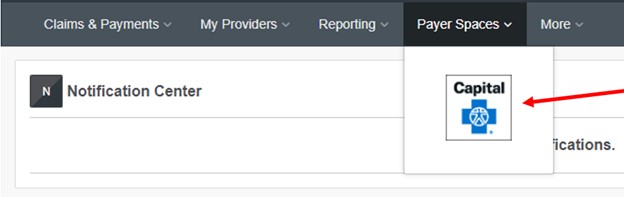
If the specific terms of a court decree state that one of the parents is responsible for the child’s health care expenses or health care coverage and the plan of that parent has actual knowledge of those terms, that plan is primary. If the parent with financial responsibility has no coverage for the child’s health care services or expenses, but that parent’s spouse does, the spouse’s plan is primary.

If the parents are separated (whether or not they ever were married) or are divorced, and there is no court decree allocating responsibility for the child’s health care services or expenses, the order of benefit determination among the plans of the parents and the parents’ spouses (if any) is:

  • The plan of the custodial parent;
  • The plan of the spouse of the custodial parent;
  • The plan of the noncustodial parent; and then
  • The plan of the spouse of the noncustodial parent.
Custody example

Parent A and Parent B are married and currently have custody of seven children. Parent A has two children by his first marriage (Child K, L); Parent B has four children by her first marriage (Child S, T, U, and V). Parent A and Parent B have one son by their marital union (Child Y). Parent A and Parent B each have their own health insurance that covers all seven children. Parent A’s ex-spouse is remarried; Parent B’s ex-spouse is not. There is no court order specifying which parent is primary for the children’s health insurance coverage. Parent A’s date of birth is September 20, 1965; Parent B’s is June 12, 1966. The family picture is as follows:

Chart A

Coverage for children resulting from Parent A’s first marriage:

  • Child K.
  • Child L.

First pay

Second pay

Parent with custody (Parent A)

Spouse of parent with custody (Parent B)

Third pay

Fourth pay

Parent without custody (natural mother)

Spouse of parent without custody (stepfather)

Chart B

Coverage for children resulting from Parent B’s first marriage:

  • Child S.
  • Child T.
  • Child U.
  • Child V.

First pay

Second pay

Parent with custody (Parent B)

Spouse of parent with custody (Parent A)

Third pay

Fourth pay

Parent without custody (natural father)

N/A (No Spouse)

Chart C

Coverage for child resulting from Parent A and Parent B’s marriage:

  • Child Y.

First pay

Second pay

Parent with earlier birth date (Parent B)

Parent with later birth date (Parent A)

The Birthday rule applies to Child Y since he/she is the child of Parent A and Parent B.

Active or inactive employee

The plan that covers a person as an employee who is neither laid off nor retired (or as that employee’s dependent) is primary. If the other plan does not have this rule, and if, as a result, the plans do not agree on the order of benefits, this rule is ignored.

Continuation of coverage

If a person whose coverage is provided under a right of continuation pursuant to federal or state law also is covered under another plan, the plan covering the person as an employee, Member, Subscriber, or retiree (or as that person’s dependent) is primary and the continuation coverage is secondary. If the other plan does not have this rule, and if, as a result, the plans do not agree on the order of benefits, this rule is ignored.

Order of benefit exceptions

When a Member is covered as a dependent by an employer group and also has Medicare coverage, there are exceptions to the rule where Medicare is primary. If you are unsure whether Medicare is primary, and the Member is covered by one of Our products, contact Provider Services: 1.866.688.2242.

Other Party Liability (OPL) and Third Party Liability (TPL)

Other Party Liability (OPL) refers to the coordination of health care benefits with motor vehicle insurance and workers’ compensation carriers. Third Party Liability (TPL) or subrogation provides the ability for Us to recover payments made on behalf of a Member who is injured or becomes ill, based on the actions of a responsible third party.

Participating Providers must cooperate with Us to facilitate payment for services provided to Members by the proper insurer when workers’ compensation or motor vehicle insurance is involved.

Motor vehicle or auto insurance

We are the secondary payer when duplicate health care coverage exists between Us and motor vehicle insurance under the Pennsylvania Motor Vehicle Financial Responsibility Law (MVFRL).

MVFRL covers an insured individual who sustains an injury as a result of the maintenance, operation, or other use of a motor vehicle.

Our products (group and individual) exclude coverage for services eligible under MVFRL. The first party auto insurance benefits must be exhausted before We will consider charges related to a motor vehicle accident/injury.

If one of Our Member’s auto benefits have been exhausted, a claim can be submitted as normal and should include the notation, “Auto Benefits Exhausted with the date of Exhaust,” in Remarks. This written notation should be submitted as follows:

  • ANSI 837 – record in the 2330 loop, for Other Subscriber information must be completed. The other subscriber (SBR data elements), Claim Level Adjustments (CAS data elements), Coordination of Benefits Payer Paid Amount (AMT data element). Loop 2330A with the Other Subscriber Name and the 2330B with the Other Payer Name.
  • UB-04 paper and DDE submission – record in Locator 80 (Remarks).
  • CMS 1500 DDE – record in Claim Notes.
  • CMS 1500 paper claims – attach a copy of the Personal Injury Protection (PIP) sheet and exhaust letter to the hard-copy form.
  • Please Note: To comply with HIPAA privacy regulations, when coordination of benefits information is included with a claim and one insurer’s Explanation of Benefits (EOB) or payment notice is being submitted to another insurer, any patient information that does not pertain to the patient and services at issue must be removed prior to submission to the second insurer.

If it is determined by a Peer Review Organization (PRO) or court that a Provider has provided unnecessary medical treatment or rehabilitative services or merchandise or that future provision of such treatment, services, or merchandise will be unnecessary, the claims are not eligible under the Provider Agreement.

Workers’ compensation

Pennsylvania state law assigns the liability to the employer for injuries, illnesses, or conditions resulting from on-the-job accidents or working conditions. Self-employed individuals and executive officers of a corporation are not generally covered by the law and are ineligible for workers’ compensation. For processing consideration, an executive officer must submit a copy of the Executive Officer Application, Executive Officer Affidavit, and notification from the Department of Labor approving the opt out with the effective date. Our health plans (group and individual) exclude coverage for services eligible under workers’ compensation. We consider such claims only after the workers’ compensation carrier has denied the workers’ compensation claim or has determined that services are not related to a particular workers’ compensation diagnosis.

We do not provide benefits for claims related to the workers’ compensation diagnosis when the Member has entered into a lump sum settlement with the employer or workers’ compensation carrier that covers future medical expenses or if it is determined by a Peer Review Organization (PRO) or court that a Provider has provided unnecessary medical treatment or rehabilitative services or merchandise or that future provision of such treatment, services, or merchandise will be unnecessary, the claims are not eligible under Our health plan.

If a Provider wishes to submit a claim that was denied by workers’ compensation, We require a copy of the workers’ compensation denial and information on any possible appeal by the Member. Any such claims denied by workers’ compensation will not be considered for payment by Us if:

  • The employee did not use the Provider specified by the employer or workers’ compensation carrier.
  • Timely filing limits were not met (120 days for Member to notify employer, 72 hours for employer to notify workers’ compensation carrier after receiving notification from the employee).

Third party liability/subrogation

We have the right of subrogation on all claims paid on behalf of a Member from the party responsible for the Member’s injury or illness. Subrogation recovery is initiated after We pay Covered Services in accordance with the Member’s plan.

COB billing

Our coverage may be secondary or tertiary to another Commercial insurance, including another Blue plan.

Participating Providers must first submit COB non-duplication claims to the primary carrier. After the primary carrier has made its benefit determination, the claim must be submitted to the secondary carrier.

To ensure correct processing of a secondary claim submitted electronically, the primary patient liability amount must be indicated on the claim. This may be done by using value codes or entering the information in the “Other Insurance” section of the Direct Data Entry or the appropriate loop and segment of the ANSI 837. Patient liability includes: Deductible, Coinsurance, copayments, and noncovered charges that may be billed to the Member. If the combined primary and secondary carrier payments exceed the Participating Provider’s maximum allowance, a refund may be in order. Participating Providers should contact Provider Services.

Paper COB

For paper UB-04 claims: Locator 39-41 (Value Codes). Use A4 (primary allowed amount) or B4 (secondary payer allowed amount) if Capital Blue Cross is secondary or tertiary to another payer.

  • For paper 1500 claims: Include a copy of the primary SOR.

Copayments and COB

The primary copayment should be collected and a claim for payment should be filed with the secondary payer.

  • Please Note: Claims for workers’ compensation or auto insurance should be filed directly with the workers’ compensation or auto insurance plan. If a copayment is collected but accepted by the workers’ compensation or auto insurance plan, Providers must, by law, reimburse the Member the copayment amount collected.

COB payment information

The primary plan processes claims, while the secondary plan may consider the difference between what the primary plan reimburses and any remaining balance.

Claims submitted for balance consideration after partial payment by auto insurance plan or workers’ compensation follow the method of coordination selected by the Member’s plan.

COB method claims

When the group selects the COB method for claims processing, We generally pay, subject to the exclusions below, the lesser of the normal contract benefit (NCB) or the COB balance up to Our allowance. However, no more than the primary patient liability will be paid.

  • The COB balance is calculated as the allowed amount less the primary insurance payment. The secondary copayment and Coinsurance are waived. This amount will be paid if it is less than the NCB.
  • The NCB will be paid if it is less than the COB balance. Deductibles, copayments, and Coinsurance may be applied.
  • Please Note: If the COB balance is less than the NCB, but the primary cost sharing is greater than the COB balance, the primary patient liability will be paid up to Our NCB. To use the exception, the primary patient cost-sharing amounts must be submitted on the claim.

Non-duplication method claims

When the Member’s group selects the non-duplication method for claims processing, the COB balance is calculated as the secondary allowed amount less the secondary Deductible, copayment, and/or Coinsurance, less the primary insurance payment. This method may lead to zero paid claims. The Provider may bill the Member for non-Covered Services and/or the Deductible, copayment, or Coinsurance not covered by the primary payment.

Medicare COB

Determination of whether Capital Blue Cross or Medicare is primary:

Status of member
Employer with less than 20 employees
Employer with 20 or more employees but less than 100
Employer with 100 employees or more

Age 65 and older – employee or spouse currently employed

Medicare Primary

Capital Blue Cross Primary

Capital Blue Cross Primary

Disabled employee, spouse, or dependent under age 65 and eligible for Medicare, currently employed

Medicare Primary

Medicare Primary

Capital Blue Cross Primary

Disabled employee, spouse, or dependent under age 65 and eligible for Medicare, not currently employed

Medicare Primary

Medicare Primary

Medicare Primary

Retired employee and spouse entitled to Medicare

Medicare Primary

Medicare Primary

Medicare Primary

  • Please Note: If a Member is entitled to Medicare solely due to End Stage Renal Disease (ESRD), We are primary for the first 30 to 33 months depending on the coordinating period. After that time, Medicare becomes primary.
  • Please Note: Special rules apply to Members with multiple Medicare entitlement situations. Contact Provider Services: 1.866.688.2242 for questions related to coverage for these Members.

Exceptions to COB policy

When FEP Members have Medicare as their primary insurance, FEP generally will pay claims as the secondary insurer by paying the corresponding Medicare deductible(s), and any coinsurance for covered services up to Medicare’s allowable charge.

Advance Beneficiary Notice (ABN)

CMS does not require Us as a Capital Blue Cross Medicare Advantage plan to accept the Advance Beneficiary Notice (ABN) for Capital Blue Cross Medicare Advantage Members. The ABN is given to beneficiaries enrolled in the Medicare fee-for-service (FFS) program. It is not used for items or services provided under the Capital Blue Cross Medicare Advantage Program or for prescription drugs provided under the Medicare Prescription Drug Program (Part D). The ABN is used to fulfill both mandatory and voluntary notice functions. For additional ABN information please see https://www.cms.gov/Medicare/Medicare-General-Information/BNI/ABN.html.

An ABN is to be utilized when a Capital Blue Cross Medicare Advantage Member receives services from a noncontracted, non-participating Medicare assignment Provider. In this instance, the Provider would utilize the form to notify Members they are financially responsible for the services.

Statement of Remittance (SOR)

A statement of remittance (SOR) is issued to Providers to identify payment actions on CMS 1500 and UB-04 claims. A table of items is shown below.

Providers must receive their SOR electronically (eSOR). The eSOR can be downloaded using the Secure File Transfer application via Our Provider Portal. Access Capital’s Payer Spaces page, and under the “Applications” tab click “Secure File Transfer”.

Statement of Remittance (SOR) headings and descriptions

Heading

Description

Identification number

Member’s Capital Blue Cross assigned identification number (prefix not included).

Claim number

A unique number assigned to identify one particular claim.

Patient name and PCN

First and last name of the patient (Subscriber or Dependent) for whom the services were rendered. PCN is an alpha/numeric medical record number that may be assigned by the Provider and included on the claim.

Service from date

Month, day, and year the service began.

Service to date

Month, day, and year the service ended.

Proc code

Procedure or revenue code(s) for service(s) rendered.

Total charge

Total dollar amount the Provider charged for the rendered service(s).

Allowable amount

Dollar amount that We allow for the service(s) rendered. This amount is based on Our contracted rate with the Provider.

Provider responsibility

Amount the Provider charged for services provided that is not covered by us.

Member responsibility – Copayment and other

The portion of the allowable amount that is due to the Provider from the Member. The applicable copayment amount is on the Member’s ID card, and the Member is responsible to pay this directly to the Provider at the time of service.

Reimbursement account paid

Amount paid from Member Reimbursement Account, if applicable.

Amount paid

The amount being paid to the Provider that is included in the check accompanying the SOR.

MSG/Reason codes

Codes which indicate the reason why a line item or claim was denied or adjusted. The descriptions for all codes used are on the last page of the SOR.

Paid/Adjusted claims

Defines the status of claims data being viewed.

Claim totals

The total dollar amount applied to the individual claim being viewed.

Code definition

Descriptions of what the MSG/Reason Codes mean that include any action necessary on the part of the Provider.

This week’s payments

The sum of the amount paid for every new processed claim listed on the SOR for the week.

Reimbursement amount paid

Amount, if any, made from Member’s Reimbursement Account.

Debit remittance balance

The total dollar amount owed by the Provider to Capital Blue Cross for current and prior overpayments, adjustments, or errors.

Check amount

The amount being paid to the Provider (This Week’s Payments minus Debit Remittance Balance). This line on the SOR must match the amount on the check.

New debit remittance

The total amount, if any, owed by the Provider to Us if This Week’s Payments do not exceed the Debit Remittance Balance. (Remaining balance carries forward to next SOR.)

Statement of Remittance (SOR) sample

Statement of Remittance (SOR) sample

Debit Balance Report (DBR)

The Debit Balance Report (DBR) identifies claims which are overpaid, adjusted, or offset. The report is included with an SOR that has an offset amount listed in the Debit Remittance Balance field. The Debit Remittance Balance field is located on the Payment Totals page of the SOR. The DBR field descriptions are shown in the sample DBR below.

We offer an Electronic Debit Balance Report (eDBR) to Providers. The eDBR may be downloaded using the Secure File Transfer application on Our Provider Portal. Access Capital’s Payer Spaces page, and under the “Applications” tab click “Secure File Transfer”.

The DBR is used in conjunction with the SOR. The amount reported in the Overpayment Amount column of the DBR is the amount being recovered on each claim listed. For claims where the amount owed to Us is not recovered in full, the remaining amount will be reported in the Remaining Debit Balance column. If there is a remaining balance, it will be collected from future SORs. Recoveries (also referred to as “Offsets”) will be made from the line of business on which the original overpayment was made. When a claim is offset, it shows on the DBR until the balance is zero.

Review your DBR and SOR together. The DBR lists the patient and claim number whose claim was credited and offset. The final page of the SOR lists the total amount that was offset for that week. This amount will match the amount shown on the DBR.

To identify adjustments performed on an HRA account, please reference the original SOR. To determine whether an account is an HRA account, a payment shows in the Reimbursement Account Paid field. The adjusted claim still shows the payment amount located in the Reimbursement Account Paid field, even though it was previously paid on the original. The dollar amount previously paid is also included in “This Week’s Payments” under Provider Total Paid Amount on the final page.

Debit balance report headings and descriptions

Heading

Description

For the payment week:

Beginning date of the week covered by the SOR payment

Provider group #

Provider group ID number and name

Patient account #

An alpha/numeric medical record number that may be assigned by the Provider and included on the claim

Claim number

A unique number assigned to identify one particular claim

Subscriber ID

Member’s assigned identification number prefix not included)

Patient first name

First name of the patient (Subscriber or Dependent) for whom the services were rendered

Patient last name

Last name of the patient (Subscriber or Dependent) for whom the services were rendered

Date of service

Month, day, and year of the service

Amount recovered

The dollar amount that is taken back for this claim from this week’s payment

Remaining debit balance

The outstanding balance still owed by the Provider to Us on this account

Total

Total remaining outstanding balance

Debit Balance Report (DBR) sample

Debit Balance Report (DBR) sample

Caims Rejected to Member due to no Coverage Report (CRR)

There may be times when a Member presents an ID card even though the Member’s coverage has lapsed. When this occurs, the claim will be processed and an Explanation of Benefits (EOB) indicating no coverage will be sent to the former Member. Because the patient’s coverage with Us is no longer effective, the claim does not appear on the SOR. However, a “Claims Rejected to Member Due To No Coverage” report (eCRR) may be downloaded using the Secure File Transfer application on Our Provider Portal. The report lists claims for which the Member is no longer a Capital Blue Cross enrollee. The report includes the following information:

  • Our Provider number.
  • NPI number.
  • Provider’s name.
  • Member’s previously-assigned Capital Blue Cross identification number (no longer active).
  • Member’s name.
  • Member’s account number.
  • Disallow message (i.e., “Coverage for this Member was terminated prior to the date of service, so no payment can be made.”).
  • Our claim number.
  • From date.
  • To date.
  • Date the denied claim was finalized.

This report helps you identify patients who are no longer covered by us. In these situations, contact the former Member to obtain their current insurance information in order to submit their claims to the appropriate entity.

  • Please Note: Hardcopy submissions of claims for patients that have never been covered by Us will be returned to the Provider indicating no coverage but will not appear on this report. Electronically submitted claims for patients who have never had coverage are no longer accepted into the system.

Electronic Remittance Advice (ERA)

We offer an Electronic Remittance Advice (ERA) for Providers wishing to receive remittance information in the standard ANSI 835 format. Providers receiving an ERA may work with their practice management software vendors to use this data for auto-posting remittance data directly to patient accounts. To initiate enrollment for ERA service, Providers should go to the provider automation page, and complete the ANSI 835 ERA (electronic remittance advice) form. For additional information, please call 800.874.8433, option 4.

Notification of denials

Providers will be notified of a claim denial on the SOR and/or ERA. The SOR and/or ERA details the amounts paid by Us for specific procedures along with the cost-sharing provisions due from the Member.

Providers may contact Us regarding a denied claim by following the Provider inquiry, claim review, or appeal procedure outlined in the dispute resolution and Provider appeals section of this Provider Manual. Except for Capital Blue Cross Medicare Advantage, claims denied as non-covered benefits are not subject to appeal.

Prohibition of member billing

As a Participating Provider, you have entered into a Provider Agreement with Capital Blue Cross to accept payment directly from us. Payment constitutes payment in full, with the exception of applicable copayments and/or Coinsurance as listed on the Explanation of Benefits (EOB)/Statement of Remittance (SOR).

You may not balance bill Members for the difference between actual billed charges and your contracted payment rate. A Member cannot be “balance billed” for Covered Services denied for lack of information. Failure to notify Us of a service that requires preauthorization will result in payment denial. In this scenario, Members may not be balance billed and are responsible only for their applicable copayments and/or Coinsurance.

A Member cannot be billed for a Covered Service that is not medically necessary, unless the Member‘s informed written consent is obtained prior to rendering a non-Covered Service. This consent must include information regarding his/her financial responsibility for the specific services received.

Services not provided directly to the Member are non-covered and not reimbursable per Our Provider Agreement with that Provider.

Balance billing rules under Medicar

Please refer to the Medicare Managed Care Manual, Chapter 4, Section 170, for additional information.

Fee-for-service payment and Allied Health Professionals payment level

Fee-for-service payment

Payment for adjudicated claims for Covered Services will be made directly to the Participating Provider. Payment will be at the lower of (i) billed charges or (ii) the current applicable program fee schedule, less copayments or Coinsurance and Deductibles, as applicable.

Payment for adjudicated claims for services provided by non-Participating Providers will be made directly to the Member/Subscriber. However, payment for adjudicated claims for services rendered by Providers that do not participate in Capital Blue Cross Medicare Advantage as applicable, will be made directly to the non-Participating Provider so long as the non-Participating Provider accepts Medicare assignment.

Allied Health Professionals payment level

We will pay Allied Health Professionals for all Covered Services provided under Our Indemnity, PPO and POS Programs based on the lower of (i) billed charges, or (ii) Our applicable standard fee schedule for the applicable category of professional health care Provider in effect from time to time, less any applicable Cost Sharing Provisions due from a Member. Currently, Our standard fee schedules for non-physician health care Providers are 85 percent of the Physician Provider Program Fee Schedule: (i) Certified registered nurse Practitioners, (ii) physician assistants, (iii) licensed dietician-nutritionists, (iv) licensed psychologists., (v) social worker, and (vi) licensed professional counselor.

Payment integrity programs

Our pre and post payment integrity programs ensure claims process accurately based on nationally recognized coding standards, in addition to our contracts, policies, and procedures.

Our claims editing system checks data validity, reporting errors, omissions, inconsistencies, and inappropriate coding relationships, such as unbundling and modifier appropriateness, including but not limited to the following:

  • The CPT, HCPCS, ICD-10, Modifiers and Place of Service are valid for the date of service
  • The CPT, HCPCS, ICD-10, Modifiers and Place of Service are coded to the highest level of specificity
  • Valid code relationships (e.g., Modifier to Procedure Code, Add-On to Primary Code Procedure)
  • Identification of:
    • Modifier 51 Exempt Procedures
    • Bundling/Unbundling Scenarios
    • Eligibility of services for Assistant Surgery, Co-Surgery and Team Surgery
    • Application of the Global Surgery Period
    • Unit Limitation defined by CPT/HCPCS code description or CPT coding guidelines
    • Correct reporting of Professional and Technical Components

Claims are assessed for appropriateness using nationally recognized coding standards such as:

  • Medicare National Correct Coding Initiative (NCCI).
  • CPT, HCPCS and ICD-10 coding rules.
  • Nationally recognized publications/literature and Medical Specialty Societies.
  • CMS Published Billing and Coding Manuals, Policies, and Transmittals.
  • National and Local Coverage Determinations (NCD and LCD).
  • Medicare Code Editor (MCE).
  • Medicare Outpatient Code Editor (OCE).
  • Center for Medicare & Medicaid Services’ Medicare Physician Fee Schedule (MPFS).
  • UB-04 Data Specifications adopted by the National Uniform Billing Committee (NUBC) for facility claims.

Providers must continue to use only the code sets that are valid for the date of service indicated on the claim. Accurate and complete coding of CPT/HCPCS codes, modifiers, units, DRG’s and ICD-10 codes to the highest level of specificity will result in appropriate and timely (processing and reduce the need for submission of corrected claims.

1) Pre-Pay programs

Facility Claim Reviews (Itemized Bill Review):

  • General Description
    • Equian (an Optum company) is a vendor that conducts facility claim reviews on Our behalf prior to rendering percent of charge payments. This program is an enhancement to Our existing claims adjudication processes requiring the submission of an itemized invoice allowing for validation between the submitted claim and the provided invoice.
  • Objective
    • The purpose of the facility claim review is to ensure reporting of claim submission, pricing and processing resulting in validation between submitted claims and invoices.
  • Process
    • The vendor notifies the facility whose claim is under review via electronic communication and requests an itemized invoice.
    • Facilities have 15 days to submit their itemized bill to the vendor.
    • If the itemized bill is not received, the claim will be rejected for payment.
    • After the vendor reviews the itemized bill, the findings are forwarded to the facility and Capital Blue Cross.
    • Facility payment(s) could be reduced depending on the outcome of the review.
    • Once Capital Blue Cross notifies the vendor that the facility claim has finalized, a Forensic Review Report (FRR) explaining the findings on any service that resulted in a reduced payment is sent to the facility provider.
    • Providers have 60 days to dispute the findings with the vendor. This single level administrative billing dispute process is outlined in the Notice of Claim Review Findings (provider report).
    • This process does not apply to Members covered under FEP, Capital Blue Cross Medicare Advantage or Medicare Supplement products.

The requested itemized bill should be submitted directly to Equian’s (an Optum company) Medical Claims Analyst (MCA) using one of the following methods:

For Standard/USPS mail: Optum - Itemized Bill Review Medical Claims Analyst - Admin PO Box 31309 Salt Lake City, UT 84131

For UPS/FedEx packages: Medical Claims Analyst - Admin Optum - Itemized Bill Review 1355 S. 4700 West Salt Lake City, UT 84104

Coordination of Benefits (COB) process

Verifies third party liability to ensure Capital Blue Cross is only paying claims for members where Capital Blue Cross is responsible, such as when there is no other health insurance coverage or Capital is the primary insurer.

2) Post-Pay programs

Retrospective professional provider and facility claim reviews:

  • General Description
    • This program, conducted by Capital Blue Cross, is a retrospective review of professional and facility finalized and paid claims.
  • Objective
    • To ensure correct reporting and payment of claims.
  • Process
    • Recent claim submissions, up to and including the previous 24 months, may be reviewed.
    • A letter is issued identifying the findings Capital Blue Cross corrects and retracts payment if an incorrectly reported claim is identified.
    • Providers can appeal the vendor's findings within 60 days. This single level administrative billing dispute process is outlined in the provider notification letter.
    • After at least 60 days has elapsed, Capital Blue Cross adjusts the payment. Once completed, these retractions are reflected on the debit balance reports. Providers should not submit a refund unless that is part of their contractual arrangement.
    • This process does not apply to Members covered under FEP, CHIP, or Medicare Supplement products.
    • We ensure proper payment by reviewing claims data using algorithms that identify improper billing.

Retroactive payment adjustments:

  • Capital Blue Cross will not initiate an adjustment on a previously paid claim due to any rate changes made after the initial claim payment per Capital’s Retroactive Payment Adjustment Policy.

Credit balance recovery

Our hospital credit balance recovery program, conducted by Conduent or TREND Health Partners, provides ongoing reviews of all open credit balances with facilities. Identified balances are reviewed, and a determination is made as to whether an overpayment has occurred. Our vendors function as liaisons to resolve credit balance issues and determine the validity of the balance prior to the retraction.

DRG validation reviews

  • General Description
    • ClaimLogiq (a Machinify company) is a vendor that conducts inpatient facility DRG claims on Our behalf.
  • Objective
    • The purpose of the DRG validation review is to ensure that the diagnostic, procedural information, and discharge status of the patient reported on the hospital claim align with the information in the patient’s medical record.
  • Process
    • For selected claims, the medical records are requested from the facility and reviewed for appropriate coding, based on nationally accepted coding guidelines.
    • Claim selection and corresponding medical record reviews are based on a 10-month retrospective review from the claim paid date.
    • The vendor notifies providers in writing when a review affects the DRG assignment and provider payment.
    • Providers have 60 days to dispute the findings. This single-level process is outlined in the provider's determination letter.
    • After 60 days, Capital Blue Cross adjusts the payment. Once completed, these retractions are reflected on the debit balance reports.

Provider education and outreach

This notification process is to educate providers of their common coding or billing errors identified by various payment integrity efforts. Additionally, professional provider's claims data is analyzed to identify outlier billing, within their respective specialties. The goal of this program is to provide outreach and education to providers.

Case audit following problem identification

When a potential problem is identified, a case audit is initiated. A sample of medical records may be requested for review. A registered nurse with a Certified Professional Coder (CPC) designation reviews the medical records and compares them to claims submissions. Additionally, We may choose to conduct an on-site audit. This usually includes obtaining additional copies of clinical records and interviewing the Provider and appropriate staff. Members may also be interviewed or sent a questionnaire to verify that services were performed as reported.

As appropriate, Our Medical Directors review the auditor’s findings to make the final Medical Necessity determination.

Fraud, waste and abuse investigations

Our Special Investigations Unit’s goal is to support Capital Blue Cross as a medical value leader in providing affordable, high quality health care to Our members and customers.

The Special Investigations Unit (SIU) investigates potential allegations of Member and Provider fraud, waste, and abuse. The SIU seeks to maintain the integrity of Member and Provider claims submitted to us, Our subsidiaries, affiliates, and employees through proactive detection and investigation of potential fraud, waste, and abuse. When necessary, SIU takes internal and/or external corrective action to assist Us in continuing to provide quality, affordable health care to all its Members. In instances of suspected fraud, SIU tracks claim reporting and collects information that may become evidence for law enforcement officials or the courts. Professional consultants may support and advise Our personnel in these activities.

Reporting fraud

If you suspect Medicare fraud or other healthcare fraud, please contact Us.

  • Online – Complete our online form
  • Phone- Call our toll-free hotline, open 24/7, at 888.612.1277. Callers may remain anonymous.
  • Mailing address: Capital Blue Cross PO Box 773737 Harrisburg, PA 17177-1132
  • Email us (Fraud@capbluecross.com)

When completing the online form or sending an email to us, please include as much information as possible (such as the name of the patient or provider, address, and a summary of the allegations).

Defining fraud, waste and abuse

Fraud - is the act of knowingly submitting, or causing to be submitted, false claims or making misrepresentations of fact to obtain payment from a health care benefit program for which no entitlement would otherwise exist.

  • Example: Provider billing for services that were not rendered to Member.

Waste - is the over-utilization of services or other practices that directly, or indirectly, result in unnecessary costs. Waste is not generally considered to be caused by criminal actions, but rather the misuse of resources. Waste may involve obtaining an improper payment but does not require the same intent and knowledge as fraud.

  • Example: Provider utilizes more disposable medical equipment and drugs than actually necessary and bills health care benefit program for excess.

Abuse - includes actions that may, directly or indirectly, result in unnecessary costs. Abuse involves payment for items or services when there is no legal entitlement to that payment and the provider has not knowingly and/or intentionally misrepresented facts to obtain payment. Though abuse may involve obtaining an improper payment, it doesn’t require the same intent and knowledge as fraud.

  • Example: Provider incorrectly codes for services rendered to Member, resulting in an improper payment.

Special Investigations Unit (SIU) review process

Capital Blue Cross payment review processes were enacted to ensure that Our members receive services that are medically necessary and that the claims submitted for these services are submitted accurately. Review of claims data ensures that payment is made in accordance with but not limited to provider contracts, member health care benefit plans, group clients and state and regulatory requirements.

Types of payment review

The Special Investigations Unit (SIU) conducts several types of review to prevent and identify fraud, waste and abuse activities. Advanced proactive analytical and investigational payment reviews help to ensure that the services being rendered are clinically appropriate and that the coding submitted on the claim, is accurate and reflective of services provided.

Reviews conducted within the SIU are completed by experienced health care professionals with expertise in clinical and coding specializations. This includes registered nurses, medical directors, licensed social workers, medical coders, professional consultant, non-clinical investigators and IT analysts.

We may use an independent professional consultant or an Independent Review Organization to review documentation and provide opinions. Professional consultants are actively practicing healthcare professionals, representing major professional specialties and disciplines

Goals of SIU payment review processes
  • Ensure payments are processed in accordance with contracts held by all participating healthcare Providers and facilities.
  • Ensure claim payments are consistent with Our medical policies, network payment policies, and other administrative and/or claims-related policies.
  • Provide claims-related policy and procedure education to provider community to promote appropriate reporting of services in accordance with industry standards.
  • Ensure proper documentation of Medically Necessary and Appropriate services.
  • Identify and provide feedback regarding anomalous and aberrant behavior identified through advanced analytics and investigational activity.

Identify overpayments of services and recover improper payments.

Pre-Payment review:

In the event the SIU identifies claim patterns or trends suggestive of fraud, waste or abuse, the SIU will request medical records or other documents to support the Medical Necessity, frequency or type of services being reported as well as coding submissions for each reported service prior to the adjudication of the claim. Interviews with Members and Providers may occur as part of the prepay review process to verify that services were medically necessary and performed as reported.

Post-Payment review:

We conduct post payment reviews of Participating Provider claim submissions to help confirm appropriateness of claim coding, services billed and compliance with Our policies and procedures. We reserve the right to recover funds from the Provider or facility involving any improper payment.

We reserve the right to review all submitted claims as necessary to assure identification of all related compliance issues. Additionally, We reserve the right to review medical records and to complete interviews with the Member and/or the Provider if additional information is needed to determine whether services and/or supplies received were medically necessary and reported correctly. Post payment review may involve long term monitoring of services rendered by Providers.

Error identification and/or overpayments

At the conclusion of the payment review, Capital will notify the provider or facility in writing of the findings of the review. The provider or facility is afforded the opportunity to appeal the findings, which may involve providing clarification or further documentation that was not provided during the initial review, within 60 days of receipt of Capital’s notification.

Not all overpayment situations require Provider or facility advance notice. If an overpayment has been deemed as such, no Provider or facility appeals will be accepted.

If an overpayment has been deemed to require Provider or facility advance notification, a letter will be sent, or a phone call will be placed. We will work with the Provider, as necessary, to correct the overpayment reason(s). Overpayment notifications will then be sent to Providers and facilities in writing. Sixty days from the date of the overpayment notification, We will initiate a process to offset the monies equal to the overpayment amount from future payments to the Provider or facility. The Provider and facility also have the option to refund the overpayment amount directly to Us within the 60 day period.

If, for any reason, the offset or refund processes are insufficient to fully satisfy return of all overpayments due, We reserve the right to pursue other remedies, including legal remedies.

The following information applies to Blue Cross and Blue Shield Federal Employee Program® (FEP) Members only.

As a reminder, Capital Blue Cross, as an administrator for Members of the Federal Employees Health Benefits Program (FEHBP) and Postal Service Health Benefits Program (PSHBP) must comply with 48 C.F.R. 1631.201-70(h). If the determination is made that a Member’s claim has been paid in error for any reason (except in the case of fraud or abuse), Capital shall make a prompt and diligent effort to recover the erroneous payment to the Member from the Member or, if to the provider, from the provider; the recovery of any overpayment must be treated as an erroneous benefit payment, overpayment, or duplicate payment under 48 C.F.R. 1631.201-70(h) regardless of any time period limitations in the written agreement with the provider. As such, any contractual limitations related to payment recoveries within your participating Provider Agreement with Capital cannot apply to Members.

Provider disagreement with the findings

Professional Providers may appeal Our request for the return of overpayments, in writing, according to the instructions within the notice. In the event of an appeal, the Provider may provide additional information and documents to support the Provider’s position and have this information considered.

Any facility Provider’s right to appeal will be determined as set forth in the Provider Agreement.

Facility/Ancillary Specific Guidelines

Unless specifically indicated otherwise, instructions for Locators on all following facility types are defined as:

  • Locator 1 (Billing Provider Name, Address, and Telephone Number) The billing Provider address must be reported as a street address. Claims reporting a Post Office (PO) Box will be rejected on the submitter’s Accept/Reject (AR) Report. Also, the nine digit ZIP Code is required.
  • Locator 17 (Patient Discharge Status) If code 30 (Still Patient) is entered, the “Type of Bill” frequency (the third digit of the code entered in Locator 4) must be either “2” or “3.”
  • Locator 56 (National Provider Identifier (NPI)—Billing Provider) Enter the billing Provider’s NPI.

Acute care hospital

All Acute Care Hospital claims should be coded in accordance with, but not limited to, the National Uniform Billing Committee (NUBC) Guidelines as well as CMS.

Observation care

Observation services must be reported using Revenue Codes 0762. You must also submit, on the same claim line, HCPCS code G0378 (hospital observation service, per hour) in Form Locator 44 along with the appropriate number of units of care in Form Locator 46. When G0378 is billed, it must be billed with one claim line only and include the number of units. If no units are billed, or if more than one claim line is billed with G0378, the claim will reject.

HCPCS code G0379 is an informational code to be reported in addition to G0378 when the Member is admitted to observation as a result of a direct referral for observation care without an associated emergency department visit, hospital outpatient clinic visit, critical care service, or hospital outpatient surgical procedure. Reporting G0379 does not change reimbursement and Capital Blue Cross will not pay emergency department services when a direct observation is reported.

A HCPCS modifier is required when it clarifies or improves the reporting accuracy of the associated procedure code.

  • If multiple procedures are performed on the same date of service, Providers are required to submit all the charges on one claim.
  • When providing multiple procedures for Capital Blue Cross Medicare Advantage Members, bill each procedure on a separate line.

The PT modifier should be reported when a screening colonoscopy converts to a diagnostic procedure to ensure Member preventive benefits are correctly applied.

  • Locator 45 (Service Date) Claims for outpatient therapy services, such as physical medicine, occupational therapy, and speech therapy, should be submitted with individual dates of service. If individual dates are not listed, the claim may be denied.
  • Locator 46 (Units of Service) The following Revenue Code requires units to be recorded:
    • The Units/Days entered beside Revenue Code 0001 must be the same as the number of covered days entered in Value Code 80, which is entered in Locators 39–41. Inpatient Room and Board accommodations – units reflect the total number of days or care provided to the Member.
    • Due to FEP visit limitation for outpatient physical medicine, occupational therapy, and speech therapy, the correct number of visits is required in Locator 46 (Units of Service).
  • Locator 51 (A, B, and C) (Health Plan Identification Number, payer codes) When Capital Blue Cross or FEP is the destination payer, enter plan code 361 in the appropriate primacy order. The primary payer would be entered in A; secondary in field B; and tertiary in field C. If the payer is another Blue Plan and the three-digit identifier is available to you, that can be entered, or use Capital Blue Cross’ plan code 361. In situations where there are multiple Blue Plans, please use code B3 in place of the plan code to indicate the Blue Plan from which you are not expecting payment. For all other payers, use the code provided by the National Association of Insurance Commissioners (NAIC).
  • Locator 60 (A, B, and C) (Insured’s Unique Identifier) The first through the third characters of the identification number should be the prefix. The prefix should be obtained from the Member’s ID card. FEP identification numbers do not include a three-character prefix. When there is no prefix on an ID card for an out-of-area Member, the claim should be filed directly to the Member’s Blue Plan. If the Member’s identification number includes a two-digit suffix, include the suffix in this locator.
  • Locator 62 (A, B, and C) (Insured’s Group Number) FEP claims should not have a group number recorded in this locator. The group number is required on HMO claims.
  • Locator 63 (A, B, and C) (Authorization Code/Referral Number) – This is required for Capital Blue Cross POS, HMO, and Capital Blue Cross Medicare Advantage HMO. When applicable, use this locator to record the preauthorization number.
  • Locator 67 (Principal Diagnosis Code and Present on Admission Indicator) – The Present on Admission (POA) indicator is required for each diagnosis reported on an inpatient claim.

Present on admission

All claims involving inpatient admission to general acute care hospitals are subject to a law or regulation mandating collection of present on admission information.

“Present on admission” is defined as present at the time of the order for inpatient admission. Conditions that develop during an outpatient encounter, including emergency department, observation, or outpatient surgery, are considered as present on admission. The service to date (discharge date) is utilized to determine if the diagnosis code requires a present on admission indicator.

Capital Blue Cross will reject claims missing the present on admission indicator when it is required for the reported diagnosis code.

ICD-10-CM Official Guideline for Coding and Reporting publishes a list of diagnoses (Appendix I-Present on Admission Reporting guidelines) that are exempt from POA reporting.

  • Locator 74 (Principal Procedure Code and Date) – This is required for inpatient when a procedure is performed. Report an ICD-10 PCD code that identifies the inpatient principal procedure performed for definitive treatment, rather than one performed for diagnostic purposes or was necessary to take care of the complication. If there appear to be two procedures that are principal, then the one most related to the principal diagnosis should be selected as the principal procedure.
    • A CPT4/HCPCS outpatient procedure code and the date must be recorded in this locator on all outpatient claims.
    • An ICD-10 procedure code and date must be recorded in this locator on all inpatient claims.

Follow Medicare guidelines concerning the principal procedure code for Capital Blue Cross Medicare Advantage claims.

  • Locators 74 a–e (Other Procedure Codes and Dates) – If multiple procedures are performed on the same date of service, Providers are required to submit all the charges on one claim.
  • Locator 76 (Attending Provider Name and Identifiers) – The license number of the physician who would be expected to certify Medical Necessity or be responsible for the patient’s treatment.
    • Enter the Provider’s NPI.
  • Locator 78 (Other Provider [Individual] Names and Identifiers) – Enter the referring Provider’s NPI.
  • Locator 81 (Code—Code Field) – Enter the Provider taxonomy code on Commercial and Capital Blue Cross Medicare Advantage claims.

Private room charges

A patient is considered to have been in a private room when the Provider enters Revenue Code 011X on the UB-04 claim form. When entering a revenue code from this range, Providers must also include the reason for the private room by entering one of the following codes:

  • Value Code 02 – Hospital has no semi-private rooms.
    • This code should be used when the facility has private rooms only.
  • Condition Code 38 – Semi-private room not available.
    • Providers should enter this code when the facility has semi-private rooms, but one is not available for the patient at the time of their admission.
  • Condition Code 39 – Private room medically necessary.
    • This code should be entered when the patient needs a private room for medical requirements.

Patients should be notified that they will be responsible for this amount prior to being placed in a private room. Condition Codes 38 (Semiprivate Room Not Available), 39 (Private Room Medically Necessary), and Value Code 02 (Hospital has no Semiprivate Rooms) should not be shown on the claim in these situations.

Outpatient instructions

Only similar therapy services: i.e., claims with all physical medicine, speech therapy, occupational therapy, chemotherapy, and IV or radiation therapy services can be billed on a single claim even though they were incurred on multiple dates of service. Each date of service and each service should be reported on separate lines. Diagnostic tests performed in conjunction with these therapies must be billed separately. These instructions are not applicable to FEP outpatient claims.

Any time a facility performs separate services on the same day for the same patient, all the services should be billed on one claim.

  • Locator 14 (Priority [Type] of Admission or Visit) Record code 1 to represent a “medical emergency.” If this locator is coded with a 1 (medical emergency), then Locators 39–41, Value Code 45, and Locators 32–35 Occurrence Code 11 must be completed. Claims due to accidents should not use code 1 and the field should be left blank.
  • Please Note: If preadmission testing is done for an inpatient admission or an outpatient surgery, include the charges on the inpatient or outpatient surgery claim. Do not submit preadmission charges on a separate claim.
  • Locators 39–41 (Value Codes and Amounts) If more than one value code and dollar amount are shown for a billing period, record codes in ascending numeric order. Do not enter decimal points when recording dollar amounts.
    • When Value Code 30 (Preadmission Testing) is used, Locators 31–34 (Occurrence Codes and Dates) must have Occurrence Code 41 (Date of First Test) entered.
    • FEP requires the use of Value Code 50 for physical medicine, Value Code 51 for occupational therapy, and Value Code 52 for speech therapy.
    • Value Code 82 (Coinsurance Days) Utilized for Medicare Supplement standalone claims only.
    • Value Code 83 (Lifetime Reserve Days) Utilized for Medicare Supplement standalone claims only.
    • Providers should follow appropriate procedures for reporting the Claim Level Adjustments of other payers when submitting Capital Blue Cross secondary or tertiary claims. If submitting charges on a paper claim, it is permissible to use Value Codes A1, A2, A7, B1, B2, B7, C1, C2, and C7. If claims are submitted online via Our Provider Portal, use the fields for Claim Level Adjustments for the primary payer (or secondary payer) on the Other Insurance Information screens. For questions from Providers who submit using ANSI 837, contact your Capital Blue Cross Provider Automation Service Consultant at 800.874.8433.

Outpatient diagnostic medicare three-day payment window instructions

Capital Blue Cross follows the bundling of claims for outpatient services, prior to the inpatient admission, in accordance with Medicare's three-day payment window.

Under Medicare’s three-day payment window, a hospital (or an entity that is wholly-owned or wholly-operated by the hospital) must include, on the inpatient claim, the technical portion of all outpatient diagnostic services and admission-related nondiagnostic services (for example, therapeutic) furnished during the three (3) days preceding an inpatient admission.

Nondiagnostic services that are clinically distinct or independent from the reason for the inpatient admission (e.g., disease monitoring) are separately billed with condition code 51, attesting it was an unrelated outpatient non-diagnostic service. Hospitals must maintain documentation in the medical record to support the outpatient service(s) is unrelated to the inpatient admission.

Please Note: When combining the outpatient procedures on the inpatient hospital claim (type of bill 11X), use the appropriate “from” date of the outpatient procedures and be sure to code any condition the patient had, at the time of the order to admit, as Present on Admission (POA), regardless if the condition was present at the time the patient registered as a hospital outpatient.

A hospital that is not a Medicare subsection (d) hospital, including Critical Access Hospitals (CAHs) will be limited to one (1) day preceding an inpatient admission, such as:

  • Psychiatric hospitals and units.
  • Inpatient rehabilitation hospitals and units.
  • Long-term care hospitals.
  • Children’s hospitals.
  • Cancer hospitals.

Exclusions:

  • Ambulance and maintenance renal dialysis services provided by the hospital (or an entity wholly-owned or wholly-operated by the hospital).
  • CMS Acute Care CAHs (unless wholly-owned or operated by a non-CAH hospital).
  • Outpatient diagnostic services included in a Rural Health Center (RHC) or in Federally Qualified Health Center (FQHC) all-inclusive rate, and services furnished outside of the three-day window.
  • Skilled Nursing Facilities (SNFs), Home Health Agencies (HHAs), and Hospice providers.

Subject Revenue Codes:

Code
Description

0254

Drugs incident to other diagnostic services

0255

Drugs incident to radiology

030X

Laboratory

031X

Laboratory pathological

032X

Radiology diagnostic

0341, 0343

Nuclear medicine, diagnostic/diagnostic radiopharmaceuticals

035X

CT scan

0371

Anesthesia incident to radiology

0372

Anesthesia incident to other diagnostic services

040X

Other imaging service

046X

Pulmonary function

0471

Diagnostic audiology

0481, 0489

Cardiology, Cardiac catheter lab/Other cardiology with CPT codes such as: 93451-93464, 93503, 93505, 93530-93533, 93561-93568, 93571-93572. G0278

0482

Cardiology, stress test

0483

Cardiology, Echocardiology

053X

Osteopathic services

061X

MRT

062X

Medical/surgical supplies incident to radiology or other diagnostic services

073X

EKG/ECG

074X

EEG

0918

Testing-Behavioral health

092X

Other diagnostic services

Outpatient pharmacy billing

Acute care hospitals must use correct coding guidelines when submitting claims related to charges for drugs administered as outpatient services under revenue codes; including the use of the applicable HCPCS, or if a HCPCS is not available, the NDC that most accurately reflects the drug and dosage given. Claims submitted under revenue codes 0250-0259 and 0630-0639 without this information will not be accepted and denied with a “HCPCS Code Required” message and will be returned to the Provider.

As a reminder, units billed, and the dosage defined by the HCPCS or NDC codes must be considered when including this information on a claim. When selecting a drug HCPCS or NDC, it is more appropriate to use the code with the dosage that most closely describes the amount given rather than using a code describing a lesser dosage and report multiple units to account for the dosage administered.

Ambulance covered services

  • Advanced Life Support (ALS).
  • Paramedic intercept services.
  • Basic Life Support Services (BLS).
  • Oral and intravenous drugs.

For commercial programs, if no transport of a Member occurs but there were medical services provided as a result of an emergency, then payment will be made to the ambulance company. This applies to situations in which the Member refuses to be transported, even if medical services are provided prior to loading the Member onto the ambulance (e.g., BLS or ALS assessment).

  • Please Note: HMO programs will review these services for Medical Necessity.
Services not covered
  • Invalid coach services.
  • Transport of hospital inpatient.
    • Transport to another entity for the provision of services while the patient is still an inpatient of the hospital. Such services must be billed to the hospital.
  • Any service not listed as a Covered Service under the Member Ambulance Service Provider Agreement (e.g., additional attendants, wait time, etc.).
  • Capital Blue Cross Medicare Advantage ALS nontransporting services related to a BLS transport.
    • Capital Blue Cross Medicare Advantage follow Medicare guidelines and do not cover this service.
Special requirements
  • Block 1a (Insured’s ID Number). Include the alphanumeric prefix shown on the Member’s ID card. If there is no alphanumeric prefix, the claim should be filed directly to the Member’s Blue Plan.
    • If the Member’s alphanumeric ID number includes a two-digit suffix, include the suffix in this block.
  • Block 2 (Patient’s Name). Enter the patient’s name exactly the way it appears on the ID card.
  • Block 11c (Insurance Plan Name or Program Name). Type the applicable program name, plan name, or 361.
  • Block 21 (Diagnosis or Nature of Illness or Injury). Type the ICD-10-CM code(s) and narrative description(s) in priority order. Use of external cause codes for primary and secondary diagnoses is inappropriate and will cause the claim to be returned to the Provider.
  • Block 24b (Place of Service) Use the following code:
    • 41 Ambulance Land.
  • Block 24d (Procedures, Services, or Supplies) For all programs except Capital Blue Cross Medicare Advantage, list the HCPCS Level II code that most accurately describes the service rendered to the patient. For Capital Blue Cross Medicare Advantage, list the HCPCS codes and modifiers that are acceptable to Medicare.

Nontransporting ambulance service guidelines

To ensure correct payment for ALS/BLS services provided when the patient was not transported in an ambulance, the charges must be submitted according to these guidelines.

  • In the case of a patient death, bill with modifier QL
  • This coding applies to the following scenario:
    • When ALS/BLS treatment is rendered to stabilize a patient who is not transported.
  • Capital Blue Cross Medicare Advantage coverage of ALS non-transporting service related to a BLS transport follows CMS guidelines and is not covered. However, when filing these charges for a denial, please use the applicable vehicle HCPCS code and the modifier “GY” to correctly report these services.
  • Block 24f ($ Charges). Type the full charge for each service billed. Do not type the contracted rate(s). Do not use dollar signs ($) or decimals. Skip a space between dollars and cents. Do not report a zero charge.
  • Block 24g (Days or Units). When reporting mileage, Providers must round the total miles up to the nearest tenth of a mile (using a decimal) and report the resulting number with the appropriate HCPCS code for ambulance mileage. All ambulance transports require a “from” and “to” modifier combination to report the destination information.
    • Providers should submit only one unit for procedure codes A0426 through A0434. If a claim is received with more than one unit, the claim will be closed and returned to the Provider for resubmission.
      • When service units for ambulance trips are reported on a claim with a value greater than one, the claim will reject back to the Provider with rejection code Z1001D, “Ambulance service units cannot be greater than one.”
  • Block 24j (Rendering Provider ID #)
    • Paper claims, type the NPI number of the billing Provider.
    • Electronic claims, leave this block blank.
  • Block 27 (Accept Assignment). Required for Capital Blue Cross Medicare Advantage claims.
  • Block 28 (Total Charge). Type the total charge for the services indicated on the claim (total of all charges in Item 24f). Do not use the dollar sign ($) or decimals. Skip a space between dollars and cents. If billing a continuation claim, do not total charges until the final claim is submitted.
  • Block 32 (Service Facility Location Information). The five-digit ZIP Code is required for the service facility location. Indicate the five-digit ZIP Code for the location from where the patient was picked up or the point of origin.

The following information is for ambulance Providers submitting claims electronically via Our Provider Portal.

New Professional Claim Portal: On the Create New Claim Other Info tab, in the Ambulance Transport section enter the point-of-origin five-digit ZIP Code in Ambulance Pick up Information.

  • Block 33 (Billing Provider Info and Phone #). Type the Provider’s billing name, address, nine-digit ZIP Code, and phone number. The phone number is to be entered in the area to the right of the block title. Do not use punctuation.
    • The billing Provider address must be reported as a street address. Claims reporting a Post Office (PO) Box will be rejected on the submitter’s Accept/Reject (AR) Report.
  • Block 33a (NPI #). Type the NPI number of the billing Provider.

Ambulatory surgery center

  • Locator 3b (Medical/Health Record Number) Required for Capital Blue Cross Medicare Advantage claims.
    • Outpatient Instructions: If the admission date (Locator 12) and the “From” and “Through” dates are the same, the “Through” date can be left blank. If these three dates are not the same, then all three dates must be entered.
    • All services and/or multiple procedures that are performed on the same date of service should be billed on one claim.
    • When providing multiple procedures, bill each procedure on a separate line.
  • Locator 51 (A, B, and C) (Health Plan Identification Number, payer codes) – When Capital Blue Cross or FEP is the destination payer enter, plan code 361 in the appropriate primacy order. The primary payer would be entered in A, secondary payer in field B, and tertiary payer reflected in C. If the payer is another Blue Cross plan and the three-digit identifier is available to you, that can be entered or use Capital Blue Cross’ plan code 361.
    • In situations where there are multiple Blue Plans, please use code B3 in replacement of the plan code to indicate the Blue Plan you are not expecting payment from. For all other payers you may use the code provided by the NAIC.
  • Locator 60 (A, B, and C) (Insured’s Unique Identifier) – The first through the third characters of the identification number should be the prefix. The prefix should be obtained from the Member’s ID card. FEP identification numbers do not include a three-character prefix. When there is no prefix on an ID card for an out-of-area Member, the claim should be filed directly to the Member’s Blue Plan
    • If the Member’s identification number includes a two-digit suffix, include the suffix in this locator.
  • Locator 62 (A, B, and C) (Insured’s Group Number) – FEP claims should not have a group number recorded in this locator. The group number is required for HMO and Capital Blue Cross Medicare Advantage claims.
  • Locator 63 (A, B, and C) (Authorization Code/Referral Number) – When applicable, use this locator to record the preauthorization number. Required when an authorization is assigned by the payer, or the services were preauthorized.
  • Locator 76 Attending Provider Name and Identifiers) – The license number of the physician who would be expected to certify Medical Necessity or be responsible for the patient’s treatment. Enter the Provider’s NPI.
  • Locator 78 Other Provider [Individual] Names and Identifiers) – Enter the referring Provider’s NPI.
  • Locator 81 (Code–Code Field) – Enter the Provider taxonomy code on Capital Blue Cross Medicare Advantage claims. Capital Blue Cross will reimburse Medicare Part B Professional Component charges covered by FEP or Medicare supplemental carve-out benefits. These charges are for services performed by professional Providers who are employed by facilities. The claims are automatically received by Capital Blue Cross from Highmark Blue Cross and Blue Shield if the Capital Blue Cross/FEP secondary insurance information on file is correct.

Autism spectrum disorder

  • Block 1a (Insured’s ID number). Include the prefix shown on the Member’s identification card. When there is no alphanumeric prefix on an ID card for a BlueCard Member, the claim should be filed directly to the Member’s Blue Plan.
  • Block 2 (Patient’s Name). Enter the patient’s name exactly the way that it appears on the ID card.
  • Block 11 c (Insurance Plan Name or Program Name). Type the applicable Program name or Plan name/code.
    • Electronic providers:
      • Use the appropriate Blue Cross Plan code for all claims except BlueCard.
      • On BlueCard claims, this block should contain the Blue Shield Plan code.
    • Providers who submit hard copy:
      • Use the appropriate Program name or Plan code.
      • On BlueCard claims, this block should contain the Blue Shield Plan code.
  • Block 21 (Diagnosis or Nature of Illness or Injury). Type the ICD-10-CM code(s) and narrative description(s) in priority order. Use of “E” codes for primary and secondary diagnoses is inappropriate and will cause the claim to be returned to the Provider.
  • Block 24d (Procedures, Services, or Supplies). The services for Applied Behavior Analysis must be reported using the most appropriate Level II HCPCS procedure codes, autism related diagnosis AND Level II HCPCS modifiers. Providers must also report total units (time-based) for each service reported.
  • Block 24j (Rendering Provider ID#). Type the NPI number in the shaded area of the block. This block should remain blank if the Provider is contracted as a facility.
  • Block 32 (Service Facility Location Information). Indicate the location where the service was rendered.
  • Block 33 (Billing Provider Info and Ph #). Type the Provider’s billing name, address, nine-digit ZIP Code, and phone number. The phone number is to be entered in the area to the right of the block title. Do not use punctuation. The Billing Provider Address must be reported as a street address. Claims reporting a Post Office (PO) Box will be rejected on the submitter’s Accept/Reject (AR) Report.
  • Block 33a (NPI #). Type the NPI number of the billing Provider.

Durable medical equipment

  • Block 1a (Insured’s ID Number). Include the prefix shown on the Member’s identification card. When there is no prefix on an ID card for a BlueCard Member, the claim should be filed directly to the Member’s Blue Plan.
    • If the Member’s identification number includes a two-digit suffix, include the suffix in this block.
  • Block 2 (Patient’s Name). Enter the patient’s name exactly the way that it appears on the identification card.
  • Block 21 (Diagnosis or Nature of Illness or Injury). Type the ICD-10-CM code(s) and narrative description(s) in priority order. Use of External Causes of Morbidity codes (V00-Y99) should never be sequenced as the first-listed or principal diagnosis. If reported, it will cause the claim to be returned to the Provider.
  • Block 24a (Date[s] of Service). When billing for the monthly rental of an item, do not submit a CMS 1500 Claim Form until the month’s rental is complete. When billing for the purchase of an item, use the date of delivery as the date of service. Specifically, regarding items that are not in stock and are on order, do not bill until the item is delivered or received by the Member. Advance billing is not permitted, and payment is made only after services have been provided.
    • When billing for a monthly rental, the Through Date on the first month’s claim should not be the same as the From Date on the following month’s claim. The From Date on the second claim should be the date following the Through Date on the first claim. If the two dates are the same, the date of service on the second claim will reject as a duplicate. The following example is provided to help clarify the proper billing procedure:
      • 1st Claim – 1-16-2-15-11
      • 2nd Claim – 2-16-3-15-11
    • When billing DME accessories or supplies the ‘From” date is when the items were provided to the Member. The “to” date is the last date the supplies are expected to be used. For example, if you are providing three-month supply (January –March 2020) of diabetic testing supplies for a Member. The “From” date on the claims would be 1/1/2020 and the “to “date would be 03/31/2020. Most DME accessories or supplies provided on a recurring basis can be dispensed with a three-month supply. Unless a Member benefit or Capital policy states differently the refill requirements/limits will align with those outlined in the individual Local Coverage Determination (LCD). When billing more than one-month’s supply of these items include a narrative in the note segment of the electronic claim indicating the number of months you are billing. For example, if you bill a three-month supply of PAP accessories (i.e., mask, tubing, cushions) you must add “90-day supply” or “three –month supply.”
      • This information is required to correctly process the claim.
  • Block 24d (Procedures, Services, or Supplies). When billing for DME as defined in the Provider Agreement, use the most appropriate standard billing codes and modifiers. Most DME HCPCS require a modifier to identify whether the item was purchased, rented, replaced, or repaired. Failure to apply the most appropriate modifier or no modifier could result in incorrect payment or rejection of the claim.
    • A description of services is necessary only for services which do not have an appropriate procedure code and a miscellaneous HCPCS code is used.
    • For Custom Wheelchairs, Providers are instructed to bill the most appropriate code with one (1) unit.
  • Block 24f ($ Charges). Type the full charge for each service billed. Do not type the contracted rate(s). Do not use dollar signs ($) or decimals. Skip a space between dollars and cents. Do not report a zero charge.
    • Payment for deluxe or special features may be made only when such features are prescribed by the attending physician and when medical appropriateness criteria have been met. To be medically necessary, a deluxe or special feature must be necessary in the effective treatment of the patient’s condition and serve a therapeutic purpose as determined by the Plan. Deluxe or special features supplied for reasons of aesthetics or convenience, including special colors and other items that do not serve a therapeutic purpose, are not covered and are the sole responsibility of the Member. This information must be discussed with the Member prior to the rental or purchase of the equipment in order for the Provider to be able to bill the Member for any deluxe or special features that are not covered. Only the eligible charge amount of the equipment, excluding the deluxe or special features, should be reflected in Locator 24f of the CMS 1500 Claim Form.
    • Please Note: When procedure code L8035 – custom breast prosthesis; molded to patient model, has been authorized for HMO or Capital Blue Cross Medicare Advantage HMO Members, the item’s actual charge amount should be billed instead of the eligible charge amount as directed above.
  • Block 24j (Rendering Provider ID #). For paper claims only, type the NPI number in the shaded area of the block. For electronic submission Item 24j must be blank.
  • Block 27 (Accept Assignment). Required for Capital Blue Cross Medicare Advantage claims.
  • Block 32 (Service Facility Location Information). Indicate the location where the service was rendered. The nine-digit ZIP Code is required for the service facility location.
  • Block 33 (Billing Provider Info and Phone #). Type the Provider’s billing name, address, nine-digit ZIP Code, and phone number. The phone number is to be entered in the area to the right of the block title. Do not use punctuation.
    • The billing Provider address must be reported as a street address. Claims reporting a Post Office (PO) Box will be rejected on the submitter’s Accept/Reject (AR) Report.
  • Block 33a (NPI #). Type the NPI number of the billing Provider.
Submission of claims
  • To avoid billing confusion and duplicate processing, please advise your patients that you are submitting a claim to Capital Blue Cross on his/her behalf.
  • Fill in all the information that is requested. Items 24A through 24G, 24I, and 24J (paper claims only) must be completed for each charge listed.
  • Do not report services on the claim for which no charge was made. Multiple hard copy claims submitted for the same patient for services performed on the same day must be stapled together. This procedure also applies when different dates of service (for the same patient) are being submitted together. It is important that you report all other essential information on each claim form.
  • Prescription -The physician’s prescription must be maintained by the DME Provider for audit purposes as part of the patient’s record. Please DO NOT submit the prescription with the CMS 1500 Claim Form.
  • Letter of Medical Necessity (LMN) – Please DO NOT include the LMN when submitting a claim. However, the LMN must be kept on file by the DME Provider for audit purposes. The LMN should include the patient’s diagnosis, the severity of the symptoms, prognosis, the reason the equipment is required, physician’s estimate (in months) of the duration of its need, the reason the item is needed for treatment, and documentation that its use is being supervised.

Home health agency

  • Locator 3b (Medical/Health Record Number) – Required for Capital Blue Cross Medicare Advantage claims.
  • Locator 6 (Statement Covers Period [From–Through]) – The “From” and “Through” date format is MMDDCCYY.
    • Bill dates may not exceed a one-month period.
    • Outpatient Instructions: If the admission date (Locator 17) and the "From" and "Through" dates are the same, the "Through" date can be left blank. If these three dates are not the same, then all three dates must be entered.
    • Only "Like" therapy services can be billed on a single claim even though they were incurred on multiple dates of service.
  • Locators 35–36 (Occurrence Span Code and Dates) – Required for Capital Blue Cross Medicare Advantage claims.
  • Locators 39–41 (Value Codes and Amounts) – Providers should follow appropriate procedures for reporting the Claim Level Adjustments of other payers when submitting Capital Blue Cross secondary or tertiary claims. If submitting charges on a paper claim, it is permissible to use Value Codes A1, A2, A7, B1, B2, B7, C1, C2, and C7. If claims are submitted online via Our Provider Portal, use the fields for Claim Level Adjustments for the primary payer (or secondary payer) on the Other Insurance Information screens. For questions from Providers who submit using ANSI 837, contact your Capital Blue Cross Provider Automation Service Consultant at 800.874.8433, option 4. Value Code 61 (Place of service where service is furnished) is required.
  • Locator 42 (Revenue Codes) – Record the revenue code(s) that represent the services rendered.
    • 0023 Use on Capital Blue Cross Medicare Advantage claims that require a HIPPS code.
    • 0250 Pharmacy.
    • 0258 IV Solutions.
    • 0270 Medical/Surgical Supplies.
    • 0274 Prosthetic/Orthotic Devices.
    • 0291 Durable Medical Equipment-Rental.
    • 0292 Purchase of New DME.
    • 0293 Purchase of Used DME.
    • 0420 Physical Medicine (units represent visits).
    • 0421 Physical Medicine (units represent visits).
    • 0429 Other Physical Medicine – Use for services performed by physical therapy assistants.
    • 0430 Occupational Therapy (units represent visits).
    • 0431 Occupational Therapy (units represent visits).
    • 0440 Speech – Language Pathology (units represent visits).
    • 0441 Speech – Language Pathology (units represent visits).
    • 0550 Skilled Nursing (units represent visits) – Please Note: This revenue code should also be used for visits conducted by a wound care nurse (CWOCN).
    • 0551 Skilled Nursing (units represent visits).
    • 0560 Medical Social Services (units represent visits).
    • 0561 Medical Social Services (units represent visits).
    • 0570 Home Health Aide (units represent visits).
    • 0571 Home Health Aide (units represent visits).
    • 0579 Home Health Aide (Other) Use when Home Health Aide services do not meet “skilled” criteria. This revenue code must be billed with HCPCS Code S9122.
  • Please Note: Also use revenue code 0551 on Capital Blue Cross Medicare Advantage claims for the following services:
    • Home Health Psychiatric Nursing and Social Services Visit.
    • Home Health Nutritional/Dietary Visit.
    • Home Health Enterostomal Therapy Visit.
    • Home Health Respiratory Therapist Visit.

Home Health Aide services are covered as “skilled” when the patient meets the qualifying criteria specified for home health services, and:

  • Skilled (licensed nurse or therapist) home health services are being provided; and
  • The reason for the visit is to provide hands-on personal care of the patient or services needed to maintain the patient’s health or to facilitate treatment of the patient’s illness or injury.
  • 0581 Home Health Lab Draw Only Visit – Use this code for lab draw only visits.
  • 0636 Pharmacy – Drugs Requiring Detailed Coding – Use when reporting an additional breakdown of pharmaceutical charges that require the use of a HCPCS code to further describe the drug. The specific service units reported should be in hundreds; rounded to the nearest hundred. Do not use a decimal.
  • 0989 Private Duty Nursing (units represent hours) – Must be billed on a separate claim from other Home Health services.

For Capital Blue Cross Medicare Advantage, home health Providers should not bill for inhalation therapy, durable medical equipment, IV Therapy, and prosthetic devices provided by a durable medical equipment, prosthetic, and orthotic, or IV Therapy Provider authorized by HMO to render these services. This authorization is separate from the one used by the home health agency.

Who obtains preauthorization and who submits the claim

Member needs:

HHA

IV Therapy Provider

Skilled nursing care

X


BOTH Skilled nursing care and IV Therapy*

X


Home IV Therapy Services


X

*Exception: Capital Blue Cross Medicare Advantage. Separate authorizations should be given to the HHA and the IV Therapy Providers.

Should the Member no longer meet the Medical Necessity criteria for skilled nursing care but continues to require home IV therapy, the Member should be transitioned from the HHA to the IV Therapy Provider.

Private duty nursing

Private Duty Nursing may be eligible based on a Member’s benefit structure. Private Duty Nursing charges should be submitted on a separate claim and not be included on a claim for other home health charges. Indicate in Remarks whether the nurse is an RN or an LPN.

  • If your facility provides Private Duty Nursing services, you may submit the charges to Capital Blue Cross on a UB-04.
  • Private Duty Nursing charges for HMO Members may be submitted direct to HMO on either a UB-04 or a CMS 1500 form.
  • On Private Duty Nursing claims, units in Locator 46 represent hours.
  • Do not bill Private Duty Nursing Services and Home Health Services on the same bill.
  • Private duty nursing refers to the provision of continuous, skilled, one-on-one nursing care in the home provided by an RN or LPN on an hourly basis. Usually, the patient requires eight or more hours of skilled nursing services a day.
  • Skilled nursing services are ordered by a physician and must be delivered by licensed, skilled personnel to ensure patient safety and to achieve medically desired outcomes. Services must require the professional proficiency and the skills of an RN or LPN. The decision to use an RN or LPN is dependent on the type of services required and must be consistent with the scope of the nursing practice under applicable state licensure regulations.
  • Private duty nursing performed by an LPN must be under the supervision of a RN following a plan of care developed by the physician in collaboration with the individual, family/caregiver, and private duty nurse. Refer to Capital Blue Cross Medical Policy MP-3.004 (Private Duty Nursing Services) for further information.
  • Locator 44 (HCPCS/Accommodation Rates/HIPPS Rate Codes) – Required for outpatient claims when an appropriate HCPCS, HCPCS modifier, or HIPPS code exists for this service item. Capital Blue Cross Medicare Advantage products will follow Medicare guidelines pertaining to HIPPS Rate Codes. If HIPPS Rate Codes are not entered, the claim will be denied, and this information will be requested from the Provider.
    • If a Provider is in-network with a Capital Blue Cross Medicare Advantage Plan, they do not need to enter HIPPS Codes or RUG values on claims for that Plan. However, if a Provider is in-network with one Capital Blue Cross Medicare Advantage Plan but is out-of-network with the other Capital Blue Cross Medicare Advantage Plan, HIPPS Codes, and RUG rates are required on the out-of-network claims.
    • Capital Blue Cross Medicare Advantage claims may require a HIPPS code and the corresponding revenue code. For home health agencies, the appropriate revenue code is 0023.
  • Locator 45 (Service Date) – Individual service dates must be listed on outpatient claims that cover multiple service dates. If individual dates are not listed, the claim will be denied, and this information will be requested from the Provider.
  • Locator 46 (Units of Service) – A unit represents visits.
  • Locator 51 (A, B, and C) (Health Plan Identification Number, payer codes) – When Capital Blue Cross or FEP is the destination payer, enter plan code 361 in the appropriate primacy order. The primary payer would be entered in A, secondary in field B, and tertiary reflected in C. If the payer is another Blue Cross plan and the three-digit identifier is available to you, that can be entered or use Capital Blue Cross’ plan code 361.
    • In situations where there are multiple Blue Plans, please use code B3 in replacement of the plan code to indicate the Blue Plan you are not expecting payment from.
    • For all other payers you may use the code provided by the National Association of Insurance Commissioners (NAIC).
  • Locator 60 (A, B, and C) (Insured’s Unique Identifier) – The first through the third characters of the identification number should be the prefix. The prefix should be obtained from the Member’s ID card. FEP identification numbers do not include a three-character prefix. When there is no prefix on an ID card for an out-of-area Member, the claim should be filed directly to the Member’s Blue Plan
    • If the Member’s identification number includes a two-digit suffix, include the suffix in this locator.
  • Locator 63 (A, B, and C) (Authorization Code/Referral Number) – This is required for Capital Blue Cross POS, HMO, and Capital Blue Cross Medicare Advantage claims.
  • Locator 76 (Attending Provider Name and Identifiers) – The license number of the physician who would be expected to certify Medical Necessity or be responsible for the patient’s treatment.
    • Enter the Provider's NPI.
  • Locator 81 (Code-Code Field) – Enter the Provider taxonomy code on Capital Blue Cross Medicare Advantage claims.

Hospice

There are no hospice benefits under the Capital Blue Cross Medicare Advantage programs. When a Capital Blue Cross Medicare Advantage Member elect’s hospice care, CMS requires that the Member receive traditional Medicare benefits. For information and requirements on hospice benefits, please contact your Medicare intermediary.

All charges incurred by a Capital Blue Cross Medicare Advantage Member while in hospice status, even if not related to the terminal illness, should be billed to original Medicare with the exception of the following:

  • Nonemergency transportation coverage with preauthorization.
  • Smoking cessation program.
  • Immunizations other than Hepatitis B, Pneumococcal, and Influenza.
  • Hearing aids and routine hearing exams.

Hospice services incorrectly billed to Capital Blue Cross will reject indicating hospice related services are not billable to Capital Blue Cross Medicare Advantage.

  • Bill original Medicare if you receive this denial.

Capital Blue Cross Medicare Advantage will only cover services that are not related to the treatment of the terminal illness and are not covered under traditional Medicare.

Please Note: The following services should be billed to the Capital Blue Cross Medicare Advantage plan, should the Member have this level of coverage through his/her Capital Blue Cross Medicare Advantage plan:

  • Dental.
  • Vision.
  • Fitness.
  • Hearing.

If non-hospice, Medicare-Covered Services are provided to the enrollee and paid by original Medicare, and the enrollee follows Plan requirements, then the enrollee is only responsible for Plan cost sharing and original Medicare pays the Provider. The Capital Blue Cross Medicare Advantage Plan must pay the Provider the difference between the Original Medicare cost sharing (usually 20 percent) and Capital Blue Cross Medicare Advantage Plan cost sharing.

Please Note: An HMO enrollee who chose to receive services out-of-network has not followed Plan rules and therefore pays FFS cost sharing.

Supplemental benefits, if eligible, payable by Capital Blue Cross Medicare Advantage are vision, hearing, dental, and fitness.

  • Locator 6 (Statement Covers Period [From–Through]) – The “From” and “Through” date format is MMDDCCYY.
    • Outpatient Instructions: If the admission date (Locator 12) and the "From" and "Through" dates are the same, the "Through" date can be left blank. If these three dates are not the same, then all three dates must be entered.
    • Only similar therapy services can be billed on a single claim even though they were incurred on multiple dates of service.
    • FEP inpatient claims that span calendar years should be billed on one claim. The charges no longer need to be split. Benefits will be applied based on those in effect on the date that services begin.
  • Locator 14 (Priority [Type] of Admission or Visit) – Required on FEP Claims.
  • Locator 17 (Patient Discharge Status) – Required on inpatient claims and FEP claims.
  • Locators 39–41 (Value Codes and Amounts) – If more than one value code and dollar amount is shown for a billing period, record codes in ascending numeric order.
    • Providers should follow appropriate procedures for reporting the Claim Level Adjustments of other payers when submitting Capital Blue Cross secondary or tertiary claims. If submitting charges on a paper claim, it is permissible to use Value Codes A1, A2, A7, B1, B2, B7, C1, C2, and C7. If claims are submitted online via Our Provider Portal, use the fields for Claim Level Adjustments for the primary payer (or secondary payer) on the Other Insurance Information screens. For questions from Providers who submit using ANSI 837, contact your Capital Blue Cross Provider Automation Service Consultant at 800.874.8433, option 4.
    • Value Code 61 (Place of service where service is furnished) is required.
  • Locator 42 (Revenue Codes) – Record the revenue code(s) that represent the services rendered.
    • 0560 Medical Social Services (units = visits).
    • 0570 Hospice Aide (units = visits).
    • 0651 Hospice Service referred to as Skilled Nursing in the Provider Agreement (units = visits).
    • 0661 Respite Care (aides in-home). Units should equal the number of hours of respite care provided (1 unit = 1 eight-hour shift). Use condition code 39 to indicate Medical Necessity. (Please Note: This revenue code is not covered by FEP).
    • 0652 Continuous Home Care (RN and LPN) (units = hours) Please Note: Care must be provided for a period of at least eight hours before the continuous nursing care rate will be applied. Continuous nursing care can be provided in one hour increments beyond the eight-hour shift.
    • 0655 Inpatient Respite (unit = days).
    • 0656 Inpatient Non-respite (units = days).
    • 0657 Physician Services (medical care by the hospice physician). This code includes “hands-on” medical visits rendered by a physician affiliated with the Hospice. The attending physician may also bill. It is extremely important to ensure that the attending physician and the Hospice-affiliated physician do not bill for the same service. This code does not include administrative services of the Hospice-affiliated physician.
    • All Covered Services including DME, oxygen, and IV solutions/related IV supplies, should be billed by the Hospice with the following exceptions:
      • Prescription drugs should only be billed for patients whose benefits require the Hospice to bill for these services (e.g., FEP).
      • The Covered Services mentioned above (DME, oxygen, IV solutions/related IV supplies, and prescription drugs, when applicable) will be reimbursed on a reasonable charge basis.
      • The prospective payment rates included in the Provider Agreement include the costs of supportive services such as dietetic and bereavement counseling whether provided by an MSW or the spiritual staff as well as the medical supplies which are essential to the patient’s treatment.
      • Diagnostic services, if medically necessary according to the Group Contract, are to be billed by the Provider of the services. Payment will not be made to the Hospice for diagnostic services rendered by another Provider.
  • Locator 44 (HCPCS/Accommodation Rates/HIPPS Rate Codes) – HCPCS should be reported on outpatient claims, if applicable.
    • HCPCS and HCPCS modifiers must be used on Capital Blue Cross Medicare Advantage and FEP claims for appropriate outpatient services. Capital Blue Cross Medicare Advantage and FEP will follow the Medicare guidelines for billing with HCPCS and HCPCS modifiers.
    • Room rates are required on inpatient claims.
  • Locator 45 (Service Date) – On outpatient claims that cover multiple service dates, individual service dates must be listed in this locator. If individual dates are not listed, the claim will be denied, and individual dates will be requested from the Provider.
    • All claims for skilled nursing visits, hospice aides, and/or outpatient therapy services, such as physical medicine, occupational therapy, and speech therapy should be submitted with individual dates of services. If individual dates are not listed, the claim may be denied.
  • Locator 46 (Units of Service) – A unit represents visits or hours. Differentiate between per shift and per hour by using a clear description of services rendered (if applicable).
  • Locator 51 (A, B, and C) (Health Plan Identification Number, payer codes) – When Capital Blue Cross or FEP is the destination payer enter plan code 361 in the appropriate primacy order. The primary payer would be entered in A, secondary in field B, and tertiary reflected in C. If the payer is another Blue Cross plan and the three-digit identifier is available to you, that can be entered or use Capital Blue Cross’ plan code 361.
    • In situations where there are multiple Blue Plans, please use code B3 in replacement of the plan code to indicate the Blue Plan you are not expecting payment from. For all other payers you may use the code provided by the National Association of Insurance Commissioners (NAIC).
  • Locator 60 (A, B, and C) (Insured’s Unique Identifier) – The first through the third characters of the identification number should be the prefix. The prefix should be obtained from the Member’s ID card. FEP identification numbers do not include a three-character prefix. When there is no prefix on an ID card for an out-of-area Member, the claim should be filed directly to the Member’s Blue Plan.
    • If the Member’s identification number includes a two-digit suffix, include the suffix in this locator.
  • Locator 76 (Attending Provider Name and Identifiers) – The license number of the physician who would be expected to certify Medical Necessity or be responsible for the patient’s treatment (not required).
    • Enter the Provider’s NPI.

Infusion therapy

  • Block 1a (Insured’s ID Number). Include the prefix shown on the Member’s identification card. When there is no prefix on an ID card for a BlueCard Member, the claim should be filed directly to the Member’s Blue Plan.
    • If the Member’s identification number includes a two-digit suffix, include the suffix in this block.
  • Block 2 (Patient’s Name). Enter the patient’s name exactly the way that it appears on the identification card.
  • Block 11c (Insurance Plan Name or Program Name). Plan/code 361.
  • Block 21 (Diagnosis or Nature of Illness or Injury). Type the diagnosis code(s) and narrative description(s) in priority order.
  • Block 23 (Preauthorization Number). Required for services that must be authorized.
  • Block 24a (Date[s] of Service). The Managed Care programs require a from and to date.
  • Block 24b (Place of Service). Use the following code:
    • 12 Home.
  • Block 24d (Procedures, Services, or Supplies). For all programs other than Capital Blue Cross Medicare Advantage list the following:
    • Per Diems: List the Health care Common Procedure Coding System (HCPCS) Level II “S” per diem code from the Capital Blue Cross Fee Schedule for Home Infusion Therapy Services that most accurately describes the service rendered to the patient. Enter HCPCS Level II code S9379 for any non-Fee Schedule services.
    • Drugs, biologicals, enteral therapy nutrients, and TPN additives: List the applicable Level II HCPCS code, drug/biological/enteral therapy nutrient/TPN additive description, and National Drug Code number. Legend items requiring a prescription (i.e., Heparin and Saline) must be coded and billed separately.
    • Nursing services (including Peripherally Inserted Central Catheter and Midline Insertion Nursing Services): Applicable CPT codes 99601 and 99602 should be listed to reflect the HIT nursing service rendered to the patient.
    • To bill for nursing services for PICC line insertion without supplies, use CPT code S5522. To bill for nursing services rendered for Midline insertion without supplies, use CPT code S5523.
    • Modifiers: When providing multiple therapies simultaneously (excluding pain management, total parenteral nutrition therapy, and enteral nutrition therapy), the applicable codes must be entered on the claim.
    • SH – Second concurrently administered therapy.
    • SJ – Third or more concurrently administered therapy.
Capital Blue Cross Medicare Advantage claims
  • Capital Blue Cross Medicare Advantage HCPCS/procedure codes should be the same as those that are acceptable to Medicare.
  • Capital Blue Cross Medicare Advantage pay by line item; therefore, charges for IV therapy services must be billed by line item with the same codes used for billing to Medicare. Do not use HCPCS code A9270 to bill any charges.
  • The drug charge should be billed separately from the pump and other equipment charges.
    • Use the applicable HCPCS code to bill for IV drugs. If a specific code is not available, use J9999 with a description of the drug and NDC number.
  • Block 24f ($ Charges). Type the Provider’s established charge for nursing and per diem services rendered. Do not type the contracted rate. Do not use dollar signs ($) or decimals. Skip a space between dollars and cents. Do not report a zero charge.
    • For non-fee schedule services billed with HCPCS code S9379, list the agreed upon per diem amount, rather than your actual charge.
    • For drugs, biologicals, enteral therapy nutrients, and TPN additives, please utilize your actual charge. These codes should be listed separately.
    • For enteral nutrition therapy per diems, the Provider should submit the actual charge or the Fee Schedule amount, whichever is lower.
    • For commonly used drugs mixed in bulk and solutions that are used for multiple patients and not wasted, bill only for what is actually dispensed for each patient. Do not submit charges for individual bottles/vials when the same bottle is used to supply several patients. Reimbursement is not made for unused medication and supplies.
  • Block 24g (Days or Units). Type the number of units for each service rendered. The number of units differs per type of service rendered.
    • The per diem number of units equals the number of days of therapy. Nursing units are represented as follows:
      • Visits 99601.
      • Hours 99602.
    • For drugs, biologicals, enteral therapy nutrients, and TPN additives, the number of units equals the unit of measure per the drug code description.
  • Block 24j (Rendering Provider ID #).
    • Paper claims, type the NPI number of the billing Provider.
    • Electronic claims, leave this block blank.
  • Block 27 (Accept Assignment). Required for Capital Blue Cross Medicare Advantage claims.
  • Block 32 (Service Facility Location Information). The nine-digit ZIP Code is required for the service facility location.
  • Block 33 (Billing Provider Info and Ph #). Type the Provider’s billing name, address, nine-digit ZIP Code, and phone number. The phone number is to be entered in the area to the right of the block title. Do not use punctuation.
    • The Billing Provider Address must be reported as a street address. Claims reporting a Post Office (PO) Box will be rejected on the submitter’s Accept/Reject (AR) Report.
  • Block 33a (NPI #). Type the NPI number of the billing Provider.
  • Block 33b (Capital Blue Cross Legacy #). Type the ID Qualifier 1A, followed by the billing Provider Capital Blue Cross Legacy Provider number.

LTACH

  • Locator 6 (Statement Covers Period [From–Through]) – The “from” and “through” date format is MMDDCCYY.
    • FEP inpatient claims that span calendar years should be billed on one claim. The charges no longer need to be split. Benefits will be applied based on those in effect on the date that services begin.
  • Locator 44 (HCPCS/Accommodation Rates/HIPPS Rate Codes) – Room rates are required on inpatient claims.
  • Locator 50 (A, B, and C) (Payer Name) – Enter the Payer Name. If multiple, please enter in primacy order.
  • Locator 51 (A, B, and C) (Health Plan Identification Number, payer codes) – When Capital Blue Cross or FEP is the destination payer, enter plan code 361 in the appropriate primacy order. The primary payer would be entered in A, secondary in field B, and tertiary reflected in C. If the payer is another Blue Cross plan and the three-digit identifier is available to you, that can be entered or use Our plan code 361.
    • In situations where there are multiple Blue Plans, please use code B3 in replacement of the plan code to indicate the Blue Plan you are not expecting payment from.
    • For all other payers you may use the code provided by the NAIC.
  • Locator 60 (A, B, and C) (Insured’s Unique Identifier) – The first through the third characters of the identification number should be the prefix. The prefix should be obtained from the Member’s ID card. FEP identification numbers do not include a three-character prefix. When there is no alpha prefix on an ID card for an out-of-area Member, the claim should be filed directly to the Member’s Blue Plan.
    • If the Member’s identification number includes a two-digit suffix, include the suffix in this locator.
  • Locator 61 (A, B, and C) (Insured’s Group Name) – Enter the group name of the primary insured in 61A, group name of the secondary insured in 61B, and the group name of the tertiary insured in 61C.
    • Providing applicable information in this locator will expedite processing of COB claims.
  • Locator 63 (A, B, and C) (Authorization Code/Referral Number) – This is required for all Capital Blue Cross products. Use this locator to record the preauthorization number.
  • Locator 74 (Principal Procedure Code and Date) – This code identifies the procedure performed during the period covered by the claim.
    • If the revenue code for IV therapy (260), anesthesia (370), or chemo IV (335) is entered, the appropriate surgical procedure code and date must also be recorded.
  • Locator 76 (Attending Provider Name and Identifiers) – The license number of the physician who would be expected to certify Medical Necessity or be responsible for the patient’s treatment.
    • Enter the Provider’s NPI.

Opioid treatment program

  • Locator 4 (Type of Bill) – Enter Bill Type 087X (Freestanding Non-residential Opioid Treatment Programs). Hospital-based providers bill OTP services on Type of Bill 013X (Hospital Outpatient) and 085X (Critical Access Hospital).
  • Locators 18–28 (Condition Codes) – Enter condition code 89 when billing for a Provider-based (hospital or CAH) OTP.
  • Locator 42 (Revenue Codes) – Record the revenue code(s) 090x-091x, 0949 on Type of Bill 013x, 085x, or 087x, that represent the services rendered when billing for OTP services.
  • Locator 44 (HCPCS/Accommodation Rates/HIPPS Rate Codes) - OTP Providers must bill for OTP services (billed using HCPCS codes G2067 through G2080, and G2215 to G2216). Bill G2076-G2080 and G2215- G2216 separately in addition to primary weekly bundled code.
  • Locator 46 (Units of Service) – The OTP HCPCS codes require units to be recorded:
    • G0137 – Intensive Outpatient Services; minimum of nine services over a 7-contigusous day period, bill separately in addition to code for primary procedure.
    • G1028 – Bill separately along with the respective weekly bundled payment code
    • G2067-G2075 – 1 unit per weekly bundle;
    • G2076 – Only bill for new OTP Members.
    • G2077 – 1 unit per assessment.
    • G2078 – Bill along with the respective weekly bundled payment code G2067 in units of up to three (for a total up to a one-month supply).
    • G2079 – Bill along with the respective weekly bundled payment code G2068 in units of up to three (for a total of up to a one-month supply).
    • G2080 – Bill counseling or therapy services that substantially exceed the amount specified in the Member’s individualized treatment plan (1 unit per each 30 minutes).
    • G2215 – Bill separately along with the respective weekly bundled payment code.
    • G2216 – Bill separately along with the respective weekly bundled payment code. Record dosage that was dispensed rounded to the nearest whole number (with a minimum dosage of 1mg).
  • Locator 51 (A, B, and C) (Health Plan Identification Number, payer codes) – When Capital Blue Cross or FEP is the destination payer enter plan code 361 in the appropriate primacy order. The primary payer would be entered in A, secondary in field B, and tertiary reflected in C. If the payer is another Blue plan and the three-digit identifier is available to you, that can be entered or use Capital Blue Cross’ plan code 361.
    • In situations where there are multiple Blue Plans, please use code B3 in replacement of the plan code to indicate the Blue Plan you are not expecting payment from. For all other payers you may use the code provided by the NAIC.
  • Locator 60 A, B, and C) (Insured’s Unique Identifier) – The first through the third characters of the identification number should be the prefix. The prefix should be obtained from the Member’s ID card. FEP identification numbers do not include a three-character prefix. When there is no prefix on an ID card for an out of area Member, the claim should be filed directly to the Member’s Blue Plan.
    • If the Member’s identification number includes a two-digit suffix, in the suffix in this locator.
  • Locator 63 (A, B, and C) (Authorization Code/Referral Number ) - This is required if the Member’s benefits include preauthorization. When applicable, use this locator to record the preauthorization number.

Outpatient midwifery birthing center

  • Locator 6 (Statement Covers Period [From–Through]) – The “From” and “Through” date format is MMDDCCYY.
    • Outpatient Instructions: If the admission date (Locator 12) and the "From" and "Through" dates are the same, the "Through" date can be left blank. If these three dates are not the same, then all three dates must be entered.
  • Locator 42 (Revenue Codes) – Record the revenue code(s) that represents the services rendered. Report revenue code 0724 (Labor Room/Delivery, Birthing Center) on all claims.
  • Locator 44 (HCPCS/Accommodation Rates/HIPPS Rate Codes) – HCPCS and HCPCS modifiers must be used on FEP claims for appropriate outpatient services. FEP will follow the Medicare guidelines for billing with HCPCS and HCPCS modifiers.
  • Locator 51 (A, B, and C) (Health Plan Identification Number, payer codes) – When Capital Blue Cross or FEP is the destination payer, enter plan code 361 in the appropriate primacy order. The primary payer would be entered in A, secondary payer in field B, and tertiary payer in C. If the payer is another Blue plan and the three-digit identifier is available to you, that can be entered or use Capital Blue Cross’ plan code 361.
    • In situations where there are multiple Blue Plans, please use code B3 in replacement of the plan code to indicate the Blue Plan you are not expecting payment from. For all other payers you may use the code provided by the National Association of Insurance Commissioners (NAIC).
  • Locator 60 (A, B, and C) (Insured’s Unique Identifier) – The first through the third characters of the identification number should be the prefix. The prefix should be obtained from the Member’s ID card. FEP identification numbers do not include a three-character prefix. When there is no prefix on an ID card for an out-of-area Member, the claim should be filed directly to the Member’s Blue Plan.
    • If the Member’s identification number includes a two-digit suffix, include the suffix in this locator.
  • Locator 62 (A, B, and C) (Insured’s Group Number) – FEP claims should not have a group number recorded in this locator. The group number is required for HMO.
  • Locator 63 (A, B, and C) (Authorization Code/Referral Number) – This is required for HMO.
  • Locator 76 (Attending Provider Name and Identifiers) – The license number of the physician who would be expected to certify Medical Necessity or be responsible for the patient’s treatment.
    • Enter the Provider’s NPI.
  • Locator 81 (Code-Code Field) – Enter the Provider taxonomy code on Capital Blue Cross Medicare Advantage claims.

Outpatient psychiatric facility

  • Locator 42 (Revenue Codes) – Record the revenue code(s) that represent the services rendered.
    • 0001 Total Charges (This revenue code must be included on every bill when submitting paper claims).
    • 0905 Intensive Outpatient Services-Psych.
    • 0912 Partial Hospitalization-Less Intensive.
    • 0913 Partial Hospitalization-Intensive.
    • 0914 Individual Therapy.
    • 0915 Group Therapy.
    • 0915 Family Therapy.
    • 0918 Testing.
    • 0919 Other.
    • Please Note: Payment for psychiatric partial hospitalization and intensive outpatient services is based on an all-inclusive rate. All individual services should be included under the partial hospitalization and intensive outpatient services revenue codes and be billed as one unit per day. When submitting psychiatric partial hospitalization and Intensive Outpatient Services the following revenue codes cannot be billed as standalone services: 0914, 0915, 0916, 0918, 0961, and 0988.
    • Please Note: For the following revenue codes, payment may be made at the outpatient rate for the individual Provider if the Member benefits allow:
      • 0918 When reported for evaluations.
      • 0919 When reported for medication checks.
  • Locator 44 (HCPCS/Accommodation Rates/HIPPS Rate Codes) – When billing for services under revenue codes 0905, 0912, 0913, 0914, 0915, 0916, and 0918, Providers must also include an appropriate Health care Common Procedure Coding System (HCPCS) code.
  • Locator 46 (Units of Service) – The following Revenue Codes require units to be recorded:
    • 0905 Intensive Outpatient Services – Psychiatric.
    • 0912 Partial Hospitalization-Less Intensive.
    • 0913 Partial Hospitalization-Intensive.
    • 0914 Individual Therapy.
    • 0915 Group Therapy.
    • 0916 Behavioral Health Treatments/Services/Family Therapy.
    • 0001 Total Units must be completed on all Capital Blue Cross claims.
    • The Units/Visits entered beside Revenue Code 0001 must be the same as the number of days entered in Value Code 80, which is entered in Locators 39–41.
  • Locator 51 (A, B, and C) (Health Plan Identification Number, payer codes) – When Capital Blue Cross or FEP is the destination payer, enter plan code 361 in the appropriate primacy order. The primary payer would be entered in A, secondary in field B, and tertiary reflected in C. If the payer is another Blue plan and the three-digit identifier is available to you, that can be entered or use Our plan code 361. In situations where there are multiple Blue Plans, please use code B3 in replacement of the plan code to indicate the Blue Plan you are not expecting payment from. For all other payers you may use the code provided by the National Association of Insurance Commissioners (NAIC).
  • Locator 60 (A, B, and C) (Insured’s Unique Identifier) – The first through the third characters of the identification number should be the alpha prefix. The alpha prefix should be obtained from the Member’s ID card. FEP identification numbers do not include an alpha prefix. When there is no alpha prefix on an ID card for an out-of-area Member, the claim should be filed directly to the Member’s Blue Plan.
    • If the Member’s identification number includes a two-digit suffix, include the suffix in this locator.
  • Locator 63 (A, B, and C) (Authorization Code/Referral Number) – This is required if the Member’s benefits include preauthorization. When applicable, use this locator to record the preauthorization number.
  • Locator 76 (Attending Provider Name and Identifiers) – The license number of the physician who would be expected to certify Medical Necessity or be responsible for the patient’s treatment (not required).
    • Enter the Provider’s NPI.
    • Claims will be paid according to the benefits in effect under the Group Contract at the time services are rendered and the provisions of the Capital Blue Cross Outpatient Psychiatric Hospital agreement.

Outpatient rehabilitation facility

  • Locator 3b (Medical/Health Record Number) – Required for Capital Blue Cross Medicare Advantage claims.
  • Locator 6 (Statement Covers Period [From–Through]) – The “from” and “through” date format is MMDDCCYY.
    • Outpatient Instructions: Only similar therapy services, i.e., claims with all physical medicine, speech therapy, occupational therapy, chemotherapy, and IV or radiation therapy services, can be billed on a single claim even though they were incurred on multiple dates of service. Diagnostic tests performed in conjunction with these therapies must be billed separately.
  • Locators 39–41 (Value Codes and Amounts) – If more than one value code and dollar amount are shown for a billing period, record codes in ascending numeric order. Do not enter decimal points when recording dollar amounts.
    • FEP requires the use of Value Code 50 for physical medicine, Value Code 51 for occupational therapy, and Value Code 52 for speech therapy.
  • Locator 44 (HCPCS/Accommodation Rates/HIPPS Rate Codes) – This field is required for Capital Blue Cross Medicare Advantage and FEP claims. The same HCPCS codes used for Medicare are to be used for Capital Blue Cross Medicare Advantage.
    • HCPCS and HCPCS modifiers must be used on Capital Blue Cross Medicare Advantage and FEP claims for appropriate outpatient services. Capital Blue Cross Medicare Advantage and FEP will follow the Medicare guidelines for billing with HCPCS and HCPCS modifiers.
  • Locator 45 (Service Date) – All claims for outpatient therapy services, such as physical medicine, occupational therapy, and speech therapy, should be submitted with individual dates of service. If individual dates are not listed, the claim may be denied.
  • Locator 46 (Units of Service) – Due to the FEP visit limitation for outpatient physical medicine, occupational therapy, and speech therapy, the correct value code in Locators 39–41 (Value Code and Amounts) and number of visits are required in Locator 46 (Units of Service).
  • Locator 51 (A, B, and C) (Health Plan Identification Number, payer codes) – When Capital Blue Cross or FEP is the destination payer, enter plan code 361 in the appropriate primacy order. The primary payer would be entered in A, secondary in field B, and tertiary reflected in C. If the payer is another Blue plan and the three-digit identifier is available to you, that can be entered, or use Our plan code 361.
    • In situations where there are multiple Blue Plans, please use code B3 in replacement of the plan code to indicate the Blue Plan from which you are not expecting payment.
    • For all other payers you may use the code provided by the NAIC.
  • Locator 60 (A, B, and C) (Insured’s Unique Identifier) – The first through the third characters of the identification number should be the prefix. The prefix should be obtained from the Member’s ID card. FEP identification numbers do not include a three-character prefix. When there is no prefix on an ID card for an out-of-area Member, the claim should be filed directly to the Member’s Blue Plan.
    • If the Member’s identification number includes a two-digit suffix, include the suffix in this locator.
  • Locator 62 (A, B, and C) (Insured’s Group Number) – FEP claims should not have a group number recorded in this locator. The group number is required on HMO claims.
  • Locator 63 (A, B, and C) (Authorization Code/Referral Number) – This is required for Capital Blue Cross POS, HMO, and Capital Blue Cross Medicare Advantage. When applicable, use this locator to record the preauthorization number.
  • Locator 76 (Attending Provider Name and Identifiers) – The license number of the physician who would be expected to certify Medical Necessity or be responsible for the patient’s treatment.
    • Enter the Provider’s NPI.
  • Locator 80 (Remarks Field) – If more than one type of therapy is being billed on a claim (for example, physical medicine, occupational therapy, and/or speech therapy), enter "Multiple Therapies" in remarks.
  • Locator 81 (Code-Code Field) – Enter the Provider taxonomy code on Capital Blue Cross Medicare Advantage claims.

Outpatient substance use facility

  • Locator 42 (Revenue Codes) – Record the revenue code(s) that represent the services rendered:
    • 0001 Total Charges (This revenue code must be included on every bill when submitting paper claims).
    • 0906 Intensive Outpatient Services-Chemical Dependency.
    • 0912 Partial Hospitalization-Less Intensive.
    • 0913 Partial Hospitalization-Intensive.
    • 0914 Individual Therapy.
    • 0915 Group Therapy.
    • 0915 Family Therapy.
    • 0918 Testing.
    • 0919 Other.
    • Please Note: payment for partial hospitalization and intensive outpatient services is based on an all-inclusive rate. All individual services should be included under the partial hospitalization and intensive outpatient services revenue codes and be billed as one unit per day. When submitting psychiatric partial hospitalization and Intensive Outpatient Services the following revenue codes cannot be billed as standalone services: 0250, 0270, 0300, 0914, 0915, 0916, 0918, 0961 and 0988.
    • Please Note: For the following revenue codes, payment may be made at the outpatient rate for the individual Provider if the Member benefits allow:
      • 0918 When reported for evaluations.
      • 0919 When reported for medications checks.
  • Locator 44 (HCPCS/Accommodation Rates/HIPPS Rate Codes) – When billing for services under revenue codes 0906, 0912, 0913, 0914, 0915, 0916, and 0918, Providers must also include an appropriate HCPCS code.
  • Locator 46 (Units of Service) – The following Revenue Codes require units to be recorded
    • 0906 Intensive Outpatient Services – Chemical Dependency.
    • 0912 Partial Hospitalization – Less Intensive (over three hours).
    • 0913 Partial Hospitalization – Intensive (over three hours).
    • 0914 Individual Therapy.
    • 0915 Group Therapy.
    • 0916 Behavioral Health Treatments/Services/Family Therapy.
    • 0001 Total Units must be completed on all Capital Blue Cross claims.
    • The units/days entered beside Revenue Code 0001 must be the same as the number of days entered in Value Code 80, which is entered in Locators 39–41.
  • Locator 51 (A, B, and C) (Health Plan Identification Number, payer codes) – When Capital Blue Cross or FEP is the destination payer enter plan code 361 in the appropriate primacy order. The primary payer would be entered in A, secondary in field B, and tertiary reflected in C. If the payer is another Blue plan and the three-digit identifier is available to you, that can be entered or use Capital Blue Cross’ plan code 361.
    • In situations where there are multiple blue Plans, please use code B3 in replacement of the plan code to include the Blue Plan you are not expecting payment from. For all other payers you may use the code provided by the NAIC.
  • Locator 60 (A, B, and C) (Insured’s Unique Identifier) – The first through the third characters of the identification number should be the prefix. The prefix should be obtained from the Member’s ID card. FEP identification numbers do not include a three-character prefix. When there is no prefix on an ID card for an out-of-area Member, the claim should be filed directly to the Member’s Blue Plan.
    • If the Member’s identification number includes a two-digit suffix, include the suffix in this locator.
  • Locator 63 (A, B, and C) (Authorization Code/Referral Number) – This is required if the Member’s benefits include preauthorization. When applicable, use this locator to record the preauthorization number.
  • Locator 76 (Attending Provider Name and Identifiers) – The license number of the physician who would be expected to certify Medical Necessity or be responsible for the patient’s treatment.
    • Enter the Provider’s NPI.

Prosthetics and orthotics

  • Prosthetic Device: An item either surgically implanted or worn as an anatomic supplement (e.g., bone screws, artificial eye, limb, colostomy supplies) which replaces all or part of a body organ or replaces all or part of the function of an absent or permanently inoperative/malfunctioning body part.
  • Orthotic Device: A rigid or semi-rigid supportive item (e.g., neck brace, back corset, splint) which restricts or eliminates motion of a weak or diseased body Member.
  • Prosthetic and orthotic devices may be eligible for coverage provided they are:
    • Necessary for the alleviation or correction of medical conditions arising out of accidental injury or illness.
    • Prescribed by a physician.
    • Medically necessary.
Deluxe/Special features on prosthetic and orthotic items
  • Payment for deluxe or special features may be made only when such features are prescribed by the attending physician and when medical appropriateness criteria have been met. To be medically necessary, a deluxe or special feature must be necessary in the effective treatment of the patient’s condition and serve a therapeutic purpose as determined by the Plan. Deluxe or special features supplied for reasons of aesthetics or convenience, including special colors and other items that do not serve a therapeutic purpose, are not covered and are the sole responsibility of the Member. This information must be discussed with the Member prior to the rental or purchase of the equipment in order for the Provider to be able to bill the Member for any deluxe or special features that are not covered. Only the eligible charge amount of the equipment, excluding the deluxe or special features, should be reflected in Locator 24f of the CMS 1500 Claim Form.
    • Block 1a (Insured’s ID Number). Include the prefix shown on the Member’s identification card. When there is no prefix on an ID card for a BlueCard Member, the claim should be filed directly to the Member’s Blue Plan.
    • If the Member’s identification number includes a two-digit suffix, include the suffix in this block.
  • Block 2 (Patient’s Name). Enter the patient’s name exactly the way that it appears on the identification card.
  • Block 11c (Insurance Plan Name or Program Name). Type the applicable Program name or Plan name/code.
Electronic Providers
  • Use the appropriate Blue Cross Plan code for all claims except BlueCard.
  • On BlueCard claims, this block should contain the Blue Shield Plan code. Refer to the Member’s identification card for this code.
Providers who submit hard copy
  • Use the appropriate Program name or Plan Code.
  • One BlueCard claims, this block should contain the Blue Shield Plan code. Block 21 (Diagnosis or Nature of Illness or Injury). Type the ICD-10-CM code(s) and narrative description(s) in priority order. Use of “E” codes for primary and secondary diagnoses is appropriate and will cause the claim to be returned to the Provider.
  • Block 21 (Diagnosis or Nature of Illness or Injury). Type the ICD-10-CM code(s) and narrative description(s) in priority order. Use of “E” codes for primary and secondary diagnoses is inappropriate and will cause the claims to be returned to the Provider.
  • Block 24a (Date[s] of Service). When billing for the purchase of an item, use the date of delivery as the date of service. Advance billing is not permitted, and payment is made only after services have been provided.
  • Block 24d (Procedures, Services, or Supplies). Use the following guidelines for HCPCS codes:
    • Enter the appropriate Level II Medicare HCPCS code assigned to the item provided.
    • Use E1399 for a covered prosthetic or orthotic when a specific code is not available.
    • Use A9900 for a covered supply when a specific code is not available.
    • When using E1399 or A9900, a narrative description is required.
    • Use the HCPCS codes and modifiers that are acceptable for Medicare.
    • Claims will be processed using the procedure code (HCPCS) reported. A description of services is necessary only for services which do not have an appropriate procedure code and a miscellaneous HCPCS code is used.
  • Block 24j (Rendering Provider ID #). For paper claims only, type the NPI number in the shaded area of the block. For electronic claims submission, Item 24j must be blank.
  • Block 27 (Accept Assignment). Required for Capital Blue Cross Medicare Advantage claims.
  • Block 32 (Service Facility Location Information). Indicate the location where the service was rendered. The nine-digit ZIP Code is required for the service facility location.
  • Block 33 (Billing Provider Info and Ph #). Type the Provider’s billing name, address, nine-digit ZIP Code, and phone number. The phone number is to be entered in the area to the right of the block title. Do not use punctuation.
    • The billing Provider address must be reported as a street address. Claims reporting a Post Office (PO) Box will be rejected on the submitter’s Accept/Reject (AR) Report.
  • Block 33a (NPI#) Type the NPI number of the billing Provider.
Submission of claims
  • To avoid billing confusion and duplicate processing, please advise your patients that you are submitting a claim to Capital Blue Cross on his/her behalf.
  • Fill in all the information that is requested. Items 24A through 24G, 24I, and 24J (paper claims only) must be completed for each charge listed.
  • Do not report services on the claim for which no charge was made. Multiple hard copy claims submitted for the same patient for services performed on the same day must be stapled together. This procedure also applies when different dates of service (for the same patient) are being submitted together. It is important that you report all other essential information on each claim form.
  • Prescription -The physician’s prescription must be maintained by the Prosthetics & Orthotics Provider for audit purposes as part of the patient’s record. Please DO NOT submit the prescription with the CMS 1500 Claim Form.
  • Letter of Medical Necessity (LMN) - Please DO NOT include the LMN when submitting a claim. However, the LMN must be kept on file by the P and O Provider for audit purposes. The LMN should include the patient’s diagnosis, the severity of the symptoms, prognosis, the reason the equipment is required, physician’s estimate (in months) of the duration of its need, the reason the item is needed for treatment, and documentation that its use is being supervised.
  • Claims for Out-of-Area Members – Unique billing guidelines exist for the submission of claims for out-of-area Members. Claims for prosthetics and orthotics should be submitted to the Blue Plan in the state to which the item shipped or in which it was purchased at a retail store.

Psychiatric hospitals

  • Locator 4 (Type of Bill) – Enter Bill Type 086X (Residential Treatment Center) for inpatient admissions to residential treatment centers.
  • Locator 6 (Statement Covers Period [From–Through]) – The “from” and “through” date format is MMDDCCYY.
    • FEP inpatient claims that span calendar years should be billed on one claim. The charges no longer need to be split. Benefits will be applied based on those in effect on the date that services begin.
  • Locators 31–34 (Occurrence Codes and Dates) – The code and associated date defining a significant event relating to this bill that may affect payment.
    • The Occurrence Date format for electronic and hard-copy submission is MMDDCCYY. If there are more Occurrence Codes than there are spaces available, use Locator 80 (Remarks) for recording.
    • Occurrence Codes 01–06 (Accident-Related Codes) are used if the Priority (Type) of Visit (Locator 14) is coded with a number 1 (Emergency).
    • When Occurrence Code 41 (Date of First Test for Preadmission Testing) is used, Locators 39–41 (Value Codes) must have code 30 (preadmission testing) and the dollar amount entered.
  • Locators 39–41 (Value Codes and Amounts) – If more than one value code and dollar amount are shown for a billing period, record codes in ascending numeric order. Do not enter decimal points when recording dollar amounts.
    • When Value Code 30 (Preadmission Testing) is used, Locators 31–34 Occurrence Codes and Dates) must have Occurrence Code 41 (Date of First Test) entered.
    • Value Code 80 (Covered Days) Total covered days must always equal the total units associated with Revenue Code 0001. For inpatient claims, covered days exclude the date of discharge or death.
  • Locator 42 (Revenue Codes) – Record the revenue code(s) that represent the services rendered.
    • 1001 Behavioral Health Accommodations/Residential Treatment–Psych.
      • For FEP, 1002 (Behavioral Health Accommodations-Residential-Chemical Dependency) and billed with a principal diagnosis code that is any covered diagnosis code.
  • Locator 44 (HCPCS/Accommodation Rates/HIPPS Rate Codes) – Room rates are required on inpatient claims.
  • Locator 46 (Units of Service) – The Revenue Codes for private and semiprivate rooms require units to be recorded:
    • The Units/Days entered beside Revenue Code 0001 must be the same as the number of covered days entered in Value Code 80, which is entered in Locators 39–41.
  • Locator 51 (A, B, and C) (Health Plan Identification Number, payer codes) – When Capital Blue Cross or FEP is the destination payer, enter plan code 361 in the appropriate primacy order. The primary payer would be entered in A, secondary in field B, and tertiary reflected in C. If the payer is another Blue plan and the three-digit identifier is available to you, that can be entered or use Capital Blue Cross’ plan code 361. In situations where there are multiple Blue Plans, please use code B3 in replacement of the plan code to indicate the Blue Plan you are not expecting payment from. For all other payers you may use the code provided by the NAIC.
  • Locator 60 (A, B, and C) (Insured’s Unique Identifier) – The first through the third characters of the identification number should be the prefix. The prefix should be obtained from the Member’s ID card. FEP identification numbers do not include a three-character prefix. When there is no prefix on an ID card for an out-of-area Member, the claim should be filed directly to the Member’s Blue Plan.
    • If the Member’s identification number includes a two-digit suffix, include the suffix in this locator.
  • Locator 63 (A, B, and C) (Authorization Code/Referral Number) – This is required if the Member’s benefits include preauthorization. When applicable, use this locator to record the preauthorization number.
  • Locator 76 (Attending Physician ID) – The license number of the physician who would be expected to certify Medical Necessity or be responsible for the patient’s treatment.
    • Enter the Provider’s NPI.
  • Please note for FEP claims, benefits for inpatient admissions are available for residential treatment center facilities (RTCs) for treatment of medical, mental health, and/or substance use conditions performed and billed by a licensed and accredited residential treatment center when the Member meets the following criteria:
    • The services are medically necessary as determined by Capital Blue Cross.
    • The Member receives precertification for the residential treatment center facility stay before admission.

Radiation therapy facility

  • Locator 3b (Medical/Health Record Number) – Required for Capital Blue Cross Medicare Advantage claims.
  • Locator 6 (Statement Covers Period [From–Through]) – The “from” and “through” date format is MMDDCCYY.
    • Only similar therapy services can be billed on a single claim even though they were incurred on multiple dates of service.
  • Locator 15 (Point of Origin for Admission or Visit) – A code reflecting the patient’s point of origin is required on outpatient claims. This requirement does not include claims in the following category:
    • Hospital laboratory services provided to nonpatients (Type of Bill 014X).
  • Locator 51 (A, B, and C) (Health Plan Identification Number, payer codes) – When Capital Blue Cross or FEP is the destination payer, enter plan code 361 in the appropriate primacy order. The primary payer would be entered in A, secondary in field B, and tertiary reflected in C. If the payer is another Blue plan and the three-digit identifier is available to you, that can be entered, or use Capital Blue Cross’ plan code 361. In situations where there are multiple Blue Plans, please use code B3 in replacement of the plan code to indicate the Blue Plan you are not expecting payment from. For all other payers you may use the code provided by the National Association of the NAIC.
    • If Medicare was a payer, enter M4 (Medicare), 5M (Medicare Part A Only), 8M (Part B Medicare Only), or 7M (Service Not Covered by Medicare).
    • When Basic Blue Cross® is the primary payer and Medicare is the secondary or tertiary insurance, enter the appropriate Blue Plan code in Locator 50A. Do not enter payer code M4 for Medicare in Locators 50B or 50C.
    • When FEP is the primary payer, enter Plan Code 361 in Locator 50A.
    • Providers may submit other Payer ID codes such as those provided by the National Association of Insurance Commissioners (NAIC).
  • Locator 60 (A, B, and C) (Insured’s Unique Identifier) – The first through the third characters of the identification number should be the prefix. The prefix should be obtained from the Member’s ID card. FEP identification numbers do not include a three-character prefix. When there is no prefix on an ID card for an out-of-area Member, the claim should be filed directly to the Member’s Blue Plan.
    • If the Member’s identification number includes a two-digit suffix, include the suffix in this locator.
  • Locator 62 (A, B, and C) (Insured’s Group Number) – FEP claims should not have a group number recorded in this locator. The group number is required for Commercial HMO and Capital Blue Cross Medicare Advantage claims.
  • Locator 76 (Attending Provider Name and Identifiers) – The license number of the physician who would be expected to certify Medical Necessity or be responsible for the patient’s treatment.
    • Enter the Provider’s NPI.
  • Locator 81 (Code-Code Field) – Enter the Provider taxonomy code on Capital Blue Cross Medicare Advantage claims.

Rehabilitation hospital

  • Locator 3b (Medical/Health Record Number) – Required for Capital Blue Cross Medicare Advantage claims.
  • Locator 6 (Statement Covers Period [From–Through]) – The “from” and “through” date format is MMDDCCYY.
    • FEP inpatient claims that span calendar years should be billed on one claim. The charges no longer need to be split. Benefits will be applied based on those in effect on the date that services begin.
  • Locators 31-31 (Occurrence Codes and Dates) – The code and associated date defining a significant event relating to this bill that may affect payment.
    • The Occurrence Date format for electronic and hard-copy submission is MMDDCCYY. If there are more Occurrence Codes than there are spaces available, use Locator 80 (Remarks) for recording.
    • Occurrence Codes 01–06 (Accident-Related Codes) are used if the “Type of Admission” (Locator 14) is coded with a number 1 (Emergency).
    • When Occurrence Code 42 (Date of Discharge) is used, the “Frequency Digit” (3rd digit) of Locator 4 (Type of Bill) must equal 4.
  • Occurrence Codes 01–06 (Accident-Related
  • Locator 38 (Responsible Party Name and Address [Claim Addressee]) – This locator must be completed when entering claims for Host or FEP Members.
  • Locators 39–41 (Value Codes and Amounts) – If more than one value code and dollar amount are shown for a billing period, record codes in ascending numeric order. Do not enter decimal points when recording dollar amounts.
    • FEP requires the use of Value Code 50 for physical therapy, Value Code 51 for occupational therapy, and Value Code 52 for speech therapy.
    • Value Code 80 (Covered Days) Total covered days must always equal the total units associated with Revenue Code 0001. For inpatient claims, covered days exclude the date or discharge or death.
    • The Number of units must always be greater than 01 and equal to or less than the number of days between the “from” and “through” dates (Locator 6). On interim bills (Bill Types 112 and 113), include the “through” date in the covered days.
    • Value Code 82 (Coinsurance Days) Utilized for Medicare supplemental standalone claims only.
  • Locator 42 (Revenue Codes) – Record the revenue code(s) that represent the services rendered.
    • 0024 Use on Capital Blue Cross Medicare Advantage claims that require a HIPPS code.
  • Locator 44 (HCPCS/Accommodation Rates/HIPPS Rate Codes) – Room rates are required on inpatient claims.
    • Required for outpatient Capital Blue Cross Medicare Advantage (except for those claims discussed in the following paragraph) and FEP claims when an appropriate HCPCS, HCPCS modifier, or HIPPS code exists for this service item. Capital Blue Cross Medicare Advantage products will follow Medicare guidelines pertaining to HIPPS Rate Codes. If HIPPS Rate Codes are not entered, the claim will be denied, and this information will be requested from the provider.
    • If a Provider is in-network with Our Capital Blue Cross Medicare Advantage Plans, they do not need to enter HIPPS Codes or RUG values on claims for that Plan. However, if a Provider is in-network with one of Our Capital Blue Cross Medicare Advantage Plans but is out-of-network with the other Capital Blue Cross Medicare Advantage Plans HIPPS Codes and RUG rate are required on the out-of-network claims.
      • Some claims for out-of-area Capital Blue Cross Medicare Advantage patients may require a HIPPA code and the corresponding revenue code. For inpatient rehabilitation hospitals, the appropriate revenue code is 0024.
  • Locator 46 (Units of Service) – The Units/Days entered beside Revenue Code 0001 must be the same as the number of covered days entered in Value Code 80, which is entered in Locators 39–41.
  • Locator 51 – When Capital Blue Cross or FEP is the destination payer, enter plan code 361 in the appropriate primacy order. The primary payer would be entered in A, secondary in field B, and tertiary reflected in C. If the payer is another Blue plan and the three-digit identifier is available to you, that can be entered or use Capital Blue Cross’ plan code 361. In situations where there are multiple Blue Plans, please use code B3 in replacement of the plan code to indicate the Blue Plan you are not expecting payment from. For all other payers you may use the code provided by the National Association of Insurance Commissioners (NAIC).
  • Locator 60 (A, B, and C) (Insured’s Unique Identifier) – The first through the third characters of the identification number should be the prefix. The prefix should be obtained from the Member’s ID card. FEP identification numbers do not include a three-character prefix. When there is no prefix on an ID card for an out-of-area Member, the claim should be filed directly to the Member’s Blue Plan.
    • If the Member’s identification number includes a two-digit suffix, include the suffix in this locator.
  • Locator 62 (A, B, and C) (Insured’s Group Number) – FEP claims should not have a group number recorded in this locator. The group number is required on Commercial HMO claims.
  • Locator 63 (A, B, and C) (Authorization Code/Referral Number) – When applicable, use this locator to record the preauthorization number.
  • Locator 76 (Attending Provider Name and Identifiers) – The license number of the physician who would be expected to certify Medical Necessity or be responsible for the patient’s treatment.
    • Enter the Provider’s NPI.
  • Locator 81 (Code-Code Field) – Enter the Provider taxonomy code on Capital Blue Cross Medicare Advantage claims.
  • Additional Day Claims – The hospital should bill the charges to Medicare as a No-Pay bill. This is because Medicare Part A still needs to calculate the days of stay. The ancillary charges should be billed to Medicare Part B. When submitting the additional day claim to us, the Provider should bill only for the services incurred from the point when Medicare Part A benefits were exhausted. The Provider should indicate the amount that Medicare Part B paid on the ancillary charges.
    • The words “Additional Day Claim” should be entered in Remarks.

Renal dialysis

  • Locator 6 (Statement Covers Period [From–Through]) – The “from” and “through” date format is MMDDCCYY.
    • Dialysis claims can be billed on a weekly or monthly basis, but not both.
  • Locators 18–28 (Condition Codes) – Enter condition code 73 when billing for dialysis self-care training.
  • Locators 31–34 (Occurrence Codes and Dates) – Enter occurrence code 51 for the date of the patient’s last Kt/V reading.
    • When submitting charges under Revenue Code 0820, 0821, 0831 0841, 0851, 0880, or 0881, the following value codes must be used:
      • A8 – Weight of patient in kilograms.
      • A9 – Height of patient in centimeters.
      • D5 – Result of last Kt/V reading.
  • Locator 42 (Revenue Codes) – Record the revenue code(s) that represent the services rendered.
    • 0820* Home Hemodialysis or Other Rate (units represent visits).
    • 0821* Hemodialysis/Composite or Other Rate (units represent visits).
    • 0831* Peritoneal/Composite or Other Rate (units represent visits).
    • 0841* CAPD/Composite or Other Rate (units represent home sessions).
    • 0851* CCPD/Composite or Other Rate (units represent home sessions).
    • 0881* Ultrafiltration or Other Rate (units represent visits).
    • 0001 Total Charges (This revenue code must be included on every bill when submitting paper claims).
      • *If more than one type of dialysis service is provided to a patient in a month, either submit multiple copies of the monthly claim or submit a separate claim for each dialysis type provided.
    • Remarks should be used for all revenue codes that end in 9.
    • All outpatient claims must contain a line item date of service for each revenue code billed.
  • Locator 44 (HCPCS/Accommodation Rates/HIPPS Rate Codes) – HCPCS and HCPCS modifiers must be used on Capital Blue Cross Medicare Advantage PPO and FEP claims for appropriate outpatient services. Capital Blue Cross Medicare Advantage PPO and FEP will follow the Medicare guidelines for billing with HCPCS and HCPCS modifiers. When conducting dialysis training, one of the following HCPCS codes must be submitted:
    • 90989 Dialysis Training – Completed course (1 unit per date of service).
    • 90993 Dialysis Training – Course not completed (1 unit per date of service).
      • These codes must be used in conjunction with Revenue Code 0820, 0821, 0831, 0841, or 0851.
  • Locator 45 (Service Date) – Individual service dates must be listed on claims to identify actual treatment dates during the Statement Covers Period noted in Locator 6. If individual dates are not listed, the claim will be denied, and this information will be requested from the Provider.
  • Locator 46 (Units of Service) – A unit represents pints or HCPCS units. The following Revenue Codes require units to be recorded:
    • 0381 # Pints.
    • 0382 # Pints.
    • 0383 # Pints.
    • 0634 # Units (Less than 10,000 units—each unit indicated on the UB-04 represents 100 units of epoetin [Q4081] actually administered).
    • 0635 # Units (10,000 units or more—each unit indicated on the UB-04 represents 100 units of epoetin [Q4081] actually administered).
  • Locator 51 (A, B, and C) (Health Plan Identification Number, payer codes) – When Capital Blue Cross or FEP is the destination payer enter plan code 361 in the appropriate primacy order. The primary payer would be entered in A, secondary in field B, and tertiary reflected in C. If the payer is another Blue plan and the three-digit identifier is available to you, that can be entered or use Capital Blue Cross’ plan code 361.
    • In situations where there are multiple Blue Plans, please use code B3 in replacement of the plan code to indicate the Blue Plan you are not expecting payment from.
    • For all other payers you may use the code provided by the NAIC.
  • Locator 60 (A, B, and C) (Insured’s Unique Identifier) – The first through the third characters of the identification number should be the prefix. The prefix should be obtained from the Member’s ID card. FEP identification numbers do not include a prefix. When there is no prefix on an ID card for an out-of-area Member, the claim should be filed directly to the Member’s Blue Plan.
    • If the Member’s identification number includes a two-digit suffix, include the suffix in this locator.
  • Locator 62 (A, B, and C) (Insured’s Group Number) – FEP claims should not have a group number recorded in this locator. The group number is required for Commercial HMO claims.
  • Locator 76 (Attending Provider Name and Identifiers) – The license number of the physician who would be expected to certify Medical Necessity or be responsible for the patient’s treatment.
    • Enter the Provider’s NPI.
  • Please Note: Billing requirements for the Capital Blue Cross Medicare Advantage products follow Medicare guidelines.
  • Locator 81 (Code-Code Field) – Enter the Provider taxonomy code on Capital Blue Cross Medicare Advantage claims.

Skilled nursing facility

  • Locator 3b (Medical/Health Record Number) – Required for Capital Blue Cross Medicare Advantage claims.
  • Locator 4 (Type of Bill) – For outpatient services, use Type of Bill 23X.
  • Locator 6 (Statement Covers Period [From–Through]) – The “From” and “Through” date format is MMDDCCYY.
    • Bill dates may not exceed a one-month period.
  • Locator 15 (Point of Origin for Admission or Visit) – Required for all bill types.
  • Locators 39-41 (Value Codes and Amounts) – Do not enter decimal points when recording dollar amounts.
    • Value Code 80 (Covered Days) Total number of days billed. Covered days are calculated based on the code entered in Locator 22 (Patient Status).
    • If the patient status is a discharge or transfer, the last day billed cannot be included in the covered days.
      • Example: (From 01-01-201x) - (Through 01-30-201x)
      • Patient Status = 01
      • Covered Days = 29
    • If the patient status indicates that the patient is still admitted, the last day billed must be included in the covered days.
      • Example: (From 01-01-201x) - (Through 01-30-201x)
      • Patient Status = 30
      • Covered Days = 30
    • Value Code 82 (Coinsurance Days) Record the number of Medicare Coinsurance days for which reimbursement is being sought. Not required for additional day claims.
    • Coinsurance days are not required for VA Hospital SNF claims.
  • Locator 42 (Revenue Codes) – Record the revenue codes(s) that represent the service provided. Do not report one all-inclusive revenue code that combines all charges into one line. All charges on the claim must be itemized.
    • 0022 Required on Capital Blue Cross Medicare Advantage claims.
    • 0429 Other Physical Medicine – Use for services performed by physical therapy assistants.
  • Please Note: If your Provider Agreement stipulates payment of services at three levels of care use the following revenue codes when submitting an inpatient skilled nursing facility claim:
    • Revenue Code 191–Subacute Care/Subacute Care–Level 1.
    • Revenue Code 192–Subacute Care/Subacute Care–Level 2.
    • Revenue Code 193–Subacute Care/Subacute Care–Level 3.
    • Otherwise, use Room & Board revenue code.
  • Locator 44 (HCPCS/Accommodation Rates/HIPPS Rate Codes) – HCPCS are not required for outpatient physical medicine services. (See exceptions in the first bullet below).
    • Required for outpatient Capital Blue Cross Medicare Advantage (except for those claims discussed in the following paragraph) and FEP claims when an appropriate HCPCS, HCPCS modifier, or HIPPS code exists for this service item. Capital Blue Cross Medicare Advantage products will follow Medicare guidelines pertaining to HIPPS Rate Codes. If HIPPS Rate Codes are not entered, the claim will be denied, and this information will be requested from the Provider.
    • If a Provider is in-network with a Capital Blue Cross Medicare Advantage program AND providing services to a Capital Blue Cross Member, RUG codes are required in addition to the level of care revenue codes. For additional information, please reference CMS.gov.
    • Room rates are required on inpatient claims.
  • Locator 45 (Service Date) – Required on outpatient claims.
    • On claims that cover multiple service dates, individual service dates must be listed in this locator. If individual dates are not listed, the claim will be denied, and individual dates will be requested from the Provider.
    • All claims for outpatient therapy services, such as physical medicine, occupational therapy, and speech therapy should be submitted with individual dates of service. If individual dates are not listed, the claim may be denied.
  • Locator 46 (Units of Service) – The units entered for Revenue Code 0001 must be the same as the number of covered days recorded in Value Code 80, which is entered in Locators 39–41.
  • Locator 50 (Payer Name) – If Medicare was a payer, enter M4 (Medicare), 5M (Medicare Part A Only), 8M (Part B Medicare Only), or 7M (Service Not Covered by Medicare).
    • When Basic Blue Cross is the primary payer and Medicare is the secondary or tertiary insurance, enter Plan Code 361 in Locator 50A. Do not enter payer code M4 for Medicare in Locators 50B or 50C.
    • When FEP is the primary payer, enter Plan Code 361 in Locator 50A.
    • Please Note: VA Hospital Skilled Nursing Facilities (SNFs) must enter Payer Identification code 7M on claims for FEP Members that indicate that Medicare is primary in Locator 50A.
    • Providers may submit other Payer ID codes such as those provided by the National Association of Insurance Commissioners (NAIC).
    • If multiple payers, please enter in primacy order.
  • Locator 60 (A, B, and C) (Insured’s Unique Identifier) – The first through the third characters of the identification number should be the prefix. The prefix should be obtained from the Member’s ID card. FEP identification numbers do not include a three-character prefix. When there is no prefix on an ID card for an out-of-area Member, the claim should be filed directly to the Member’s Blue Plan.
    • If the Member’s identification number includes a two-digit suffix, include the suffix in this locator.
  • Locator 63 (A, B, and C) (Authorization Code/Referral Number) – This is required for Commercial HMO and Capital Blue Cross Medicare Advantage HMO. When applicable, use this locator to record the preauthorization number for all products.
  • Locator 76 (Attending Provider Name and Identifiers) – The license number of the physician who would be expected to certify Medical Necessity or be responsible for the patient’s treatment.
    • Enter the Provider’s NPI.
  • Locator 80 (Remarks) – If the Member has primary coverage under Medicare Part A and Medicare has paid the first 20 days in full, FEP will consider ten (10) Copayment days from the 21st day to the 30th day. The SNF must indicate the Coinsurance days they are billing for in the Remarks field. This applies to FEP Blue Standard® members only.
  • Locator 81 (Code-Code Field) – Enter the Provider taxonomy code on Capital Blue Cross Medicare Advantage claims.
Medicare supplement claims

The Medicare Coinsurance days can be billed to Capital Blue Cross Medicare Supplement insurance. Part 1 of this section addresses Medicare crossover billing. Refer to this section if Novitas Solutions is your fiscal intermediary. Part 2 addresses stand alone billing. Refer to this section if the patient’s Medicare Supplement insurance was unknown when billing Medicare and/or if Novitas Solutions is not your fiscal intermediary. This section also applies to VA Hospital SNFs.

If a Provider submits an adjustment to a Medicare intermediary or carrier, Capital will receive and process the adjustment without any further intervention from the Provider. For claim balances that were paid by Capital and for which Medicare made an adjustment (on payments/allowances), it is no longer necessary for you to submit adjustment requests to Capital.

Medicare crossover billing

Claims automatically cross over from Medicare for those Providers serviced by Novitas Solutions as their fiscal intermediary. For cross over billing to occur, the following additional information must be entered on a Medicare UB 04 claim form:

  • Locator 50 (Payer Name) – Enter “Medicare” on line 50A and “BlueCross XXX” on line 50B. The “XXXs” represent the Blue plan that maintains the patient’s Medicare Supplement (“Medigap”) coverage. Please fill in the appropriate Plan code.
  • Locator 58 (Insured’s Name) – Enter last name, first name, then the middle initial. Place the name of the Medicare beneficiary on line 58A and the name of the insured who has Blue Cross Medicare Supplement coverage on line 58B.
  • Locator 60 (A, B, and C) (Insured’s Unique Identifier) – Place the patient’s Medicare HIC number on line 60A and the patient’s Blue Cross Medicare Supplement contract number on line 60B. If the patient has tertiary coverage, put the identification number for that coverage on line 60C.
    • If the Member’s Blue Cross ID card has a prefix, the first through third characters of the identification number are to record the prefix. The prefix should be obtained from the Member’s ID card. The fourth through nineteenth characters of the identification number are to record the Member’s contract Group Contract number. (Must be completed on every claim).
    • If the Member’s Blue Cross ID card does not have a prefix, the Group Contract number is coded beginning in position one. For example: an FEP contract can be recognized by the patient’s agreement number which begins with an “R.” Federal contract numbers do not have a three-character prefix. Therefore, the Group Contract number will begin in position one.
  • Locator 62 (A, B, and C) (Group Number) – Line 62A should be blank.
Stand-Alone claim billing

If a Capital Blue Cross Medicare Supplement payment is not received within 30 days of the Medicare payment date or if the Blue Cross Medicare Supplement information is not obtained until after the Medicare claim is entered, submit a stand-alone claim. Complete the hard copy UB–04 format as usual, but also follow the special instructions below.

  • Locators 39–41 (Value Codes and Amounts) – A code(s) and related dollar amount(s) that identifies monetary data that is necessary for processing the claim (i.e., Value code 09 [Medicare Coinsurance amount in the First Calendar Year] or Value code 11 [Medicare Coinsurance amount in the Second Calendar Year] originally reflected on the Medicare claim). Value codes and amounts are not required for VA Hospital SNF claims.
  • Locator 50 (A, B, and C) (Payer Name) – Record the appropriate Medicare information on Line 50A and Line 50B and/or 50C should include the appropriate Blue Cross Plan Code.
    • Please Note: VA Hospital SNFs must enter Payer Identification code 7M on claims for FEP Members that indicate that Medicare is primary in Locator 50A.
  • Locator 51 (A, B, and C) (Health Plan Identification Number) – Enter the appropriate Provider number based upon the payer entered in Locator 50 (Payer Name).
  • Locator 54 (Prior Payments) – Indicate prior payment amounts covered by the primary payer (Medicare) as shown on the second line of the Medicare Intermediary Remittance Transmittal labeled “Covered Charges.” The Medicare payment amount is not the actual reimbursement from Medicare. Coinsurance amount must be recorded in Locators 39–41 (Value Codes).
    • Please Note: VA Hospital SNFs should leave this locator blank.
  • Locator 60 (A, B, and C) (Insured’s Unique Identifier) – Record the appropriate Medicare health insurance claim number on Line 60A.
    • Line 60B and/or 60C must include the appropriate Blue Cross contract number. If the Member’s Blue Cross ID card has a prefix, the first through fourth characters of the identification number are to record the prefix. The prefix should be obtained from the Member’s ID card. The fourth through nineteenth characters of the identification number are to record the Member’s Group Contract number. (Must be completed on every claim.)
    • If the Member’s Blue Cross ID card does not have a three-character prefix, the Group Contract number is coded beginning in position one. For example: an FEP contract can be recognized by the patient’s agreement number which begins with an “R.” Federal contract numbers do not have a prefix. Therefore, the Group Contract number will begin in position one.
  • Locator 62 (A, B, and C) (Insured’s Group Number) – Should be blank. If the secondary or tertiary coverage is through a Central Certification account, Locator 62B or 62C must include the three prefix characters followed by the Plan code listed on the patient’s Blue Cross ID card.
When Medicare exhausts and Capital Blue Cross is secondary

If Medicare benefits exhaust during the course of an admission, Providers must split the charges between those that were covered by Medicare and those that were incurred after Medicare exhausted. The services should then be billed to Capital on TWO separate claims. If hardcopy claims are submitted, the same Explanation(s) of Medicare Benefits form should be attached to both claims. On the claim for services covered by Medicare, enter the Medicare exhaust date in Locator 80 (Remarks).

For Example:

Admission occurred from December 1 through December 31. Medicare benefits exhausted on December 6. 1st Claim: Dates of Service 12-1 through 12-6.

Please Note: Enter 12-6 as the Medicare exhaust date in Locator 80. 2nd Claim: Dates of Service 12-7 through 12-31.

Capital Blue Cross Medicare Advantage claims authorized levels of care

The authorized level(s) of care of Capital Blue Cross Medicare Advantage HMO & PPO and out-of-area Managed Care program Members who have been admitted to a SNF must be reported using the following subacute revenue codes within Field Locator 42 (Rev Code) of the UB-04 claim. Please refer to your Provider Agreement for Level descriptors.

  • Revenue Code 191–Subacute Care/Subacute Care–Level 1.
  • Revenue Code 192–Subacute Care/Subacute Care–Level 2.
  • Revenue Code 193–Subacute Care/Subacute Care–Level 3.
Out-of-Area claims

All out-of-area Capital Blue Cross Medicare Advantage patients require a HIPPS code and the corresponding revenue code. For SNFs, the appropriate Revenue Code is 0022.

Substance use disorder detox facilities

  • Locators 39–41 (Value Code and Amounts) – If more than one value code and dollar amount is shown for a billing period, record codes in ascending numeric order. Do not enter decimal points when recording dollar amounts.
    • Value Code 80 (Covered Days) For inpatient claims, covered days exclude the date of discharge or death. Total covered days = total units.
      • Providers should follow appropriate procedures for reporting the Claim Level Adjustments of other payers when submitting Capital Blue Cross or tertiary claims.
  • Locator 44 (HCPCS/Accommodation Rates/HIPPS Rate Codes) – Room rates are required on inpatient claims.
  • Locator 46 (Units of Service) – The units entered beside Revenue Code 0001 must be the same as the number of covered days recorded in Value Code 80, which is entered in Locators 39–41.
  • Locator 51 (A, B, and C) (Health Plan Identification Number, payer codes) – When Capital Blue Cross or FEP is the destination payer, enter plan code 361 in the appropriate primacy order. The primary payer would be entered in A, secondary in field B, and tertiary reflected in C. If the payer is another Blue plan and the three-digit identifier is available to you, that can be entered or use Our plan code 361. In situations where there are multiple Blue Plans, please use code B3 in replacement of the plan code to indicate the Blue Plan you are not expecting payment from. For all other payers you may use the code provided by the NAIC.
  • Locator 60 (A, B, and C) (Insured’s Unique Identifier) – The first through the third characters of the identification number should be the prefix. The prefix should be obtained from the Member’s ID card. FEP identification numbers do not include a three-character prefix. When there is no prefix on an ID card for an out-of-area Member, the claim should be filed directly to the Member’s Blue Plan.
    • If the Member’s identification number includes a two-digit suffix, include the suffix in this locator.
  • Locator 63 (A, B, and C) (Authorization Code/Referral Code) – This is required if the Member’s benefits include preauthorization. When applicable, use this locator to record the preauthorization number.
  • Locator 76 (Attending Provider Name and Identifiers) – The license number of the physician who would be expected to certify Medical Necessity or be responsible for the patient’s treatment.
    • Enter the Provider’s NPI.
  • Please note for FEP claims, benefits for inpatient admissions are available to residential treatment center facilities (RTCs) for treatment of medical, mental health, and/or substance use conditions performed and billed by a licensed and accredited residential treatment center facility when the Member meets the following criteria:
    • The services are medically necessary as determined by Capital Blue Cross.
    • The Member received precertification for the residential treatment center stay before admission.

Substance use disorder rehabilitation facility

  • Locator 4 (Type of Bill) – Enter Bill Type 086X (Residential Treatment Center) for inpatient admissions services provided to FEP Members.
  • Locator 6 (Statement Covers Period [From–Through]) – The “from” and “through” date format is MMDDCCYY.
    • FEP inpatient claims that span calendar years should be billed on one claim. The charges no longer need to be split. Benefits will be applied based on those in effect on the date that services begin.
  • Locators 39–41 (Value Codes and Amounts) – If more than one value code and dollar amount are shown for a billing period, record codes in ascending numeric order. Do not enter decimal points when recording dollar amounts.
    • Value Code 80 (Covered Days) For inpatient claims, covered days exclude the date of discharge or death. Total covered days = total units.
  • Locator 42 (Revenue Codes)- Record the revenue code(s) that represent the services rendered.
    • Please Note: FEP and certain Blues Plans require revenue code 1002 (Behavioral Health Accommodations/Residential Treatment–Chem) be used for these services.
  • Locator 44 (HCPCS/Accommodation Rates/HIPPS Rate Codes) – Room rates are required on inpatient claims.
  • Locator 46 (Units of Service) – The units entered beside Revenue Code 0001 must be the same as the number of covered days recorded in Value Code 80, which is entered in Locators 39–41.
  • Locator 51 (A, B, and C) (Health Plan Identification Number, payer codes) – When Capital Blue Cross or FEP is the destination payer, enter plan code 361 in the appropriate primacy order. The primary payer would be entered in A, secondary in field B, and tertiary reflected in C. If the payer is another Blue plan and the three-digit identifier is available to you, that can be entered or use Capital Blue Cross’ plan code 361. In situations where there are multiple Blue Plans, please use code B3 in replacement of the plan code to indicate the Blue Plan you are not expecting payment from. For all other payers you may use the code provided by the NAIC.
  • Locator 60 (A, B, and C) (Insured’s Unique Identifier) – The first through the third characters of the identification number should be the prefix. The prefix should be obtained from the Member’s ID card. FEP identification numbers do not include a three-character prefix. When there is no prefix on an ID card for an out-of-area Member, the claim should be filed directly to the Member’s Blue Plan.
    • If the Member’s identification number includes a two-digit suffix, include the suffix in this locator.
  • Locator 63 (A, B, and C) (Authorization Code/Referral Number) – This is required if the Member’s benefits include preauthorization. When applicable, use this locator to record the preauthorization number.
  • Locator 76 (Attending Provider Name and Identifiers) – The license number of the physician who would be expected to certify Medical Necessity or be responsible for the patient’s treatment.
    • Enter the Provider’s NPI.

Urgent Care Centers (UCCs)

All services provided by participating UCCs are to be reported on the CMS Form 1500. Our general requirements with respect to proper completion and submission of claims are located in this chapter. However, the following exceptions to those general requirements applicable to UCCs are as follows:

  • Block 24b (Place of Service). Use Place of Service 20 for both Urgent and non-Urgent services.
  • Block 24d (Procedures, Services, or Supplies).
Urgent services

Services provided to Members that are urgent in nature should be billed under the Urgent Care Provider ID/taxonomy code using the global HCPCS code S9083 (Global fee Urgent Care Centers). Include all services rendered during a UCC visit unless otherwise defined in your Provider Agreement.

UCCs are encouraged to refer Members to their PCP for any medically necessary postoperative follow-up care. Payment for postoperative follow-up care in the UCC is included in the global Urgent Care allowance and is not eligible for separate consideration.

Subject to terms of your Provider Agreement, services may be eligible for payment in addition to the global HCPCS code during a UCC visit. Such services should be reported with the most appropriate HCPCS code. Please Note: HCPCS Level II add-on codes such as S9088 and HCPCS Level I codes 99050 through 99060 are not eligible for payment consideration.

  • Information concerning payment for the cost of certain biologics.
    • (i.e., Tetanus immune globulin) is available upon request.
Non-Urgent services

Services provided to Members that are non-urgent in nature should be billed under the Non-Urgent Care Provider ID/taxonomy code using the most appropriate Current Procedural Terminology (CPT) Evaluation & Management (E & M) code. For purposes of covered non-urgent services, payment will be subject to the same criteria under Our current Professional Provider Network Reimbursement policies in the Resource Center via Our Provider Portal.

  • Block 24j (Rendering Provider ID #). Should be blank. Report the appropriate taxonomy code in Block 33B with the corresponding “XX” qualifier.

Block 33a (NPI #). Type the NPI number of the billing Provider. Please be sure to use the appropriate NPI when submitting Urgent vs. non-urgent claims.

Claim submission
  • All services provided at UCCs are to be reported using the CMS 1500 Claim form.
  • It is the UCCs responsibility to determine if the services to be provided are urgent or non-urgent in nature based on the guidelines provided in this training document and any standards for Urgent Care services that are published periodically by generally recognized societies and in peer-reviewed medical literature. UCCs are also responsible for correctly submitting claims to Capital Blue Cross based on the type of service provided.
  • Submit all claims for services provided to Capital Blue Cross, Capital Advantage Insurance Company (CAIC), Commercial HMO, Capital Blue Cross Medicare Advantage, and eligible BlueCard Members to Us.
  • Claims for services rendered at a UCC for FEP Members must be forwarded to Highmark Blue Cross and Blue Shield for processing based on Highmark’s billing requirements.
  • Both urgent and non-urgent care services are to be billed using Place of Service 20.
  • To avoid billing confusion and duplicate processing, please advise your patients that you are submitting a claim to Capital Blue Cross on their behalf.
Urgent Care service claim submission
  • Report services using the global procedure code S9083.
  • Report those applicable UCC services that are separately reportable from the global procedure code as defined in your Provider Agreement.
  • Claims for these services will be processed based on the HCPCS Level II or Level I code(s) reported. A description of services is necessary only for services reported using an unlisted or Not Otherwise Classified (NOC) code(s).
  • When submitting claims to Medicare for Members covered under the Medicare supplement coverage, please include the appropriate taxonomy code describing the service as Urgent or Non-Urgent.